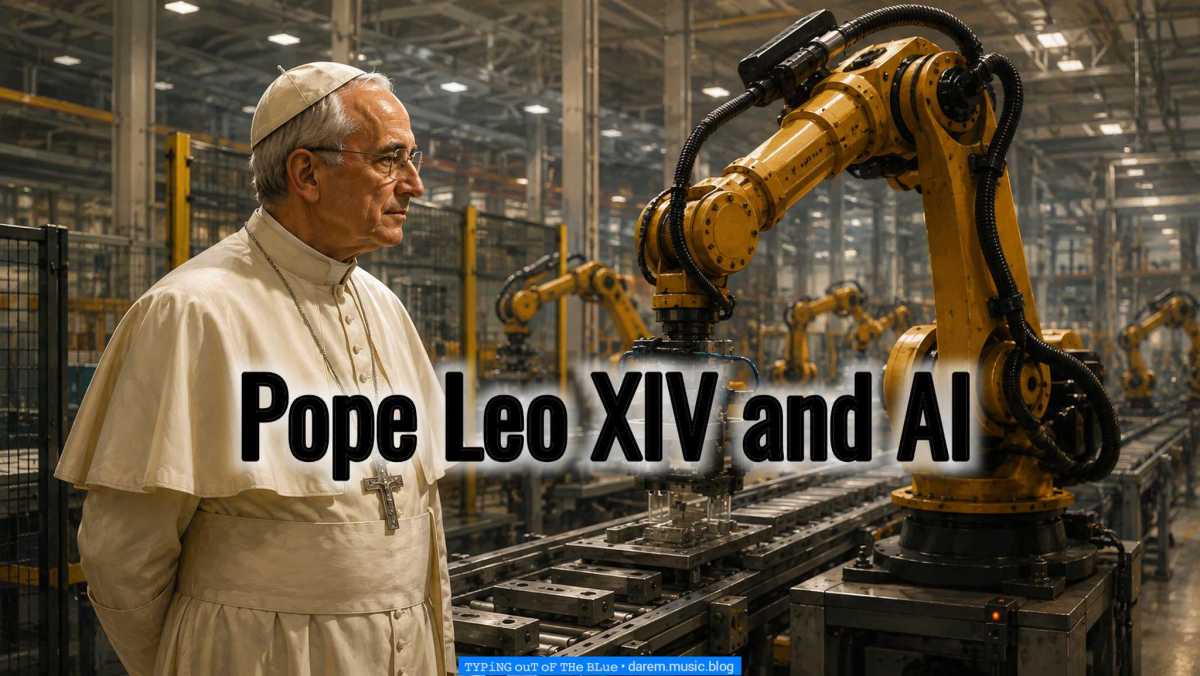
Pope Leo XIV isn’t anti-technology. He’s against technology becoming the boss. His main warning is that AI could reduce people to data points, make workers more vulnerable to displacement, and place increasing influence over information in the hands of powerful institutions.
Some of his strongest points:
• AI must be “disarmed” from military, political, and corporate domination. He warned especially about autonomous weapons and systems making life-and-death decisions without meaningful human control.
• Humans must remain responsible for moral decisions. He argues that AI can calculate, predict, and imitate, but it cannot carry moral responsibility, conscience, faith, or genuine human love.
• He compared today’s AI race to the Tower of Babel. Not because technology itself is evil, but because human pride can turn powerful tools into monuments of control and confusion.
• He warned that AI could weaken human relationships. Earlier messages from the Vatican expressed concern about AI-generated voices, faces, texts, music, and media when they replace authentic human expression or blur the line between reality and fabrication.
• He wants regulation, not a free-for-all. He repeatedly calls for ethical oversight and laws that protect workers, dignity, truth, and the common good instead of pure profit.
He isn’t just speaking from a distance. The Vatican has been hosting AI conferences and engaging with technology leaders as it seeks to shape the ethical conversation around artificial intelligence.
His thinking points to a future where people risk becoming passive consumers of machine-made content rather than creators who share their own gifts with the world. In a sense, he fears a world where the machine writes the song while the human forgets how to sing.
If we compress Pope Leo XIV’s AI position into one sentence:
Build the machine. Don’t let the machine slowly rebuild the human person.
⌨ ᴛʸᵖⁱⁿᵍ ᴏᵘᵗ ᵒᶠ ᵗʰᵉ ʙˡᵘᵉ ᵈᵃʳᵉᵐ ᵐᵘˢⁱᶜ ᵇˡᵒᵍ