Ordo Virtutum

Not all voices can join the music. And in that silence, the story finds its sharpest truth.

The Play of the Virtues by Saint Hildegard of Bingen (A short retelling)

There’s this Soul. She’s hanging with the Virtues—Humility, Charity, Patience—the good crowd. They’re all singing together, and it’s not just music, it’s like the whole vibe of heaven. Everything clicks.

Then the Devil shows up. And here’s the funny part: he can’t sing. Not a single note. He just yells, spits promises, tries to sound cool. “Come with me, I’ve got freedom, I’ve got pleasure.” But it’s all noise. No rhythm, no tune.

The Soul falls for it. Steps out of the harmony, follows the noise. For a while, she thinks she’s winning. But the deeper she goes, the more empty it gets. Just chains. No beat.

Finally, she snaps out of it. “I wanna go back.”

The Virtues don’t shame her. They don’t say, “Told you.” They just welcome her back, and their music rises again. Stronger this time, bright enough to drown out the Devil’s noise. He rages, but he’s powerless—because noise can’t beat music.

And that’s how it ends: the Soul restored, the harmony alive, and the Devil stuck in silence.

Evil makes noise. Love makes music. You decide which crowd you wanna jam with.

We remember Saint Hildegard not only through her memorial on September 17, but also through her play that still sings of mercy and truth.

ᴛʸᵖⁱⁿᵍ ᴏᵘᵗ ᵒᶠ ᵗʰᵉ ʙˡᵘᵉ ᵈᵃʳᵉᵐ ᵐᵘˢⁱᶜ ᵇˡᵒᵍ

Written around 1151, Ordo Virtutum remains the earliest known morality drama with music.

WATCH: A full staged performance of Ordo Virtutum by Saint Hildegard of Bingen. Performed live at St. John’s Cathedral, Los Angeles, directed by Patricia McKee, Katina Mitchell, and Ned Tipton.
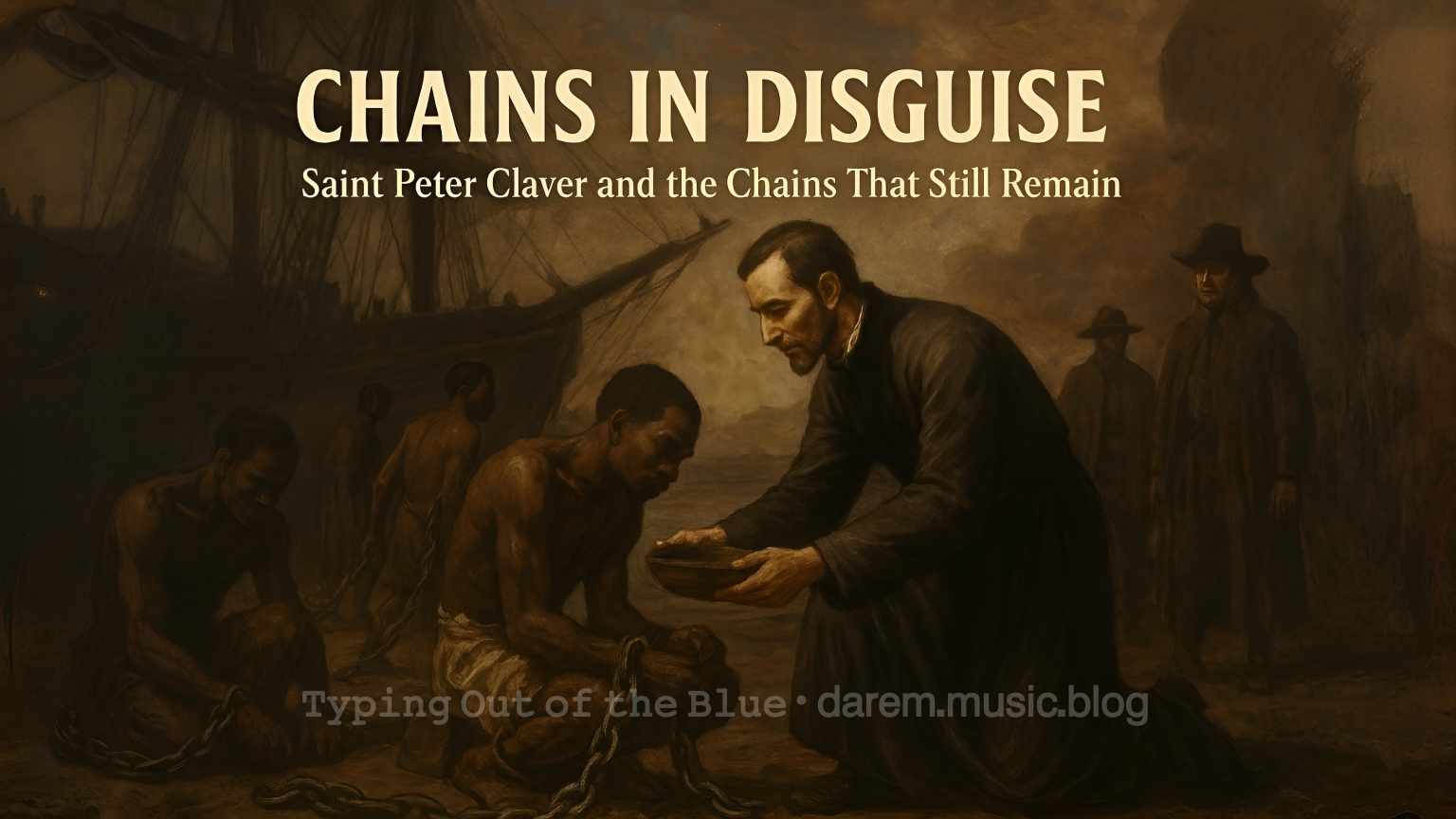

Chains in Disguise

What connects the slave ships of Cartagena to the hidden chains people carry today? On September 9, one man’s story still speaks louder than silence.

Saint Peter Claver and the Chains That Still Remain

Slavery didn’t disappear—it only changed form. Today, fifty million people live with hidden chains. They clean houses they don’t own, make clothes they can’t buy, and dig minerals for gadgets they will never use. Meanwhile, the rich spend on pleasures while keeping labor as cheap—almost free—as possible.

Centuries ago, the picture was clear and cruel. In the port city of Cartagena, Colombia, slave ships arrived full of men, women, and children. Dragging iron chains and starving, they were pulled out after weeks in the dark. Families were torn apart. Children were branded and sold like objects. Their cries mixed with the voices of buyers counting profit.

Into this walked Father Peter Claver, a Spanish Jesuit priest. He brought food, water, and medicine. He cared for the sick when no one else would. He called the enslaved not property but human beings. He named himself their “slave forever.” He didn’t end the system, but he showed that their lives had value.

In his final years, Father Peter was left weak and sick. Paralysis kept him in bed, and the servant assigned to him treated him harshly and neglected him. The man who had spent his life lifting up the forgotten died almost forgotten himself on September 8, 1654. Yet when he passed, the same city that once ignored him filled the streets to honor him.

On September 9, the Memorial of Saint Peter Claver, we remember him. And in remembering him, we face the truth: slavery never fully ended. The chains look different now, but they still exist.

𝚃𝚢𝚙𝚒𝚗𝚐 𝙾𝚞𝚝 𝚘𝚏 𝚝𝚑𝚎 𝙱𝚕𝚞𝚎 • 𝚍𝚊𝚛𝚎𝚖𝚙𝚕𝚊𝚌𝚎𝚛.𝚌𝚘𝚖

Saints • Darem Placer

Listen on Apple Music, Apple Music Classical, and YouTube Music