
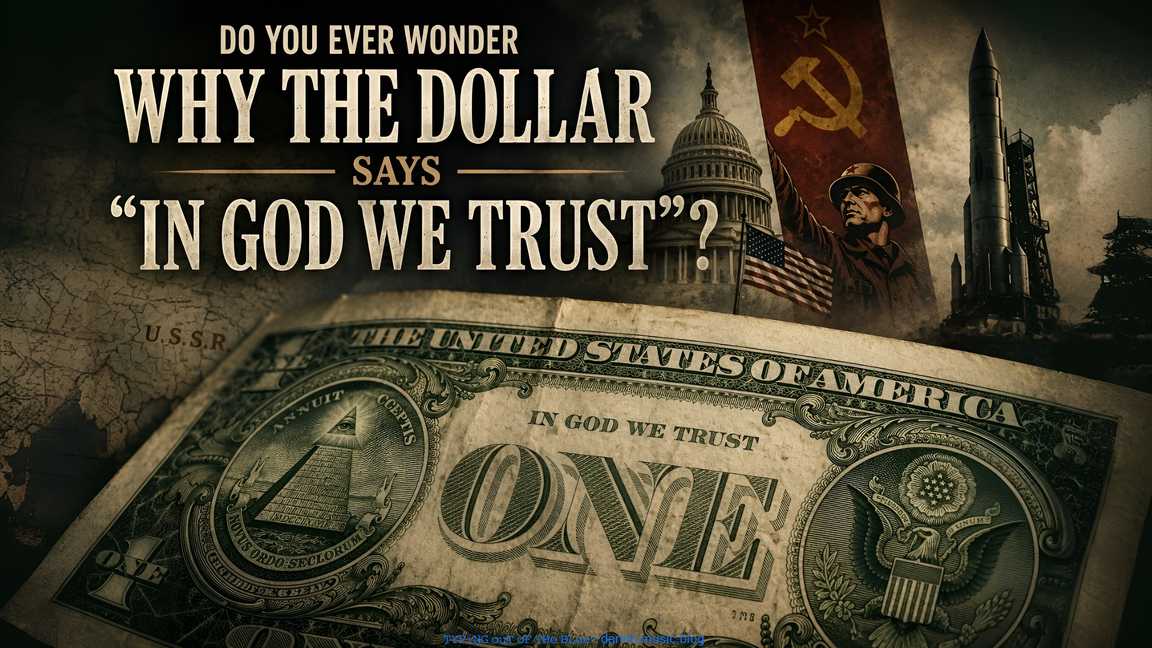
There’s a line printed on American money that millions of people see every day without really thinking about it:
“In God We Trust.”
Tiny words. Quiet words. But they carry a whole piece of history inside them.
Some people even joke about it:
“So… do atheists still use dollars?”
Funny question. But behind the joke is a real historical story.
The phrase first appeared on some American coins during the Civil War era in the 1860s. But it became much more important during the Cold War, when the United States and the Soviet Union were locked in a huge political and ideological conflict.
The Soviet government promoted state atheism. America wanted to publicly show that it stood for belief in God, religious freedom, and a different vision of society.
That’s why faith-related phrases started appearing more strongly in public life during that time.
• “Under God” was added to the Pledge of Allegiance in 1954.
• “In God We Trust” became the official national motto in 1956.
• The phrase later appeared widely on paper money.
So the line on the dollar was never just decoration. It was also a message. A cultural statement during one of the most tense periods in modern history.
Still, life today creates strange little ironies.
An atheist can use a dollar that says “In God We Trust,” while a believer can carry the same dollar yet trust only money. And somewhere in between, humanity keeps moving through grocery lines, traffic, coffee shops, and late-night convenience stores.
Maybe that’s why the phrase still catches people’s attention.
Not because everyone agrees with it.
But because it quietly asks a bigger question:
What do people really trust?
Money? Power? Fame? Systems? Themselves? God?
A few words on paper currency survived wars, politics, technology, and generations of debate. That alone makes them fascinating.
Sometimes history hides in plain sight. Right there in someone’s wallet.
⌨ ᴛʸᵖⁱⁿᵍ ᴏᵘᵗ ᵒᶠ ᵗʰᵉ ʙˡᵘᵉ ᵈᵃʳᵉᵐ ᵐᵘˢⁱᶜ ᵇˡᵒᵍ


