The Doomsday Clock

It’s not about time passing.

For those who’d rather listen.

Someone once asked, “Doomsday Clock? There’s such a thing?”

There is.

It’s not a real clock you hang on a wall. It’s a symbol created by scientists to show how close humanity is to a global disaster. Midnight doesn’t mean a date or a deadline. It stands for catastrophe caused by human actions—nuclear war, climate collapse, pandemics, or technology we fail to control.

The idea began in 1947. The people behind it were scientists who worked on the atomic bomb. After seeing what humans were capable of, they felt responsible for warning the world. They didn’t want charts or long reports. They wanted something simple, something anyone could understand.

So they made a clock.

When that clock is close to midnight, it means the risks we created are piling up.

Those risks don’t come from just one place.

Nuclear weapons are still around, and some countries are building more instead of limiting them. When nuclear powers are involved in conflicts, even a small mistake can turn into something that cannot be taken back.

Climate change is no longer something for the future. Heat, floods, droughts, and storms are already disrupting lives. Some changes trigger more changes, making the damage harder to undo once it starts.

Health systems remain fragile. Another major outbreak could spread faster than countries can respond, especially when trust and cooperation are weak.

Technology, including artificial intelligence, is moving faster than our ability to set limits. Powerful tools are now used in warfare, surveillance, and decision-making, often without clear rules.

New kinds of arms races are forming—not just with nuclear weapons, but with cyber attacks, autonomous weapons, and space systems. Everyone is rushing. Very few are slowing down.

False information spreads faster than facts. Fear and anger travel faster than truth. When people no longer agree on what is real, good decisions fall apart.

Trust is breaking down. Many people no longer trust leaders, institutions, media, or even science. Without trust, even good solutions fail.

Some leaders respond to crises by tightening control instead of working together. History shows this usually leads to more conflict, not stability.

After a while, constant crises start to feel normal. War, disasters, and suffering become background noise. When that happens, people react too late.

Countries also get tired of working together. “Me first” thinking replaces cooperation, even when the problems are clearly shared.

All of this is what the clock is reacting to. Not one event. A pattern.

Humans created these risks. Humans understand them. But humans often delay, argue, or look away.

As of 2026, the Doomsday Clock stands at 85 seconds to midnight. That’s the closest it has ever been. During the Cold War, the worst point was two minutes. After that era, the clock once moved back as far as seventeen minutes. Today, it is this close because many risks are happening at the same time.

That doesn’t mean disaster will happen tomorrow. It means the room for error is getting smaller.

The clock has moved backward before.

It moves back when weapons are reduced instead of expanded. When leaders choose cooperation over ego. When truth matters more than outrage. When science is trusted. When climate action is taken seriously. When technology is guided instead of blindly followed.

The clock is not controlled by fate. It is shaped by human choices.

You don’t need to be a scientist or a politician to matter. Paying attention matters. Questioning what spreads fear matters. Supporting choices that protect people and the planet matters. Talking about these things matters, even when they feel heavy.

The Doomsday Clock exists to remind us of one simple thing.

There is still time.

And what happens next depends on what we choose to do.

⌨ ᴛʸᵖⁱⁿᵍ ᴏᵘᵗ ᵒᶠ ᵗʰᵉ ʙˡᵘᵉ ᵈᵃʳᵉᵐ ᵐᵘˢⁱᶜ ᵇˡᵒᵍ

Digital Albums by Darem Placer on Bandcamp
Listen. Support. Buy. Download.

From Hiroshima to AI Wars — A Lesson Still Ignored

From nukes to AI: stop weaponizing, start redirecting. This world wasn’t created for war.

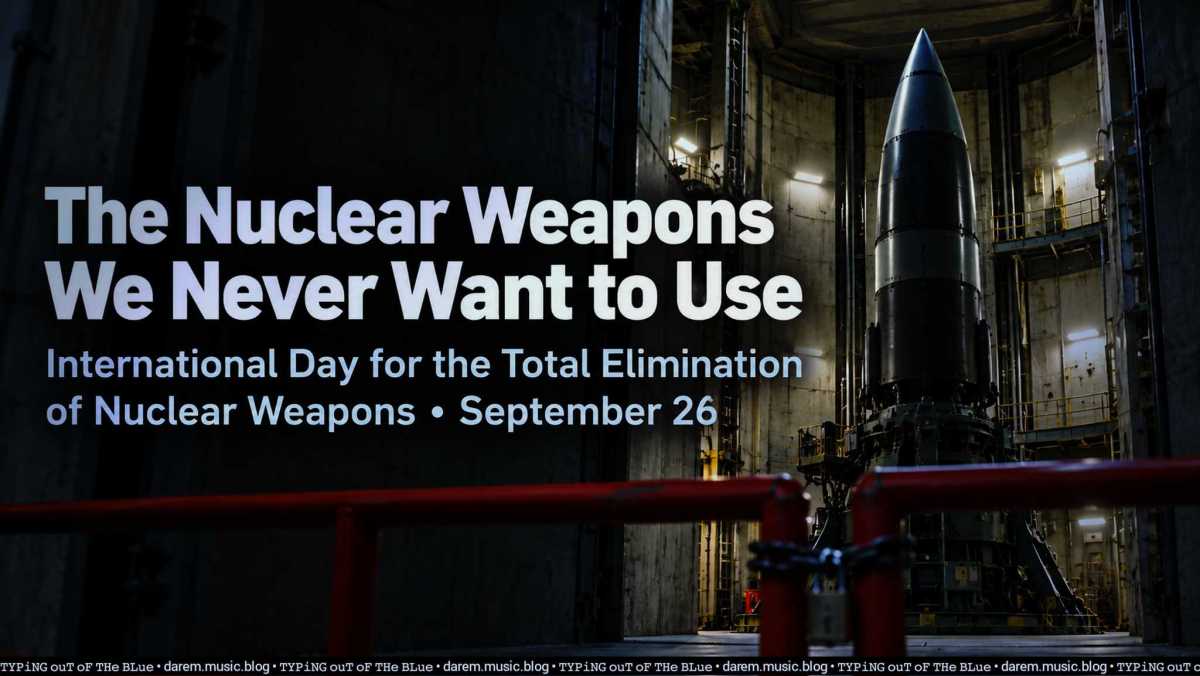
International Day for the Total Elimination of Nuclear Weapons • September 26

On August 6, 1945, at exactly 8:15 a.m., Hiroshima was wiped out in seconds. The world said, “Never again,” promising to keep human judgment ahead of technology. Yet warnings meant to save us often end up speeding up the very things they’re trying to stop.

In 1939, Albert Einstein and physicist Leó Szilárd warned the United States that Nazi Germany might develop atomic weapons. It was meant as defense—a heads-up to prevent disaster. That letter helped set in motion the Manhattan Project, and six years later the first atomic bomb didn’t fall on Germany—it fell on Japan. The warning meant to stop the monster ended up breathing life into it.

Today, 26 September, on the International Day for the Total Elimination of Nuclear Weapons, we’re reminded that the same pattern keeps repeating. German startup Helsing doesn’t build nuclear bombs—it builds AI fighter pilots, kamikaze drones, and underwater gliders, all in the name of “protecting democracy.” Spotify founder and Helsing chairman Daniel Ek backs it as a move to strengthen Europe’s defenses. But history whispers the same warning: every defensive breakthrough can become the next threat. One AI misread in a nuclear standoff could trigger a chain reaction—faster than any human can stop.

Hiroshima taught us that one mistake can erase a city. Einstein’s warning and Ek’s leadership are generations apart, but the lesson is the same: keep building ultimate weapons in the name of protection, and one day defense itself will become the disaster.

It’s past time to stop everything about nuclear weapons—and pivot our efforts toward nuclear science for peace: clean energy, medical use, climate solutions. Better yet: let’s imagine a world where all war weapons are obsolete. This world wasn’t created for war. Let’s prove it. And maybe it’s time we also rethink funding war through the platforms we use every day. When Spotify’s billionaire founder profits from your streams while steering an AI weapons company, maybe the most peaceful act is simple: uninstall Spotify.

ᴛʸᵖⁱⁿᵍ ᴏᵘᵗ ᵒᶠ ᵗʰᵉ ʙˡᵘᵉ ᵈᵃʳᵉᵐ ᵐᵘˢⁱᶜ ᵇˡᵒᵍ

A Plane Just Passed By • Darem Placer

Listen to Look Up in the Sky on Apple Music , Apple Music Classical , and YouTube Music

Look Up in the Sky includes A Plane Just Passed By