
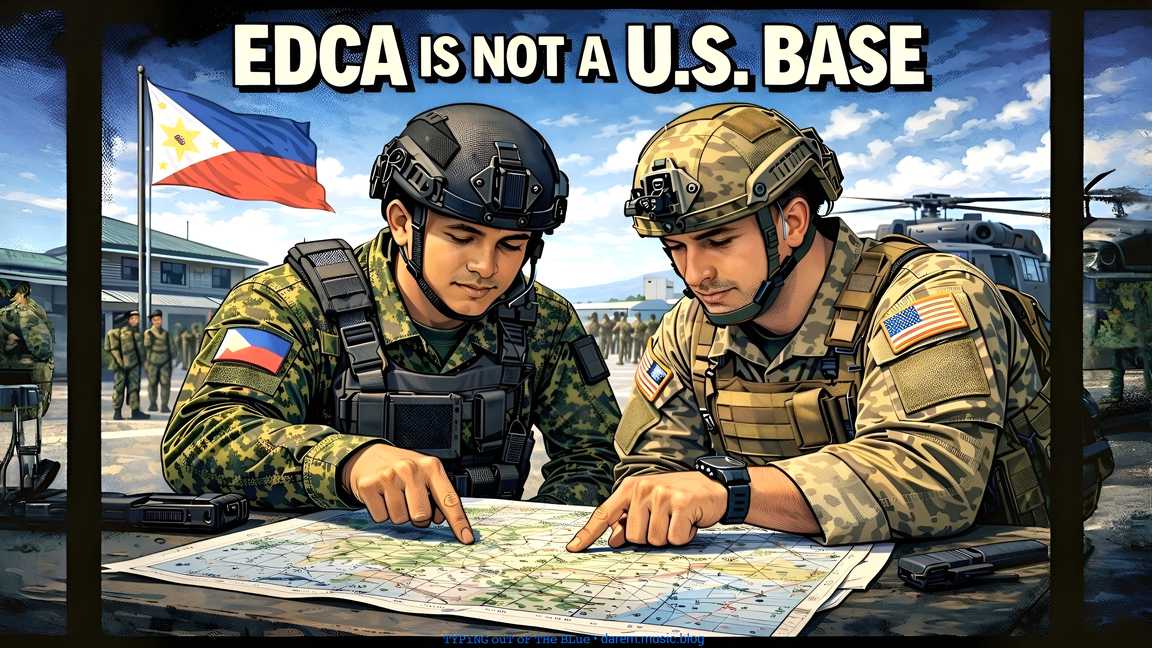
A short video online recently claimed that the United States now has several military bases in the Philippines.
That statement spreads quickly. But it is not accurate.
What people are referring to are EDCA sites.
EDCA stands for the Enhanced Defense Cooperation Agreement, a defense agreement between the Philippines and the United States signed in 2014.¹
Under EDCA, American forces are allowed to access certain Philippine military facilities and designated locations for training, joint exercises, disaster response preparation, and the temporary storage of equipment.¹
But first, it helps to understand what a U.S. military base actually is.
A true U.S. base is a facility operated and controlled by the United States military. The land is usually leased or granted under treaty, the base command belongs to the U.S., and American forces manage the operations inside the base.
That was the situation in the Philippines during the Cold War, when places like Subic Bay Naval Base and Clark Air Base were fully operated by the United States until the early 1990s.²
EDCA does not recreate that arrangement.
Under the EDCA setup today:
• The facilities remain owned by the Philippines
• The locations remain under Philippine sovereignty
• U.S. troops are present on a rotational and temporary basis
• The U.S. may store equipment and build facilities within agreed EDCA areas¹
Because of this, calling them “U.S. bases in the Philippines” can be misleading.
EDCA allows access. A military base means control.
EDCA sites are Philippine locations where U.S. forces may operate during joint activities.
They are not independent U.S. bases.
Current EDCA locations include:³
• Basa Air Base (Pampanga)
• Fort Magsaysay (Nueva Ecija)
• Antonio Bautista Air Base (Palawan)
• Mactan-Benito Ebuen Air Base (Cebu)
• Lumbia Air Base (Cagayan de Oro)
Added in 2023:
• Naval Base Camilo Osias (Cagayan)
• Lal-lo Airport (Cagayan)
• Camp Melchor Dela Cruz (Isabela)
• Balabac Island (Palawan)
EDCA expands military cooperation between the Philippines and the United States.
But it does not turn those locations into American bases.
Understanding that difference helps keep the conversation grounded in facts rather than headlines.
Sources
¹ Enhanced Defense Cooperation Agreement (2014), Department of National Defense
² Philippine–U.S. Military Bases Agreement history: Subic Bay Naval Base and Clark Air Base
³ Department of National Defense announcements on EDCA locations, including additional sites approved in 2023
⌨ ᴛʸᵖⁱⁿᵍ ᴏᵘᵗ ᵒᶠ ᵗʰᵉ ʙˡᵘᵉ ᵈᵃʳᵉᵐ ᵐᵘˢⁱᶜ ᵇˡᵒᵍ
