
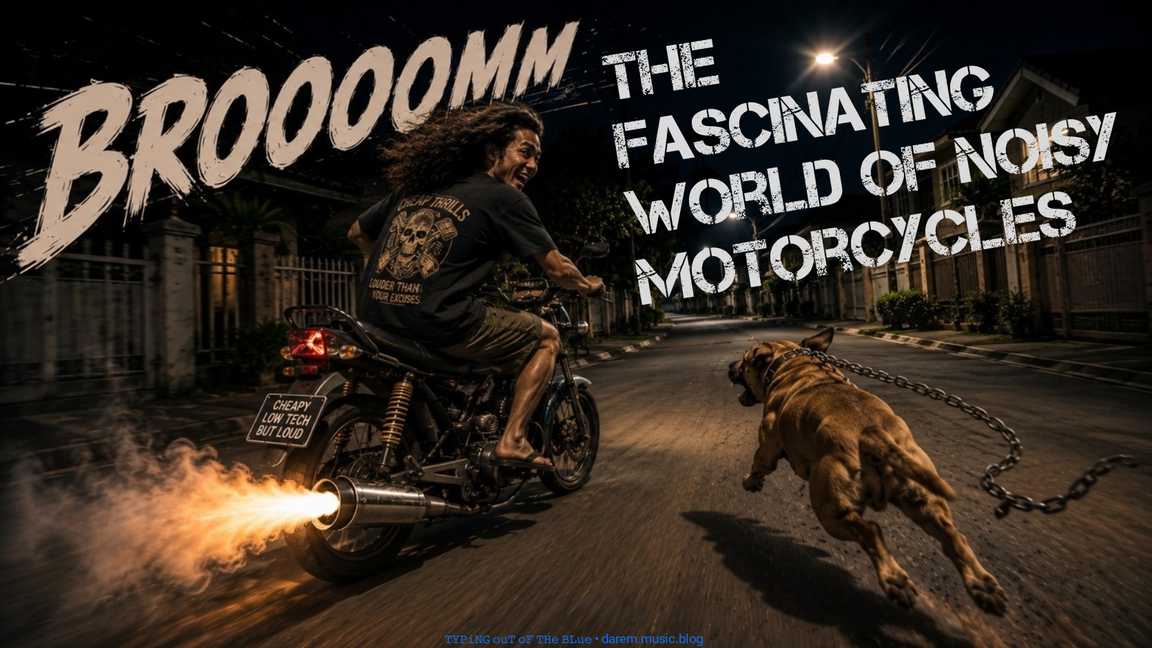
This is a long read. Not the best thing to read during a long ride. 🛵😁
Why do some riders love loud motorcycles while others want them launched into deep space at 2 AM? 😁
Motorcycle noise sits somewhere between safety tool, engineering culture, freedom, identity, live concert, and public headache.
To some people, a loud motorcycle sounds aggressive and exciting. To others, it sounds like a blender trying to win a war against thunder.
For many riders, the sound is part of the experience. A motorcycle is not just transportation. It has rhythm, pulse, and tone. Some engines even have their own “voice.” Riders often talk about exhaust notes the same way musicians talk about guitar tones or drum sounds.
A quiet scooter whispers.
A sport bike screams.
A cruiser growls like old blues music played through rusty speakers at midnight.
And somewhere out there is a modified motorcycle that sounds like a snare drum being attacked by fireworks. 😭
Good Reasons Riders Like Loud Motorcycles
• Visibility on the road
Some riders believe louder exhausts help nearby cars and trucks notice them, especially in blind spots. The famous phrase is: “Loud pipes save lives.” Though many experienced riders argue that defensive riding and visibility matter far more than exhaust volume.
• Engine feedback
The sound helps riders feel RPM changes and shifting timing naturally, almost like hearing the beat of the machine.
• Motorcycle culture
For many enthusiasts, engine sound is part of the experience. Some riders love deep bass-like rumbles. Others prefer high-pitched sport bike screams that sound like electric guitars arguing with physics.
• Group riding awareness
During convoy rides, riders can hear where fellow riders are positioned without constantly looking around.
• Performance modifications
Some aftermarket exhausts are designed for better airflow and reduced weight, with louder sound becoming part of the package.
• Pure enjoyment
Some riders simply enjoy the soundtrack of the road. Long rides with engine vibration and wind noise can feel strangely musical.
The Bad Side
• Noise pollution
A loud motorcycle in a quiet neighborhood can wake an entire street. One rev at midnight and suddenly every dog in the barangay becomes a backup vocalist. 😭
• Hearing damage
Very loud exhausts can slowly damage hearing over time, especially during long rides.
• False sense of safety
Loud pipes do not guarantee distracted drivers will hear the motorcycle. Modern cars are heavily insulated.
• Road irritation
Excessive noise creates tension between riders, drivers, and residents.
• Stereotypes
A few extremely noisy riders can give all motorcycle riders a bad reputation.
• Some setups are “all concert, no performance”
Sometimes the motorcycle sounds ready for a racetrack but moves like it is still waking up. 😅
Motorcycle Noise Limits by Country
Germany
Approximate certification range:
• Many modern motorcycles in Europe are certified around the high-70 to low-80 dB range under European regulations
Known for:
• Very strict inspections
• Strong anti-noise enforcement
• Scenic roads with tighter sound restrictions
Noise comparison:
• Similar to heavy city traffic or a loud vacuum cleaner
Germany treats vehicle noise almost like tuning an orchestra. If one instrument becomes too wild, somebody eventually appears with paperwork.
Austria
Some regions:
• Restrict motorcycles above 95 dB on certain roads
Known for:
• Alpine road restrictions
• Noise-sensitive tourist areas
Noise comparison:
95 dB is similar to:
• A chainsaw from several meters away
• A loud truck horn nearby
Apparently some mountain villages got tired of hearing endless drum solos echoing through the Alps every weekend. 😁
Switzerland
Typical approach:
• Strict vehicle noise regulations
• Strong anti-noise culture
Approximate accepted range:
• Similar to broader European motorcycle noise standards, usually around the high-70 to low-80 dB range for many modern motorcycles
Noise comparison:
Similar to:
• Busy traffic
• A loud barking dog nearby
Switzerland tends to treat excessive vehicle noise as quality-of-life pollution rather than “part of the fun.”
United States
Varies by state:
• Common limits around 80–92 dB depending on local laws
Known for:
• Mixed enforcement
• Some states very relaxed
• Others heavily regulate aftermarket exhausts
Noise comparison:
90 dB is similar to:
• A lawn mower
• A jeepney accelerating nearby
America basically has fifty different remixes of motorcycle law. 😁
Philippines
Recent LTO references:
• Around 99 dB allowable during PMVIC testing
Noise comparison:
Similar to:
• A nearby chainsaw
• A nightclub speaker outside
• A very loud modified motorcycle
Honestly, 99 dB is already extremely loud for normal public streets. Sometimes late at night it feels like somebody started a secret MotoGP qualifying lap inside the subdivision. 😭
Motorcycle Noise Levels Compared to Real Sounds
• 70–80 dB
Quiet stock motorcycle
Similar to:
• Busy traffic
• Vacuum cleaner
• 85–90 dB
Sporty motorcycle
Similar to:
• Lawn mower
• Loud shouting nearby
• 95–100 dB
Loud modified motorcycle
Similar to:
• Chainsaw
• Truck horn nearby
• 105–110 dB
Very loud open-pipe motorcycle
Similar to:
• Rock concert area
• Firecracker from moderate distance
• 120 dB+
Extreme racing exhaust
Similar to:
• Nearby firecracker explosion
• Thunder crack overhead
Remember, decibels do not increase normally. Every 10 dB increase feels dramatically louder to human ears. The jump from 90 dB to 100 dB is not “slightly louder.” It feels more like the volume knob escaped prison. 😅
After eight years of riding, loud mufflers still never fascinated me that much. Maybe they would be more convincing if actual music came out of the exhaust instead. At least the whole street could enjoy the soundtrack while traveling. 😁
Maybe that is why many experienced riders eventually begin appreciating quieter motorcycles more. Sometimes the coolest machine is the one that glides through the night with quiet confidence instead of sounding like a MotoGP concert trapped inside a subdivision.
⌨ ᴛʸᵖⁱⁿᵍ ᴏᵘᵗ ᵒᶠ ᵗʰᵉ ʙˡᵘᵉ ᵈᵃʳᵉᵐ ᵐᵘˢⁱᶜ ᵇˡᵒᵍ