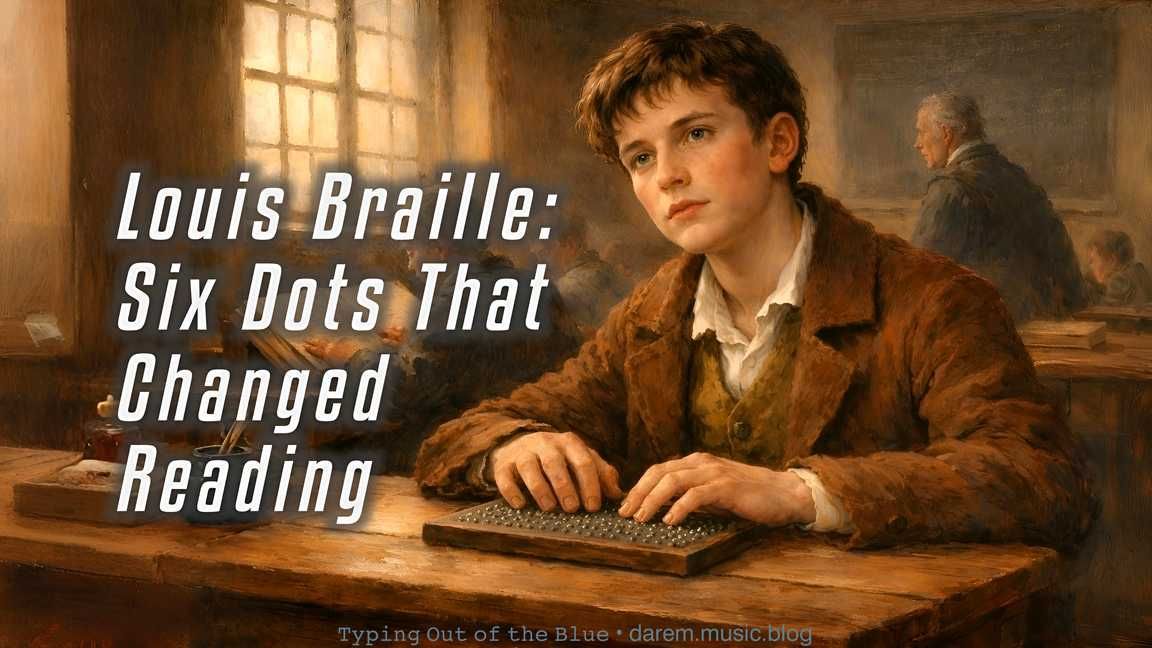
Louis Braille: Six Dots That Changed Reading

Six dots. One fingertip. How a childhood accident led him to change how the world reads.

He was three years old in Coupvray, France, when it happened. Louis Braille was inside his father’s leather workshop when an accident damaged his eye. Infection followed, and within a few years, he lost his sight completely.

In the early 1800s, blindness changed a life in very real ways. Learning depended on listening. Reading meant waiting for someone else. Books existed, but they were not designed for fingers, and writing was almost unreachable.

In 1819, Louis moved to Paris to study at the Royal Institute for Blind Youth. The school used books with raised letters shaped like ordinary print. They were heavy, slow to read, and tiring to use. Words could be felt, but reading never flowed naturally.

During his time there, Louis learned about a raised-dot system used by the French army. Soldiers read messages in the dark by touch alone. The system was complicated and impractical, but it revealed something important. Fingers understood dots better than shapes.

So he began experimenting. Patiently. Practically. Not as a grand invention, but as a response to daily difficulty. He tested combinations, removed what was unnecessary, and kept what worked. Again and again.

By focusing on a single fingertip, he reduced everything to six dots. Enough to feel at once. Enough to build letters, numbers, music, and meaning. By 1824, in Paris, the system was complete. He was fifteen years old.

Acceptance came slowly, but blind readers understood it immediately. Reading became faster. Writing became possible. Learning no longer depended on translation.

What began in a small workshop in Coupvray became a language of touch used around the world. Today, those same six dots are still read in books, schools, churches, public spaces, and digital devices. Technology has changed, but the system has not.

An accident took his sight. Experience shaped his solution. Patience turned loss into access. And for that, generations continue to read on their own terms, with gratitude.

Actual embossed Braille dots used for reading by touch. Photo by Eren Li (Pexels).

⌨ ᴛʸᵖⁱⁿᵍ ᴏᵘᵗ ᵒᶠ ᵗʰᵉ ʙˡᵘᵉ ᵈᵃʳᵉᵐ ᵐᵘˢⁱᶜ ᵇˡᵒᵍ

Digital Albums by Darem Placer on Bandcamp
Listen. Buy. Download.

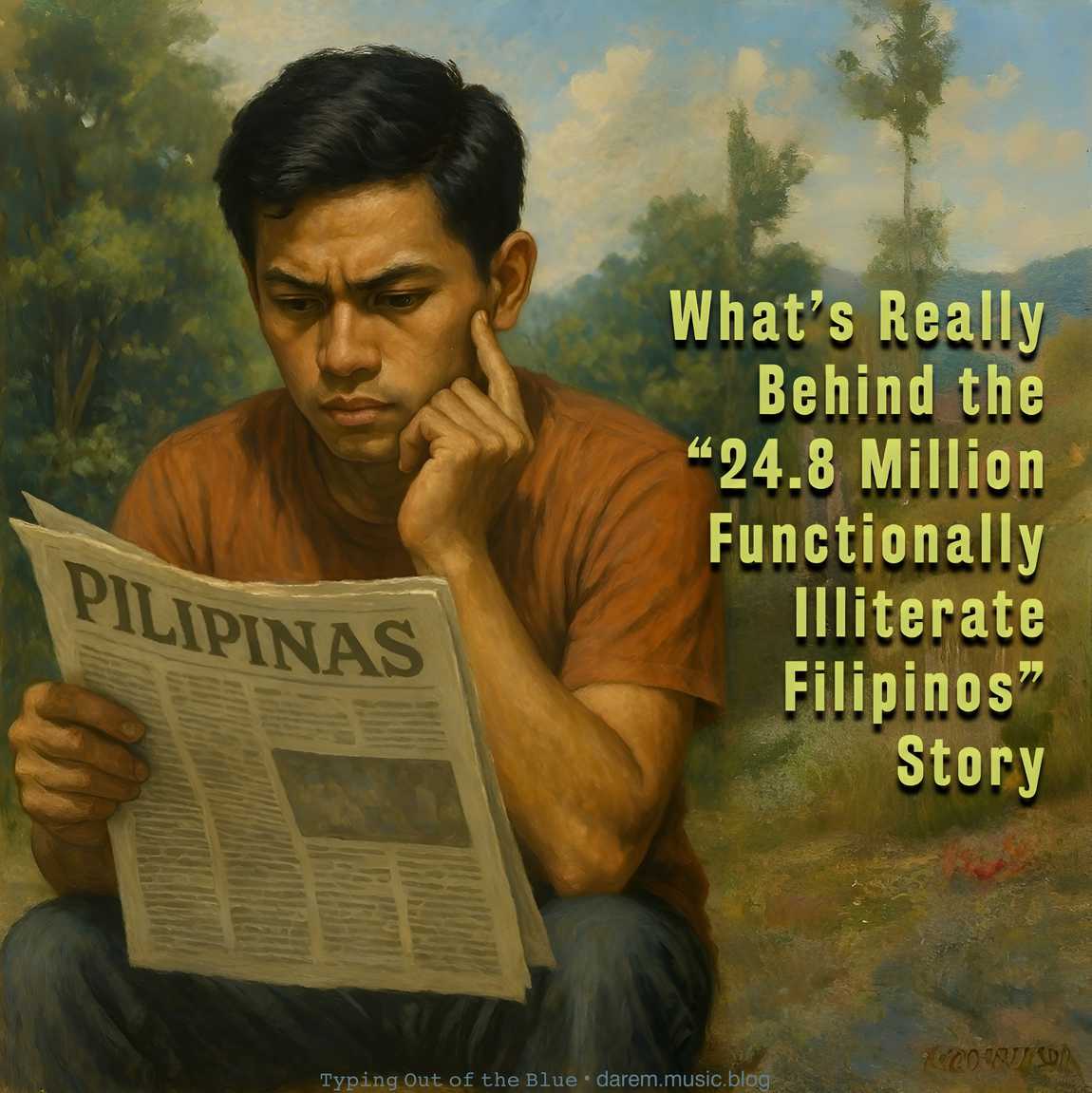
What’s Really Behind the “24.8 Million Functionally Illiterate Filipinos” Story

The PSA’s new literacy standard revealed a deeper truth: reading isn’t enough if the meaning gets lost along the way.

The number shocked many in November 2025: 24.8 million Filipinos are functionally illiterate.

But before believing the worst, it helps to look at what that figure truly means—and what quietly changed behind it.

While many reports highlighted “24.8 million Filipinos” to sound alarming, the PSA actually presented it as a percentage—70.8% functional literacy. The number only looks huge because it covers the entire population aged 10 to 64. In truth, the focus is not the count, but the rate of comprehension.

Some reports turned that percentage into population figures to grab attention. Based on PSA data, the literacy rate of 70.8% covers about 81 million Filipinos aged 10 to 64. That means roughly 23 to 25 million still struggle with comprehension—not because they can’t read, but because understanding remains a challenge.

The New Definition

In 2024, the Philippine Statistics Authority (PSA) released the latest Functional Literacy, Education and Mass Media Survey (FLEMMS).
This survey redefined what it means to be “functionally literate.”

Old rule: If you finished at least four years of high school, you were automatically counted as functionally literate, even if your comprehension wasn’t tested.

New rule: You must prove you can read, write, compute, and understand what you read. That last word—understand—changed everything.

Because of this stricter measure, the percentage dropped from roughly 91 % in 2019 to about 71 % in 2024. It’s not a national collapse—it’s a tougher, more accurate test.

What the Number Really Means

The 24.8 million refers to Filipinos aged 10 to 64 who can read and write basic text but struggle with comprehension or applying what they learn in daily life.

They’re not “illiterate” in the usual sense—they’re functionally limited.

This gap matters: It affects how people follow instructions, manage finances, or even vote with full understanding of what they read.

The Reporting Problem

The issue resurfaced in November 2025, when new headlines claimed “millions of high-school graduates can’t read.”

That’s misleading. The PSA clarified that the 24.8 million figure includes everyone in the 10-64 age group, not just graduates.

The dramatic tone came from comparing the new 2024 definition with old-method data. Once you know the difference, the “crisis” looks exaggerated.

Why It Still Matters

Even if the headlines overreacted, the concern remains real. Too many Filipinos can read words but not meaning—a quiet problem that affects jobs, learning, and daily life.

Lawmakers and educators are now using the 2024 survey to push for stronger reading-comprehension programs and better teacher support.

The Real Message

This isn’t a story of failure—it’s progress in honesty.

The Philippines isn’t losing readers—it’s finally measuring literacy for what it truly is: the ability to understand.

The headlines should have read: “Around 24.8 million Filipinos aged 10 to 64 can read and write but struggle to fully understand or apply what they read, based on the PSA’s 2024 literacy survey.”

Reading without understanding builds noise. Understanding builds a nation.

⌨ ᴛʸᵖⁱⁿᵍ ᴏᵘᵗ ᵒᶠ ᵗʰᵉ ʙˡᵘᵉ ᵈᵃʳᵉᵐ ᵐᵘˢⁱᶜ ᵇˡᵒᵍ