
The Folds That Shaped the World

From sacred rituals to modern design, origami proves that patience and creativity can turn the simplest paper into art.

World Origami Day • November 11

Origami began more than a thousand years ago in Japan, back when paper itself was rare and sacred. People used folded paper in Shinto rituals—to wrap offerings and symbolize purity.

Shinto—Japan’s ancient belief system—centers on kami, or spirits that live in nature, people, and everyday things. It values purity, gratitude, and harmony with the natural world. That’s why even paper, when folded with care, was seen as something spiritual.

As paper became more common, origami evolved into decoration and art, spreading through families, temples, and schools. It flourished during the Edo period (1603–1868), an era of peace and cultural growth when Japan was ruled by the Tokugawa shoguns. Life slowed down, creativity thrived, and origami became a quiet pastime that taught patience and precision. Every fold carried meaning—the crane for peace, the frog for luck, the butterfly for love.

Then came Lillian Oppenheimer, the woman who introduced origami to the Western world in the 1950s. She founded the Origami Center of America and worked with Japanese origami masters like Akira Yoshizawa, who created the modern style of folding and invented the symbols used in origami books today. Because of them, folding became not just a cultural practice but a bridge between worlds.

Today, origami’s influence goes far beyond art. Engineers use folding principles for space telescopes, airbags, and medical tools. Artists use it for massive installations. Teachers use it to train focus and patience. And people still fold cranes—not for skill, but for peace.

Origami’s message hasn’t changed through centuries: even something fragile can hold infinite possibilities when handled with care.

⌨ ᴛʸᵖⁱⁿᵍ ᴏᵘᵗ ᵒᶠ ᵗʰᵉ ʙˡᵘᵉ ᵈᵃʳᵉᵐ ᵐᵘˢⁱᶜ ᵇˡᵒᵍ
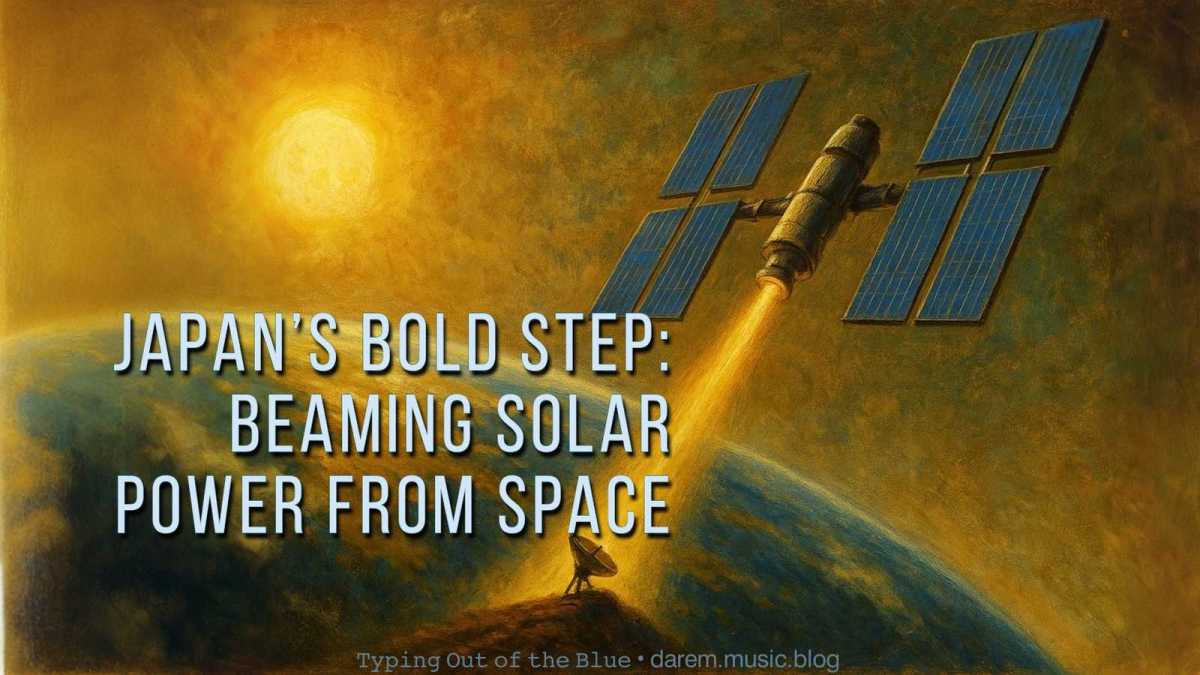
🇯🇵 Japan’s Bold Step: Beaming Solar Power From Space

Japan’s OHISAMA satellite is set to launch this 2025, catching sunlight in orbit and beaming hope down to a warming Earth.

Japan is doing something that once sounded like pure science fiction—beaming solar energy from space directly to Earth.

The project, called OHISAMA, is launching this year. A small satellite will orbit about 400 km above us, collect sunlight through its panels, convert it into microwaves, and beam it to a special antenna on the ground. Even if the output is just about 1 kilowatt at first (enough to power a few appliances), the real point is proof: that this idea works.

Power That Never Sleeps

Unlike solar farms on Earth, space solar power is not limited by clouds, weather, or night. Sunlight in orbit is constant—24 hours a day. If we can harvest and transmit that energy safely, the flow of clean power could be endless.

The Goal Behind the Dream

Japan’s mission isn’t just a flashy experiment. The aim is clear:

Prove it works — show the world that energy can really be beamed from space.

Build the roadmap — lay the groundwork for larger satellites with bigger output.

Cut the strings — reduce reliance on imported fuels and secure their own power supply.

Cool the Earth — add another weapon in the fight against climate change.

When Science Meets Survival

Climate change is no longer tomorrow’s problem. Rising heat and harsher storms are already here. OHISAMA isn’t just about technology—it’s about survival. If this works, it points to a future where clean power rains down from orbit, instead of carbon filling the skies.

Decades in the Making

Japan’s government has already written space solar power into its national energy plan, and researchers from JAXA, Japanese universities, and industry groups have been chasing this dream for decades. OHISAMA is where the chase becomes reality.

Eyes on Tomorrow

Imagine massive solar stations in space, beaming down gigawatts of power. Cities lit not by coal or oil, but by sunlight collected beyond the clouds. A future where keeping the lights on doesn’t mean warming the planet.

Not There Yet

Of course, hurdles remain—efficiency, cost, precision of the beams. OHISAMA is just a small step. But small steps are how great journeys begin.

🌍 In short: This year, Japan isn’t just testing a satellite—it may be testing a new way to cool the planet.

ᴛʸᵖⁱⁿᵍ ᴏᵘᵗ ᵒᶠ ᵗʰᵉ ʙˡᵘᵉ ᵈᵃʳᵉᵐ ᵐᵘˢⁱᶜ ᵇˡᵒᵍ

White in E-flat Major • Darem Placer
Artificial Blue Sky includes White in E-flat Major