Overview
The world can feel heavy when things do not go as planned. This reflection shows that even when we feel lost or ready to give up, Jesus is already walking with us—and He invites us to recognize Him and stay with Him.
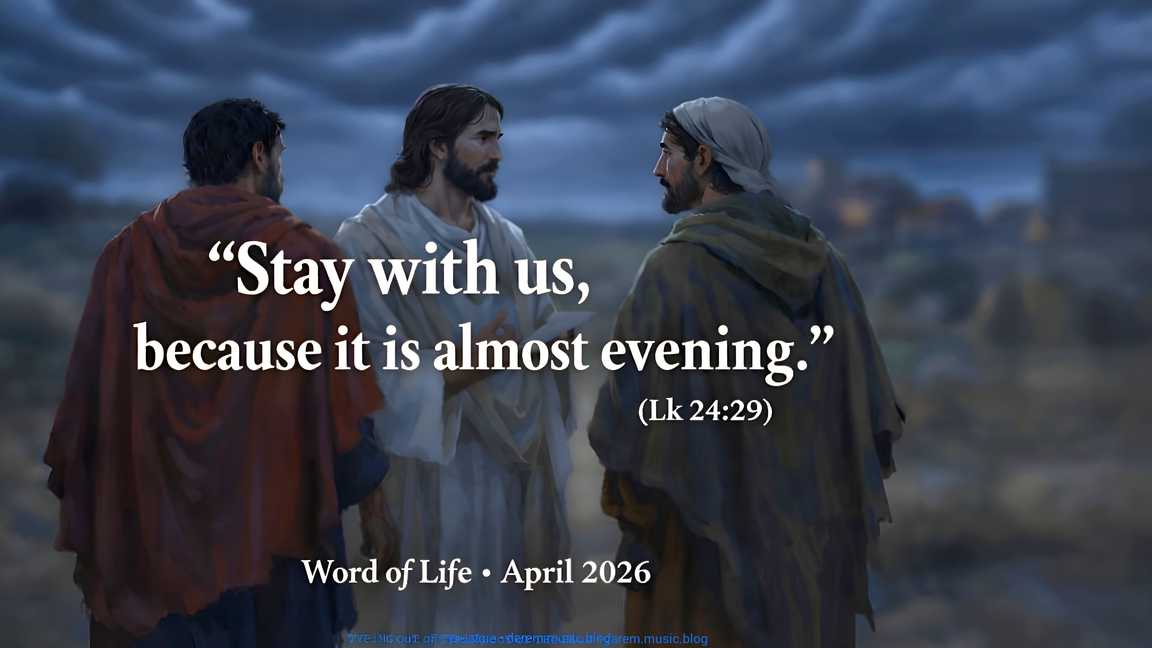
“Stay with us, because it is almost evening.” (Lk 24:29)
The road leading to the village of Emmaus marks the journey made by two disciples of Jesus. They were disillusioned because their dreams, plans, and the powerful moments spent with the Master were over. They were returning home to resume the life they had left behind, the one they had lived before meeting Him. Only three days had passed since His crucifixion, and disappointment, fear, and doubt reigned among His followers.
They were leaving Jerusalem, leaving behind their unfulfilled dream, distancing themselves from Christ and His message, “sad” because they had somehow already made the decision to abandon the mission for which they had followed Him.
This is the story of all of us when we lose our way in situations that force us, at some crossroad in life, to make a choice. We often think that the solution is to turn back, give up, to be resigned and let go—as if this were the only way to alleviate our disappointment.
“Who among us is not familiar with the story at the inn in Emmaus? Who has not walked this road on an evening when all seemed lost?”1
“Stay with us, because it is almost evening.”
During the journey, a stranger joined the two travelers, seemingly unaware of the events that have just taken place. He began asking specific questions, which drew out all their bitterness and discouragement. At first He listened to them, and then He began to explain the Scriptures. It was a dialogue among them, an encounter that left its mark, so much so that, even though they had not yet recognized Jesus, they begged Him to stay with them because it was so late in the day.2
This is perhaps one of the most beautiful prayers we find in the Gospels. It is the first prayer that came spontaneously from the heart of these disciples to the Risen Lord. And it is moving that all of us can invite Him in this way, asking Him to remain with us and among us.
The eyes of the two disciples were opened when He broke the bread, and the joy of finally recognizing Him impelled them to return to Jerusalem to announce the resurrection to their friends.
“Stay with us, because it is almost evening.”
“Perhaps nothing explains better than these words the experience of living with Jesus in our midst that we had from the very beginning of the Movement,” wrote Chiara Lubich.
“For when Jesus is present—even if it is ‘only’ a spiritual presence—He explains the Scriptures to us and our hearts burn with His love, which is Life. Once we have experienced His presence, we never want to be without it and so we too say: ‘Stay with us, Lord, because it is almost evening’—without You it is darkest night.”3
Night is a symbol of darkness, of the unknown, of the lack of the light we cannot find because we do not believe in or sense His presence that continues to accompany us, always.
Night is what envelops our planet, wounded and violated by civil war and wars that continue to be organized out of a burning desire for power and money.
Night is the experience of millions of people who no longer have a voice to cry out against injustice and oppression.
How can we become aware of this presence of Jesus, who does not always manifest Himself according to our expectations? How can we understand that He walks with us and tries to help us recognize the signs of His presence? And above all, how can we create the conditions for Him to reveal Himself and remain with us?
These are questions to which we may not always know the answer, but which urge us not to give up the search for Jesus, but rather to focus our gaze on this traveling companion whom we often do not see, to recognize Jesus who will make Himself present if we live mutual love.
The road to Emmaus is a symbol of all our roads; it is the road of encounter with the Lord; it is the road that restores joy to our hearts and brings us back to the community of believers so that we can give witness together that Christ is risen.
Prepared by Patrizia Mazzola & the Word of Life Team
1. François Mauriac, The Life of Jesus, Milan, 1950.
2. Cf. Luke 24:17–29.
3. Chiara Lubich, May They All Be One, New City Press, NY, 1968, p. 86.
⌨ ᴛʸᵖⁱⁿᵍ ᴏᵘᵗ ᵒᶠ ᵗʰᵉ ʙˡᵘᵉ ᵈᵃʳᵉᵐ ᵐᵘˢⁱᶜ ᵇˡᵒᵍ