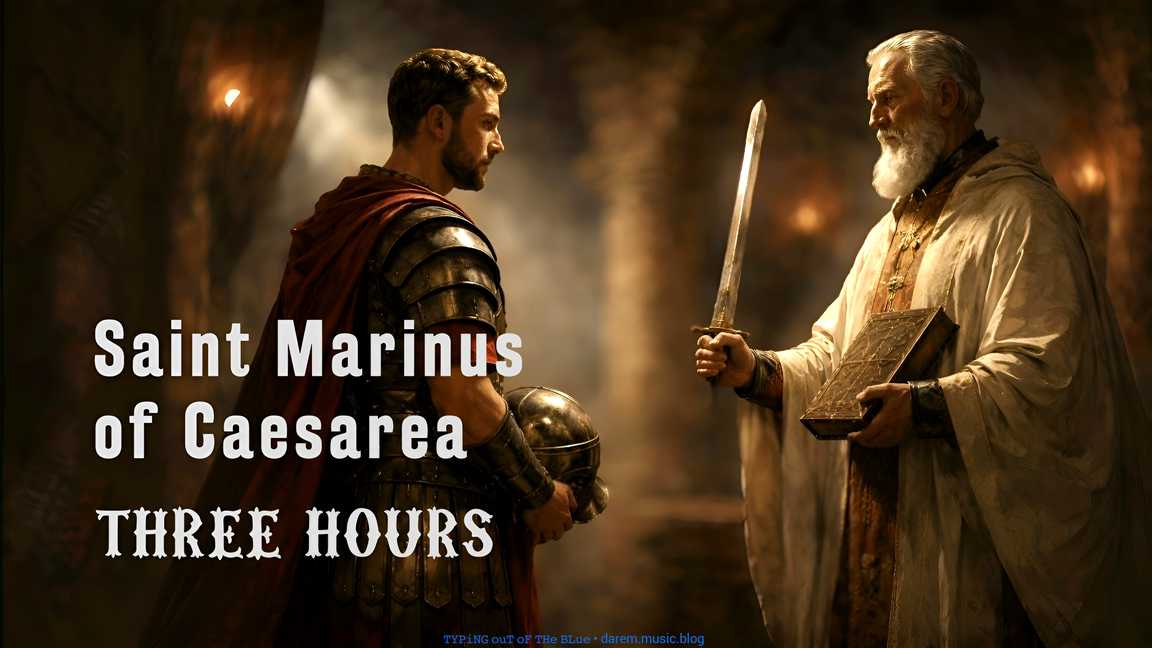
Saint Marinus of Caesarea

Sometimes the hardest part is having time to think.

Three Hours

3rd century. Caesarea. Roman rule everywhere.

Marinus was a soldier. Active duty. Trained. Disciplined. Loyal to the empire in every visible way.

He was about to be promoted to centurion. Higher rank. More pay. Public honor. It was already within reach.

Then the condition came. Before the promotion, he had to offer sacrifice to the Roman gods. A required act. Expected. It was how things were done.

Marinus said no.

Another soldier reported him. The case went to the governor. The governor gave him three hours to decide.

Marinus went to the bishop of Caesarea, traditionally identified as Theotecnus. In the church, the bishop placed a sword in one hand and the Gospel in the other. Then he told him to choose.

Marinus reached for the Gospel.

He returned to the governor. Refused the sacrifice again. He was beheaded around AD 260.

He was given time. He used it. He knew what he was about to lose.

Today, most of us are not facing execution. But we are often given time to rethink what we believe. A pause before sending a message. A night to reconsider a deal. A moment to ask whether we are about to trade something deeper for something easier.

We also get our three hours.

And what we choose in that space shapes who we become.

Let’s keep learning the saints’ way—day by day.

⌨ ᴛʸᵖⁱⁿᵍ ᴏᵘᵗ ᵒᶠ ᵗʰᵉ ʙˡᵘᵉ ᵈᵃʳᵉᵐ ᵐᵘˢⁱᶜ ᵇˡᵒᵍ

Escape the Quiet Road • Darem Placer

Saint Serenus the Gardener

Even in ordinary work, a moment can come that asks who we really are.

Serenus once lived as a soldier in the early 4th century, during the reign of Emperor Diocletian. He knew discipline. He knew command. He knew what it meant to stand under an empire.

Then he became Christian.

At some point, he left military life and chose something quieter. He became a gardener in Sirmium, a major Roman city in the province of Pannonia, located in what is now Serbia. From sword to soil. From orders to ordinary work. Gardening was not ambition. It was peace. A hidden life.

He probably thought that was enough. Work the land. Pray. Stay out of trouble.

But history does not always leave quiet people alone.

One day, a Roman woman of high status entered his garden. It may have seemed small. A social misunderstanding. A boundary crossed. Serenus approached her and told her the space was not public. Some traditions add that he mentioned modesty. Nothing theatrical. Just firm.

For a former soldier turned gardener to correct a noblewoman could easily feel insulting. She reported him.

Once brought before authorities, the issue shifted. Serenus was known to be Christian. In that era, Christians were required to offer sacrifice to the Roman gods as proof of loyalty to the empire.

He was asked to sacrifice. He refused.

He laid down the sword and chose a quieter life. But when the moment came, he did not lay down his belief.

He was executed around AD 307.

Saint Serenus shows us something clear: we can step away from power and conflict—but our faith will still be tested.

Today, being strong does not mean being loud. It means doing our work well, staying honest even when no one checks, refusing to laugh at what is wrong, and holding our values quietly but clearly. A gardener does not argue with the wind—he keeps tending what is in front of him. Strength looks like that: steady and not easily pushed around.

Let’s keep learning the saints’ way—day by day.

⌨ ᴛʸᵖⁱⁿᵍ ᴏᵘᵗ ᵒᶠ ᵗʰᵉ ʙˡᵘᵉ ᵈᵃʳᵉᵐ ᵐᵘˢⁱᶜ ᵇˡᵒᵍ