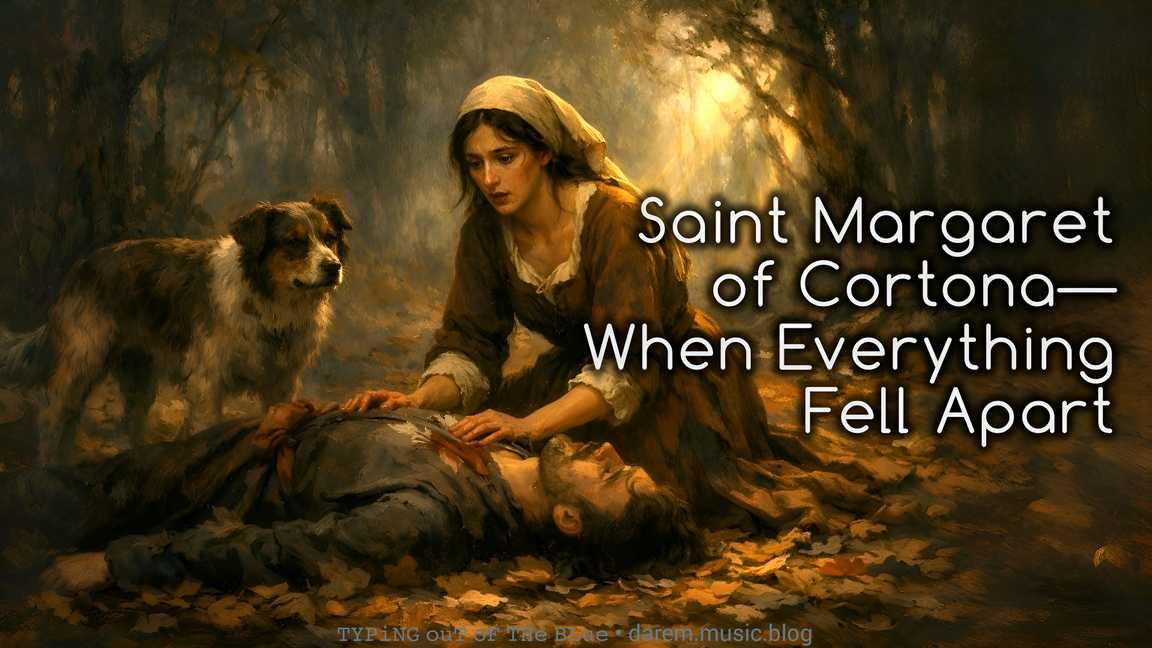
Margaret was born in 1247 in Laviano, Italy. Her mother died when she was young. Home life became hard. At sixteen, she ran away with a wealthy nobleman and lived with him for nine years. They were not married. They had a son.
Then everything collapsed.
The man she lived with was murdered. Tradition says Margaret found his body in the forest after her dog led her there. That moment broke something inside her. Not just grief. Truth. She saw how unstable her life had been. How quickly comfort can turn into dust.
She returned to her father’s house, but was rejected. So she went to Cortona with her son. Poor. Ashamed. Starting over.
That is where the real story begins.
Margaret did not pretend nothing happened. She admitted her past openly. She joined the Third Order of Saint Francis and lived in deep penance. Quiet. Consistent. Real.
She fasted. She prayed. She served the sick. She helped the poor. She founded a hospital in Cortona. People who once whispered about her began to respect her.
But her conversion was not instant perfection. She struggled with memories, with temptation, with doubt. Holiness for her was not clean and polished. It was fought for.
She died in 1297.
Today, we live in a world that brands people fast. One mistake and we are labeled. One season of our life seems to define us forever. Margaret’s life says no.
Our worst chapter does not get the final word.
She shows us that repentance is not weakness. It is strength. Owning the truth about ourselves is power. And starting again, even when others remember our past, is courage.
Saint Margaret is often called the patron of penitents and single mothers. But beyond titles, her message is simple: We can change.
Let’s keep learning the saints’ way—day by day.
⌨ ᴛʸᵖⁱⁿᵍ ᴏᵘᵗ ᵒᶠ ᵗʰᵉ ʙˡᵘᵉ ᵈᵃʳᵉᵐ ᵐᵘˢⁱᶜ ᵇˡᵒᵍ