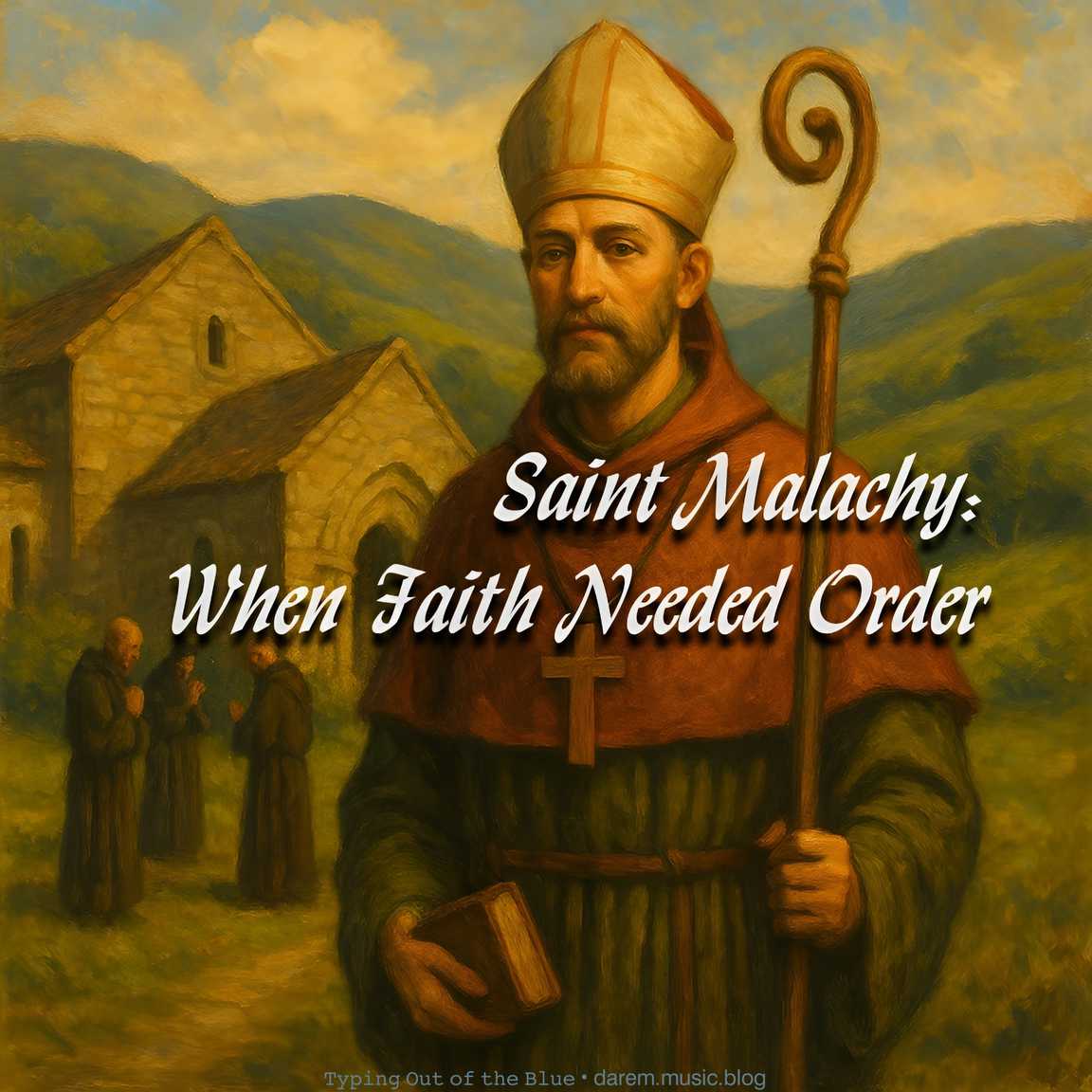
Saint Malachy: When Faith Needed Order

He didn’t seek control—only clarity. And through quiet reform, he turned confusion into peace that still echoes today.

In the early 1100s, the Church in Ireland had the heart but not the harmony. Monks prayed, abbots ruled, and bishops passed their titles like family treasures. It wasn’t scandalous, just uncoordinated. Think: different choirs singing one song, but in separate keys.

Malachy, who later became Archbishop of Armagh in Northern Ireland, stepped into that scene quietly. He didn’t come with power, only purpose. He saw that faith was alive but needed direction. So, he worked to bring unity. He reintroduced the Roman way of worship so that everyone prayed the same way again. He stopped the practice of families passing down church positions. He reminded priests to live simply and serve humbly. And he helped people rediscover confession—a forgotten path to peace.

Some leaders pushed back, not wanting change. But Malachy didn’t fight. He reformed through patience, kindness, and example. Slowly, people began to follow.

He built friendship with Saint Bernard of Clairvaux and helped Ireland reconnect with the rest of the Catholic world. When he died in France in 1148, the Church in Ireland was more united and alive than before.

Malachy wasn’t chasing control. He was restoring balance. Because when faith finds order, hearts find peace.

⌨ ᴛʸᵖⁱⁿᵍ ᴏᵘᵗ ᵒᶠ ᵗʰᵉ ʙˡᵘᵉ ᵈᵃʳᵉᵐ ᵐᵘˢⁱᶜ ᵇˡᵒᵍ
Traces of courage, silence, and sacrifice—this is Saints.

Listen on Apple Music, Apple Music Classical, and YouTube Music

A Pope’s Great-Grandson: Saint Francis Borgia

A corrupt pope once shook the Church. Generations later, his bloodline produced a saint. How did that happen?

For Catholics today, it sounds impossible. Priests cannot marry, much less have children. Yet history tells a shocking truth: Pope Alexander VI—Rodrigo Borgia—openly had mistresses and children. His name became a symbol of corruption and scandal in the late 1400s.

From this same bloodline came a saint. His great-grandson, Francis Borgia, lived as a duke in Spain, close to the royal court, surrounded by wealth and honor.

Then came the moment that broke his world. He escorted the body of Empress Isabella of Portugal to her burial. When the coffin was opened for identification, the face that once charmed an empire was already ruined by decay.

This man, raised in court life, beauty, power, and glory, suddenly saw with his own eyes that all of it—status, fame, appearances—meant nothing in the face of death. From that day, he vowed never again to serve a master who could die.

Years later, when his wife Leonor de Castro died, Francis renounced his dukedom, left everything behind, and entered the Jesuits. He rose to become their third Superior General, guiding the order with humility and discipline, sending missionaries across the world, and building schools that would shape Catholic education for centuries.

From a pope who embodied corruption came a descendant who embodied reform. Out of scandal grew holiness. Out of decay, renewal.

Good always wins—not instantly, not cleanly, but always in the end.

ᴛʸᵖⁱⁿᵍ ᴏᵘᵗ ᵒᶠ ᵗʰᵉ ʙˡᵘᵉ ᵈᵃʳᵉᵐ ᵐᵘˢⁱᶜ ᵇˡᵒᵍ

Traces of courage, silence, and sacrifice—this is Saints.

Listen on Apple Music, Apple Music Classical, and YouTube Music