If the World Hates You

John 15:18–19 speaks with striking honesty about identity, pressure, and standing firm in a world that often pulls in the opposite direction.

The Gospel of John 15:18–19 hits like cold rain on a hot street. Simple words, but heavy.

“If the world hates you, know that it hated Me first… because you are not of the world…”

Today, it feels super current. It’s so easy for us to feel pressured to become “the same as everyone else.” Blend in. Stay quiet. Don’t rock the boat. Don’t stand for truth too much because people might call us weird, judgmental, or “too serious.” But Christ basically says: don’t be shocked if following Him feels out of place sometimes.

Not every rejection means we failed. Sometimes it means we stopped dancing to the crowd’s playlist.

The tricky part is that this verse is not a license for us to act rude or arrogant. Some people think, “People hate us, so we must be holy.” Nope. Christ Himself was full of mercy, patience, and kindness. The point is deeper: when we genuinely try to live with truth, goodness, honesty, purity, or faith, some people will naturally resist it because it reflects something they don’t want to face.

Very “today” verse.

Especially online. A lot of noise rewards sarcasm, ego, flex culture, and fake image-building. Quiet goodness rarely trends. But it lasts longer. Like old church bells still ringing while viral posts turn into digital dust.

John 15:18–19 is less about fear and more about identity: We don’t need the whole world clapping for us to walk the right road.

⌨ ᴛʸᵖⁱⁿᵍ ᴏᵘᵗ ᵒᶠ ᵗʰᵉ ʙˡᵘᵉ ᵈᵃʳᵉᵐ ᵐᵘˢⁱᶜ ᵇˡᵒᵍ

Still Air•Darem Placer

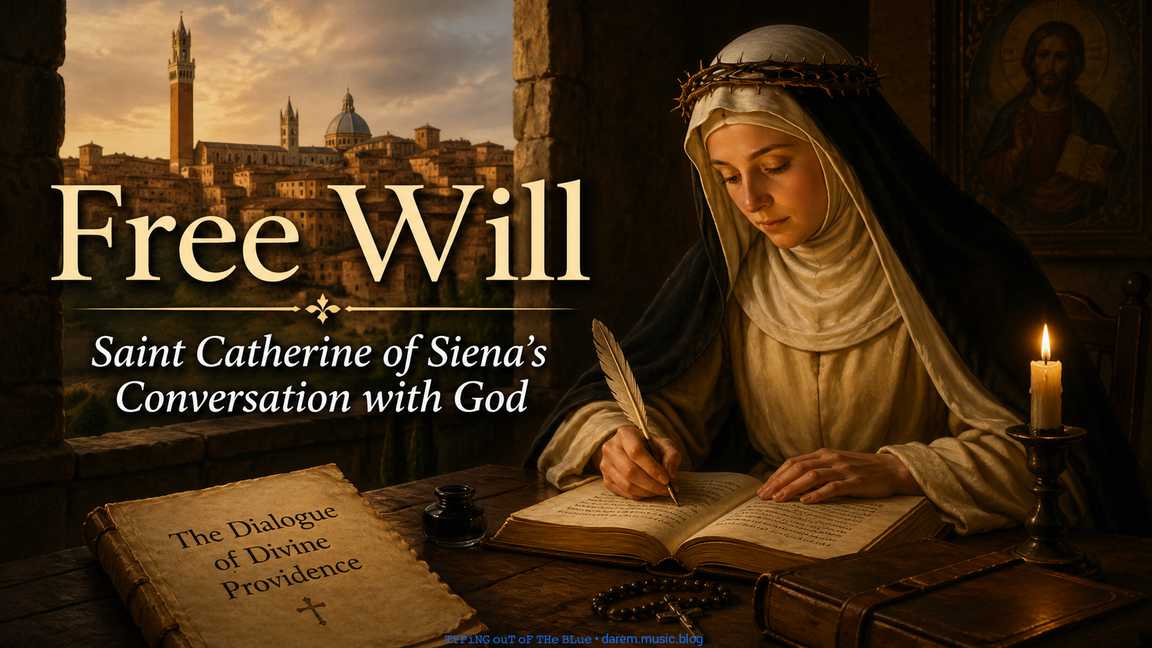
Free Will

We are free to choose—but every choice quietly shapes who we are becoming.

Catherine of wasn’t a distant thinker writing from comfort. We see someone who lived in the middle of real life—noise, sickness, conflict—and still learned to listen deeply. Born in Siena in 1347, she chose a life of prayer within the Dominican Order, but her voice reached far beyond her home. She wrote to leaders, challenged decisions, and spoke with a clarity that felt grounded, not borrowed. Her work, The Dialogue of Divine Providence, reads like a conversation because for her, it was. Not theory, not abstraction, but something lived.

In that conversation, one idea keeps returning: free will. We are free. Not partly, not occasionally, but truly free. We are not built to be controlled or forced into goodness. If love is real, we have to choose it. That is the dignity and the risk placed in our hands.

Saint Catherine helps us see this in a very concrete way. We are not carried through life. We walk. Every small decision—how we respond, how we speak, what we hold on to or let go—these are movements of our will. We can move toward truth or away from it, toward love or toward ourselves. And she does not soften the reality that God allows this, even when we choose wrongly. That freedom is real, but it is not empty. Every choice has direction, and every direction forms something in us.

But we are not left alone with it. Free will can drift if it stands by itself, so she speaks about grace. Not control, not something that cancels our choices, but help. It is what steadies us when truth is harder to choose, what strengthens us when walking away would be easier. We still choose, but we are not choosing without light.

Her message lands in a quiet but firm way. We often wait for big moments to define who we are, but she points us to something closer. The small choices, the hidden ones, the ones no one notices—this is where our direction is shaped. This is where our life is being formed.

And if we take it seriously, we realize this is not just her story. We are already in that same conversation. Every ordinary day, every simple decision, we are answering with our lives.

Let’s keep learning the saints’ way—day by day.

⌨ ᴛʸᵖⁱⁿᵍ ᴏᵘᵗ ᵒᶠ ᵗʰᵉ ʙˡᵘᵉ ᵈᵃʳᵉᵐ ᵐᵘˢⁱᶜ ᵇˡᵒᵍ
Praying Without Words • Darem Placer