
Saint Edith of Kemsing: When Fashion Met Faith

They called her too glamorous for God. But Edith’s answer still challenges how we see faith today.

Edith was born in 961, a princess, the daughter of King Edgar of England. She could have grown up in a palace, surrounded by riches and power. But her mother, Wulfthryth, chose differently. She brought her child to Wilton Abbey (a community of nuns who live, study, and pray together). The palace doors closed, and abbey walls became Edith’s world.

Inside, she grew into Sister Edith. While most nuns wore plain habits, she walked in silk robes with embroidered sleeves, her jewelry shining in the candlelight. People criticized her for it, saying she was too glamorous, too stylish to be holy.

Sister Edith didn’t stay silent. She explained her choice with calm confidence:

“If my heart is not proud, what harm is it if I wear gold? God looks at the heart, not the clothes. Beauty itself comes from Him, and it can be used to honor Him.”

Her style wasn’t for show. It was her way of lifting beauty back to God. And her life proved it—she gave generously to the poor, supported her abbey, and even helped restore churches. She carried both grace and humility, royalty and service.

Her time was short. At just twenty-three years old, in 984, Sister Edith died. Yet miracles were reported at her tomb, and she was soon honored as Saint Edith. She was remembered not as the daughter of a king who might have ruled a kingdom, but as the young woman who turned fashion into faith, and beauty into prayer.

ᴛʸᵖⁱⁿᵍ ᴏᵘᵗ ᵒᶠ ᵗʰᵉ ʙˡᵘᵉ ᵈᵃʳᵉᵐ ᵐᵘˢⁱᶜ ᵇˡᵒᵍ
Traces of courage, silence, and sacrifice—this is Saints.

Listen on Apple Music, Apple Music Classical, and YouTube Music
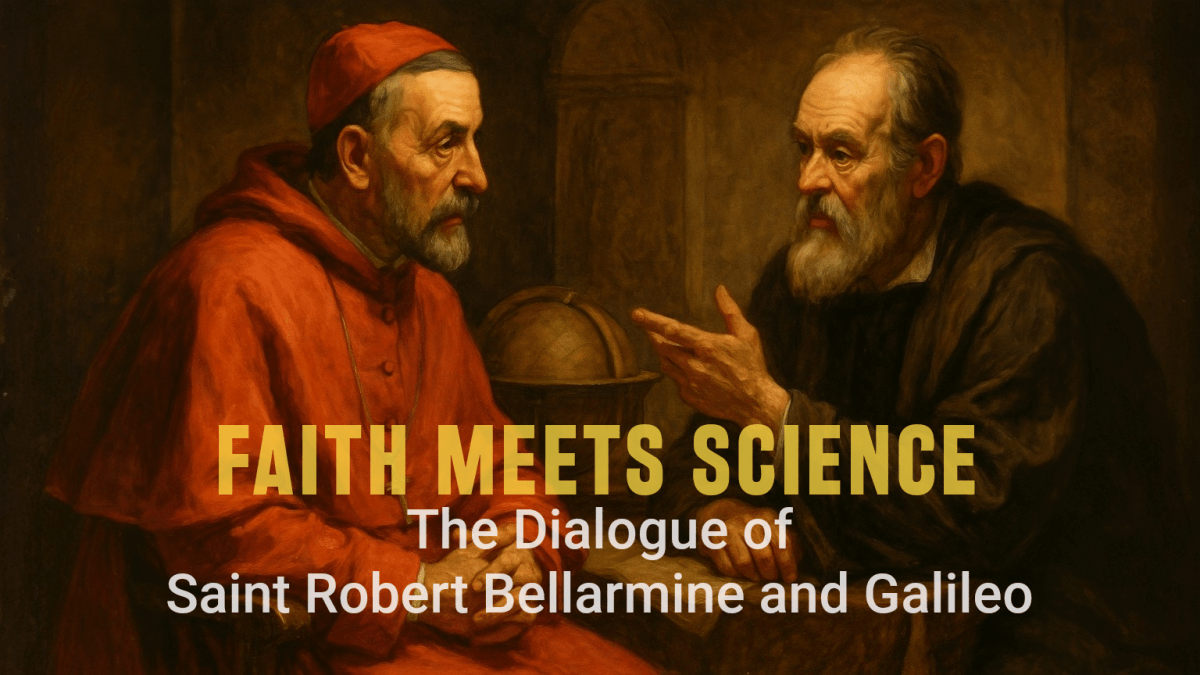
Faith Meets Science

Science challenged faith, but the response was more than resistance. A meeting of minds left a lesson the world needs today.

The Dialogue of Saint Robert Bellarmine and Galileo

When Galileo said the Earth moves around the Sun, many thought it clashed with the Bible. Cardinal Robert Bellarmine, a Jesuit and top Church thinker, was asked to respond.

In 1616, Galileo met with Cardinal Robert in Rome. Cardinal Robert wasn’t against him, but he told him: if one day science proves it true, then the Church must reread Scripture in that light. But until then, it should be treated as a theory, not as fact.

Cardinal Robert respected Galileo’s talent but wanted solid evidence before reshaping faith. He even gave Galileo a written note confirming he had not been condemned, only cautioned. After Cardinal Robert’s death in 1621, Galileo faced trial and was forced to take back his claims.

This story shows Cardinal Robert as more of a careful referee than an enemy—reminding us that faith and science can walk together, as long as we keep both humility and proof in mind.

Each year on September 17, we remember Saint Robert Bellarmine—a man with a listening ear and an understanding heart, something the world really needs today.

What Happened Next

1616 – Cardinal Robert cautioned Galileo: treat heliocentrism (the idea that the Earth moves around the Sun) as theory until proven.

1633 – Galileo was tried and forced to recant (publicly take back his claim), living under house arrest.

1822 – The Vatican allowed books teaching heliocentrism.

1835 – The Index of Forbidden Books (the Church’s official banned list) removed heliocentrism works.

1979 – Pope John Paul II opened a new study of Galileo’s case.

1992 – Pope John Paul II officially acknowledged the Church’s error and praised Galileo.

ᴛʸᵖⁱⁿᵍ ᴏᵘᵗ ᵒᶠ ᵗʰᵉ ʙˡᵘᵉ ᵈᵃʳᵉᵐ ᵐᵘˢⁱᶜ ᵇˡᵒᵍ

Traces of courage, silence, and sacrifice—this is Saints.

Listen on Apple Music, Apple Music Classical, and YouTube Music