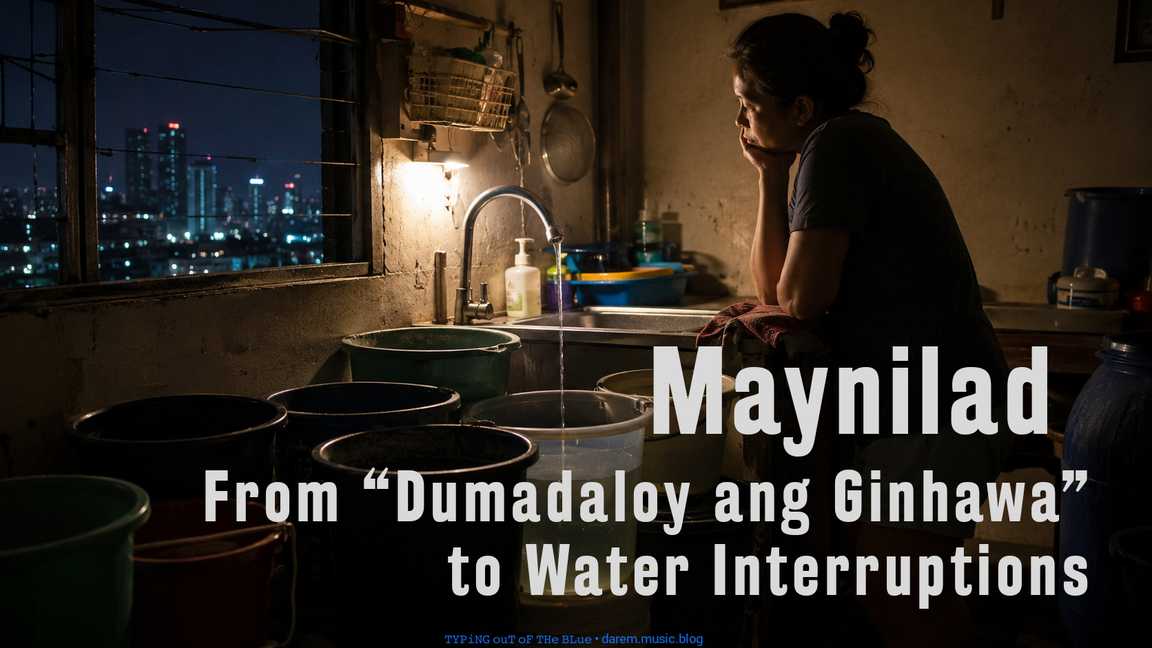
There was a time when people believed private water companies would finally solve Metro Manila’s endless water problems. No more weak pressure. No more surprise interruptions. No more families waiting beside plastic drums at midnight just to store water before supply disappeared again.
That was the promise when Maynilad Water Services began in 1997.
Before that, water service in Metro Manila was managed by the Metropolitan Waterworks and Sewerage System (MWSS). By the 1990s, the system was already struggling badly. Many pipes were old, leaks wasted huge amounts of water, and some areas barely received stable supply. Turning on the faucet sometimes felt like flipping a coin.
To address the problem, the government privatized the water system in 1997 and divided Metro Manila into two zones. Maynilad won the West Zone concession, covering much of Manila and parts of Cavite.
The company’s name came from “Maynila” and “nilad,” a mangrove plant once common along the Pasig River. It sounded modern while still carrying a connection to old Manila.
At first, many people were hopeful. Private companies were expected to modernize the aging system faster than the government could. Maynilad carried slogans filled with optimism:
“Dumadaloy ang Ginhawa.”
“Higit sa tubig ang aming serbisyo.”
“Sa Maynilad, May Pag-asa.”
Better water. Better life.
But only a few years later, the Asian Financial Crisis hit. The peso weakened, debts became heavier, and operating costs rose sharply. At the same time, droughts and water shortages added even more pressure to the system.
In 2003, Maynilad entered corporate rehabilitation after financial difficulties linked to the Asian Financial Crisis. For a time, control returned to the government.
Then in 2007, new owners took over and began rebuilding the company. Over the next several years, major improvements were made. Old pipes were replaced. New pumping stations were built. Water losses from leaks were reduced. Millions more residents gained access to water service.
But while the system improved, Metro Manila and nearby provinces also continued growing rapidly. Population increased. New residential developments expanded. Commercial areas multiplied. Water demand kept rising year after year.
At the same time, Metro Manila still depended heavily on Angat Dam for most of its water supply. When dam levels dropped during dry seasons or El Niño periods, millions immediately felt the effects.
Then came the 2019 water crisis. Entire neighborhoods experienced little or no water for days. Some families woke up in the middle of the night just to fill buckets and containers while weak water pressure briefly returned. For many residents, this became the moment frustration fully exploded into public anger.
Until today, water interruptions remain one of the biggest complaints against Maynilad.
The company usually gives several reasons for these interruptions. Some are valid infrastructure problems, while others are issues many residents feel should have been addressed long ago.
Here are the common reasons they give:
-
Low water allocation from Angat Dam
This has historically been one of the biggest causes of supply interruptions. When water levels drop during El Niño or dry seasons, less water is delivered to Metro Manila.
-
High demand
The rapid growth of Metro Manila and Cavite increased water demand across homes, businesses, malls, and residential developments faster than expected. Like a city turning the volume higher every year while the same old speakers struggled to keep up.
-
Maintenance and repairs
Many interruptions are caused by temporary shutdowns for pipe replacements, valve repairs, leak fixes, and pumping station upgrades.
-
Leaks and old pipelines
Even after years of upgrades, some parts of the underground pipe network remain decades old. Large leaks or burst pipes can force temporary shutdowns in affected areas.
-
Power interruptions
Some pumping stations rely heavily on electricity. When power problems occur, water distribution can weaken or stop completely.
-
Turbidity or dirty raw water
After heavy rains or storms, water from dams can become too muddy for normal treatment operations, temporarily slowing water production.
-
Delayed infrastructure projects
Critics say water demand grew faster than new reservoirs, treatment plants, and backup systems. Because of this, the system can still become vulnerable during peak demand periods.
-
Pressure management
Water pressure is sometimes intentionally lowered to help distribute limited supply across multiple areas. For many residents, however, weak pressure can already feel like having no water at all.
That is why the story of Maynilad remains complicated.
The company modernized large parts of an aging water system and expanded service to millions of people. But at the same time, it also became the face of frustration every time faucets suddenly run dry.
Today, one of Maynilad’s most recognizable slogans still echoes in people’s minds:
“Dumadaloy ang Ginhawa.”
For some places, maybe it does.
For others, the sound of plastic buckets filling at 2 AM still feels more familiar than comfort. Like hearing a song pause right before the chorus.
Sources: Wikipedia, CNN Philippines, IBON Foundation, Maynilad Water Services
⌨ ᴛʸᵖⁱⁿᵍ ᴏᵘᵗ ᵒᶠ ᵗʰᵉ ʙˡᵘᵉ ᵈᵃʳᵉᵐ ᵐᵘˢⁱᶜ ᵇˡᵒᵍ