Continue reading “Saint Teresa de Jesus Jornet e Ibars: She Was a Teacher”
Saint Teresa de Jesus Jornet e Ibars: She Was a Teacher
A young educator builds a life around caring for people.

A young educator builds a life around caring for people.
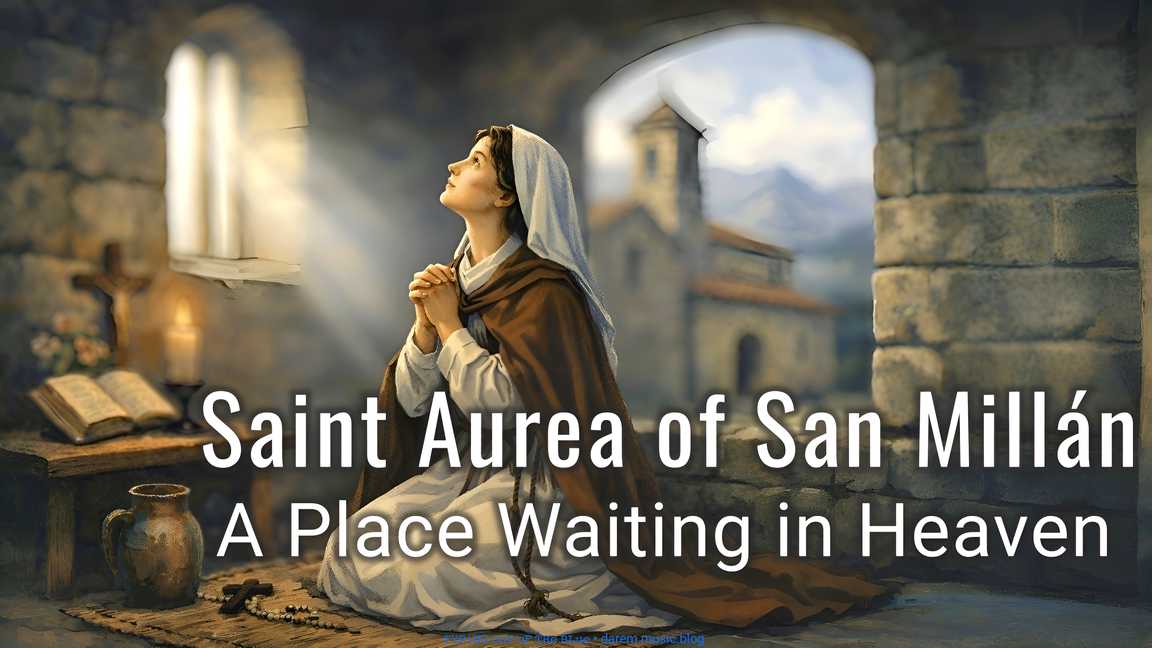
She believed a place was waiting for her in heaven. That simple hope shaped the quiet life she lived.
Aurea lived in the 11th century in northern Spain, near the shrine of Saint Millán at San Millán de la Cogolla in the region of La Rioja. She grew up with her mother Amunna close to the shrine, where both lived near the religious community.
Later, Aurea chose an unusual life even for her time. Instead of entering a convent fully, she lived alone in a small cell beside the church, dedicating her days to prayer and reflection.
Her story survives because of a monk named Gonzalo de Berceo, one of the earliest known poets in the Spanish language. In the 13th century, he wrote a poem about her life titled “Vida de Santa Oria.” Through that medieval account, Aurea became part of early Spanish religious literature.
Berceo wrote that Aurea experienced visions of heaven during her years of prayer. In these visions, saints such as Agatha, Cecilia, and Eulalia appeared to her. Medieval readers often understood them as saints she felt especially devoted to. They revealed that a place in heaven was prepared for her.
To modern readers, scenes like this can raise questions. Some may see them as symbolic storytelling common in medieval writings about saints. Others may interpret them as experiences shaped by solitude and intense spiritual life. Medieval people, however, understood them differently. For them, visions were possible moments where the spiritual world touched the ordinary one.
According to the same medieval account, Aurea later appeared to her mother Amunna in a dream or vision after her death, reassuring her that she was now in heaven. Stories like this were often included in medieval writings to express hope for those grieving the loss of a loved one.
Whatever interpretation someone takes, the image behind the story carries a simple but powerful idea. Aurea believed that a place was waiting for her in heaven.
That belief matters more than the details of the vision itself. When someone believes that goodness leads somewhere, it gives direction to life. It invites a person to grow, to change, and to keep choosing what is right.
The opposite belief can be far more dangerous. If a person begins to think there is no place for them in heaven, the temptation is to stop trying altogether. Without hope, some people simply settle into whatever darkness they are already living in.
Aurea’s story points in the other direction. It suggests that hope can shape a life. Believing that goodness has a destination can quietly guide the choices a person makes each day.
Aurea died young, around the age of 27 according to the medieval account. Yet the simple idea associated with Saint Aurea’s life still speaks today: it is better to live believing there is a place waiting in heaven than to live as if goodness leads nowhere.
Let’s keep learning the saints’ way—day by day.
ᴛʸᵖⁱⁿᵍ ᴏᵘᵗ ᵒᶠ ᵗʰᵉ ʙˡᵘᵉ ᵈᵃʳᵉᵐ ᵐᵘˢⁱᶜ ᵇˡᵒᵍ