
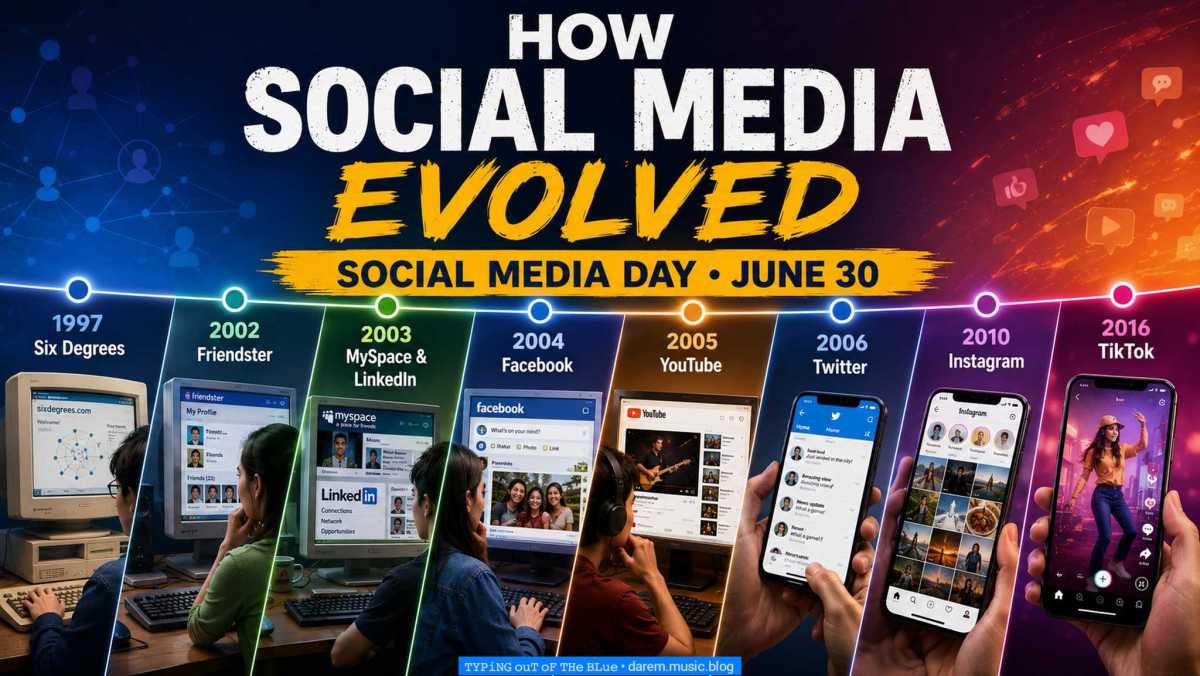
Every June 30, the world observes Social Media Day, a reminder of how quickly the internet changed from something we visited into a place where many of us practically live.
The earliest recognizable social media platforms looked nothing like today’s endless feeds and short videos. In 1997, a website called Six Degrees allowed people to create profiles and connect with friends online. It was simple by today’s standards, but it planted the seed of an idea that would eventually reshape human communication.
The early 2000s became the age of digital neighborhoods. Friendster exploded in popularity, especially in Asia, turning profile pages and friend lists into a cultural phenomenon. Soon came MySpace, where users customized profiles with music, colors, and enough glitter graphics to light up an entire era. LinkedIn arrived for professional networking, proving that social media could also wear a necktie.
Then came Facebook in 2004. What started as a university directory quickly expanded into one of the largest communication platforms in history. Birthdays, family photos, reunions, and life updates suddenly shared the same space. The internet began to feel less like a collection of websites and more like a community.
The evolution happened surprisingly fast:
• 1997 • Six Degrees
• 2002 • Friendster
• 2003 • MySpace & LinkedIn
• 2004 • Facebook
• 2005 • YouTube
• 2006 • Twitter
• 2010 • Instagram
• 2016 • TikTok
In less than two decades, social media evolved from simple online profiles into a global ecosystem of communities, creators, businesses, and conversations happening in real time.
The next wave transformed social media once more. YouTube gave ordinary people a broadcasting platform. Twitter compressed thoughts into short messages. Instagram transformed photography into a language of its own. TikTok later turned short videos into a global stage where trends could travel across continents within hours.
Today, social media is no longer just social. It is where businesses advertise, musicians release songs, students learn lessons, governments make announcements, and communities organize during emergencies. More than 5 billion people now use social media worldwide, making it one of the fastest adopted technologies in human history.
But every invention casts two shadows. The same tools that connect families across oceans can also spread misinformation across continents. The same platforms that give artists an audience can also reward outrage more than understanding.
Perhaps the biggest lesson from social media’s evolution is this: technology changes faster than human nature. Behind every screen is still a person looking for connection, belonging, laughter, meaning, or simply someone who understands them.
The apps will change.
The logos will change.
The algorithms will change.
The human need to connect probably never will.
⌨ ᴛʸᵖⁱⁿᵍ ᴏᵘᵗ ᵒᶠ ᵗʰᵉ ʙˡᵘᵉ ᵈᵃʳᵉᵐ ᵐᵘˢⁱᶜ ᵇˡᵒᵍ