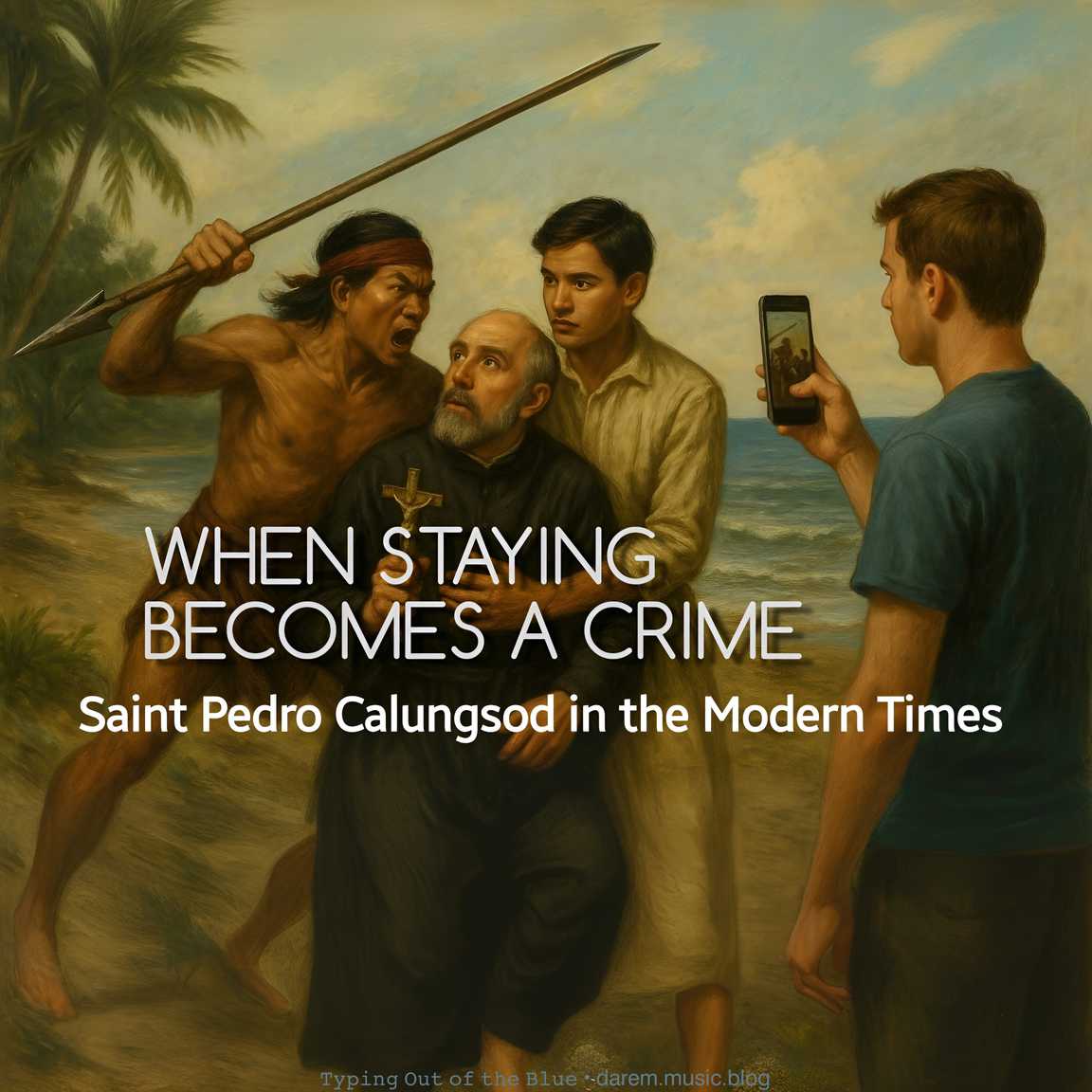
When Staying Becomes a Crime

He stayed when he could have run. In a world that calls loyalty foolish, Pedro reminds us what courage really is.

Saint Pedro Calungsod in the Modern Times

Pedro Calungsod was 17 years old, a Filipino catechist who went with Jesuit missionaries to Guam in the 1600s. He helped Fr. Diego Luis de San Vitores teach and baptize those who wished to join the faith.

A man named Choco spread a rumor that the baptismal water was poison. Because of fear, Chief Matå’pang got angry when his child was baptized with the mother’s permission only. Matå’pang attacked Fr. Diego. Pedro could have escaped but chose to stay by his side. Both were killed, and their bodies were thrown into the sea.

If Pedro Calungsod’s story happened now, no one would call him a saint.

People would say it was a crime. They’d ask why a priest baptized a child without the father’s consent. They’d question why a teenager didn’t run for safety. Some would call it foolish, not holy.

That’s how the world changed. People look at the surface—law, mistake, reaction. No one asks what was inside the choice.

Pedro stayed beside Fr. Diego when he could have escaped. He didn’t stay for reward, fame, or even a selfie to prove he was there. He stayed because loyalty meant something real to him. That’s what makes his death different.

He wasn’t trying to prove faith. He was simply being true when fear said to run.

And that’s what strikes hardest today—choosing others over your own life doesn’t come naturally anymore. But it did for him. And that’s why his story still matters.

⌨ ᴛʸᵖⁱⁿᵍ ᴏᵘᵗ ᵒᶠ ᵗʰᵉ ʙˡᵘᵉ ᵈᵃʳᵉᵐ ᵐᵘˢⁱᶜ ᵇˡᵒᵍ

Traces of courage, silence, and sacrifice—this is Saints.

Listen on Apple Music, Apple Music Classical, and YouTube Music
The 8-Digit Landline—Six Years Later

What was meant to expand our connection now feels like a relic—proof that even numbers can outgrow their purpose.

On October 6, 2019, the Philippines made all Metro Manila landline numbers 8 digits long. It felt huge at the time—one more digit to dial, one more thing to memorize. But the goal was clear: make room for the future.

The Pros Back Then

• More number capacity so telcos wouldn’t run out of lines.
• Clearer ID of which company a number belongs to.
• Future-proofing—extra space for fiber phones, business PBX, and new tech.

It was a logical move. The system was stretched wide and ready for growth.

The Cons That Stayed

Six years later, we ask: was it worth it?

• Landline use has faded, making the “expansion” feel empty.
• Harder to remember and dial when most people already live on mobile.
• Businesses spent money updating systems and printed materials.
• Some hotlines lost their simple, easy-to-recall charm.

The Hidden Cost

The shift wasn’t free. Telcos had to reprogram networks, upgrade exchanges, and update billing systems. Companies changed signs, cards, and call directories. No exact total was published, but millions were quietly spent—on something that slowly lost value.

The Confusion by Telco

Not everyone added the same digit.
PLDT used 8, Globe/Innove used 7, BayanTel used 3, Eastern Telecom used 5, and so on. So you couldn’t just “add 8” to every old number—you had to know which telco owned it. The rule made sense for network management, but it made remembering harder for everyone else.

The One-Sided Convenience

It made life easier for telcos and regulators, not for the people. They solved a supply problem—“We’re running out of numbers!”—but missed the bigger truth: demand was already falling. Landlines were slowly being replaced by mobile, chat, and fiber-based calls.

It’s like buying a ten-socket extension cord when almost everything’s already wireless. Technically smart, practically late.

The Modern Irony

Back then, prefixes mattered. The added digit told you which company owned a number. But today, because of mobile number porting, even that logic collapsed. A 0917 might be Smart, a 0920 might be DITO—nobody really knows.

The 8-digit landline tried to bring order.

Portability blurred it all again.

And maybe that’s where we are now, in a world where numbers no longer define where you belong, only who you connect with.

ᴛʸᵖⁱⁿᵍ ᴏᵘᵗ ᵒᶠ ᵗʰᵉ ʙˡᵘᵉ ᵈᵃʳᵉᵐ ᵐᵘˢⁱᶜ ᵇˡᵒᵍ

People… we forget how to communicate, but never stop trying.

Soon on Bandcamp