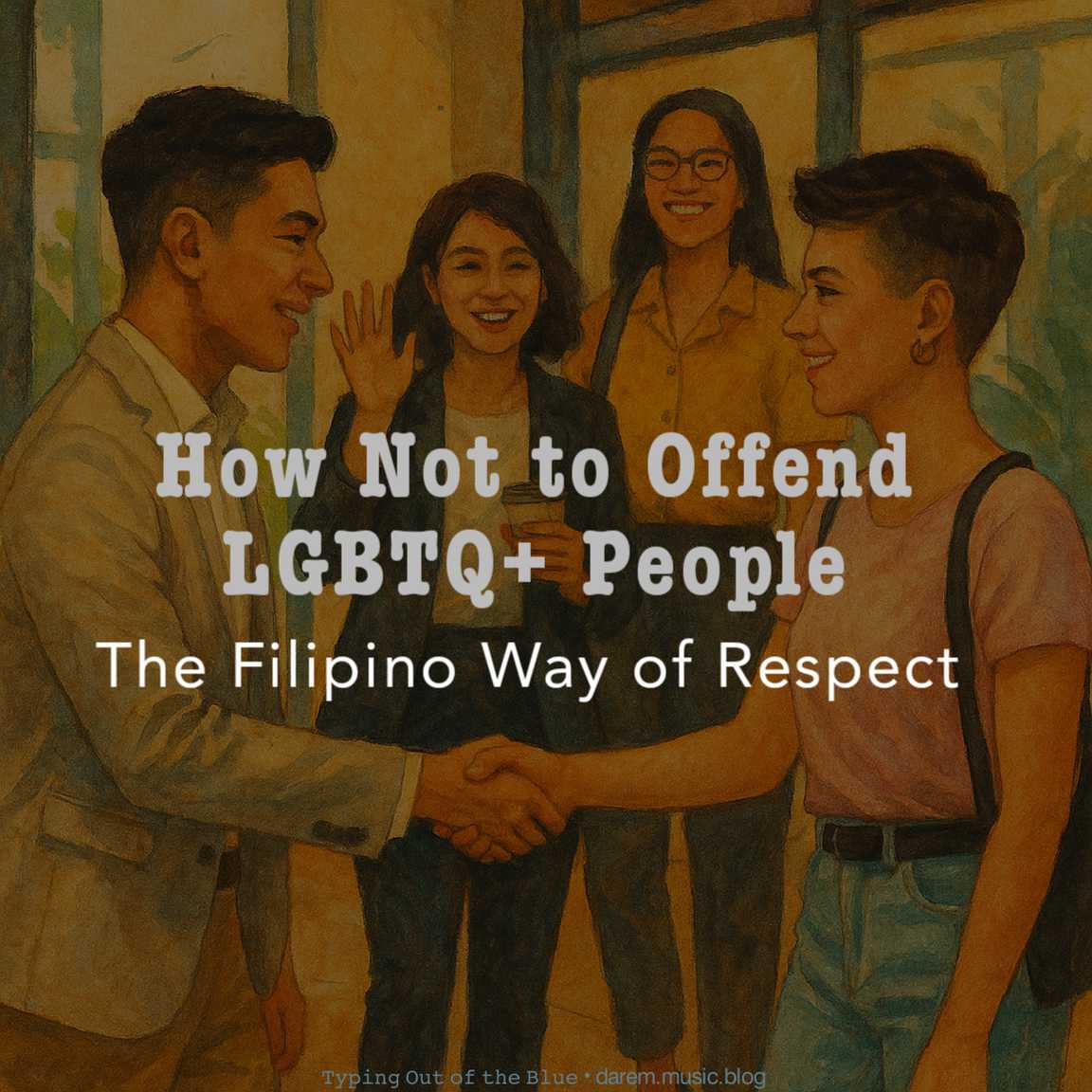
The Filipino Way of Respect
Most people don’t mean harm—they just don’t know what’s right to say. In a country where respect is shown through titles like “sir” and “ma’am,” it’s easy to worry about offending someone.
Let’s try to avoid using gendered words like “sir,” “ma’am,” “Mr.,” or “Ms.”—not because they’re wrong, but because they don’t always fit everyone. Respect can still sound polite without guessing someone’s gender. The goal isn’t perfection—it’s awareness with kindness.
1️⃣ Don’t assume.
Never guess someone’s gender based on looks or voice. If unsure, stay neutral:
“Good morning po.”
“Hello po.”
Those few words already carry respect—no guessing needed.
2️⃣ When the title gets tricky.
Filipinos love adding titles. But sometimes, gendered words can feel risky when you’re not sure how a person identifies. Here’s how to stay polite without overthinking it:
Teachers (classroom or faculty setting)
✅ “Good morning po, Teacher.”
✅ “Good morning po.”
Office or School Staff (transaction desk)
✅ “Good morning po.”
✅ “Good morning po, Registrar.”
❌ “Hello, Registrar!” — sounds sarcastic in Filipino tone.
Workplace or Company Setting
✅ “Good morning po, Coordinator.”
✅ “Good morning po, Supervisor.”
✅ “Good morning po.”
⚠️ “Hi, Boss!” — can sound friendly or disrespectful, depending on the place.
Hospitals or Clinics
✅ “Good morning po, Doctor.”
✅ “Good morning po, Nurse.”
✅ “Good morning po.”
Government or Public Service Offices
✅ “Good morning po, Officer.”
✅ “Good morning po.”
⚠️ “Hi, Bossing!” — can sound too casual in formal spaces.
Formal Letters (emails or printed letters)
When unsure of a person’s gender identity, keep it professional and neutral. Use the full name and position instead of titles.
Example:
To: Alex Dela Cruz, Registrar or Dear Alex Dela Cruz,
This keeps the message formal but inclusive—showing respect without assuming gender.
3️⃣ Tone matters.
In the Philippines, “bastos” isn’t just about words—it’s about tono.
Even a polite greeting can sound rude if said too loud or too casual.
“Good morning po” with warmth always beats “Good morning, Registrar!” with energy but no respect.
3️⃣.5️⃣ Filipino respect still matters.
Modern respect doesn’t mean erasing tradition. Saying “po,” bowing your head a bit, or using honorifics (Teacher, Kuya, Ate, Doctor, Attorney, Father, Sister, Professor) are signs of humility—not oppression.
These words are part of our cultural DNA—they remind us that manners aren’t old-fashioned—they’re timeless.
We can be inclusive without losing our values.
Being polite doesn’t make you outdated—it makes you grounded.
4️⃣ Avoid jokes and labels.
“Bakla” and “tomboy” aren’t bad words by themselves—but tone makes or breaks them. Never use them as punchlines or nicknames unless the person themselves is comfortable with it.
5️⃣ Follow their lead.
If someone introduces themselves a certain way, mirror it. That’s how you show respect.
“Hi, I’m Teacher Jamie.” → “Good morning po, Teacher Jamie.”
6️⃣ Learn, adjust, and move on.
If you make a mistake, don’t panic. Just say “Sorry po” and correct it next time. Respect is a habit—not a test.
7️⃣ Respect goes both ways.
Respect isn’t a competition. LGBTQ+ people also have the same duty to understand that others are still learning.
Not everyone means harm—some just don’t know the right words yet.
Kindness should work both ways—the courage to ask, and the grace to explain.
8️⃣ Everyone’s still learning.
No one’s born knowing the right words. Culture, upbringing, and even generation gaps all shape how we talk.
Some grew up using gendered titles automatically—others grew up being more casual.
Instead of judging, we can just meet halfway.
Respect grows faster when both sides are patient.
9️⃣ Small habits, big difference.
A smile, a soft tone, a simple “po”—they go further than any title.
Respect isn’t about memorizing the rules—it’s about feeling the moment and choosing kindness every time.
🔟 Pronouns and Neutral Words.
When talking about someone, avoid using gendered pronouns if you’re not sure. The easiest way is to repeat the person’s name instead of saying he or she.
Example:
Instead of saying, “Tell him the meeting starts at nine,” say, “Tell Alex the meeting starts at nine.”
Or reword the sentence completely:
“The meeting for Alex starts at nine.”
If you don’t know the person’s name, you can stay polite by describing their role or presence without gendered words.
Examples:
• “Can you check if the teacher in the hallway needs help?”
• “Please tell the person at the counter we’re ready.”
• “Ask the officer outside if the line has started.”
You can also use the word they or them for one person—it’s grammatically accepted worldwide and keeps your language inclusive.
Examples:
• “Someone left their umbrella here.”
• “They said the form is ready.”
• “If anyone calls, tell them to wait a moment.”
There are rare exceptions. If a person clearly says their preferred title or pronoun, respect it as it is.
Don’t argue or insist that someone is “really” male or female—it’s not your battle to win. It’s better to have peace than to prove a point.
If you accidentally use the wrong word, just correct it and move on. No need to make a big deal out of it. What matters is the intention to stay respectful.
Respect in language isn’t about choosing fancy words—it’s about making everyone feel seen.
The real goal isn’t to win—it’s to understand.
⌨ ᴛʸᵖⁱⁿᵍ ᴏᵘᵗ ᵒᶠ ᵗʰᵉ ʙˡᵘᵉ ᵈᵃʳᵉᵐ ᵐᵘˢⁱᶜ ᵇˡᵒᵍ