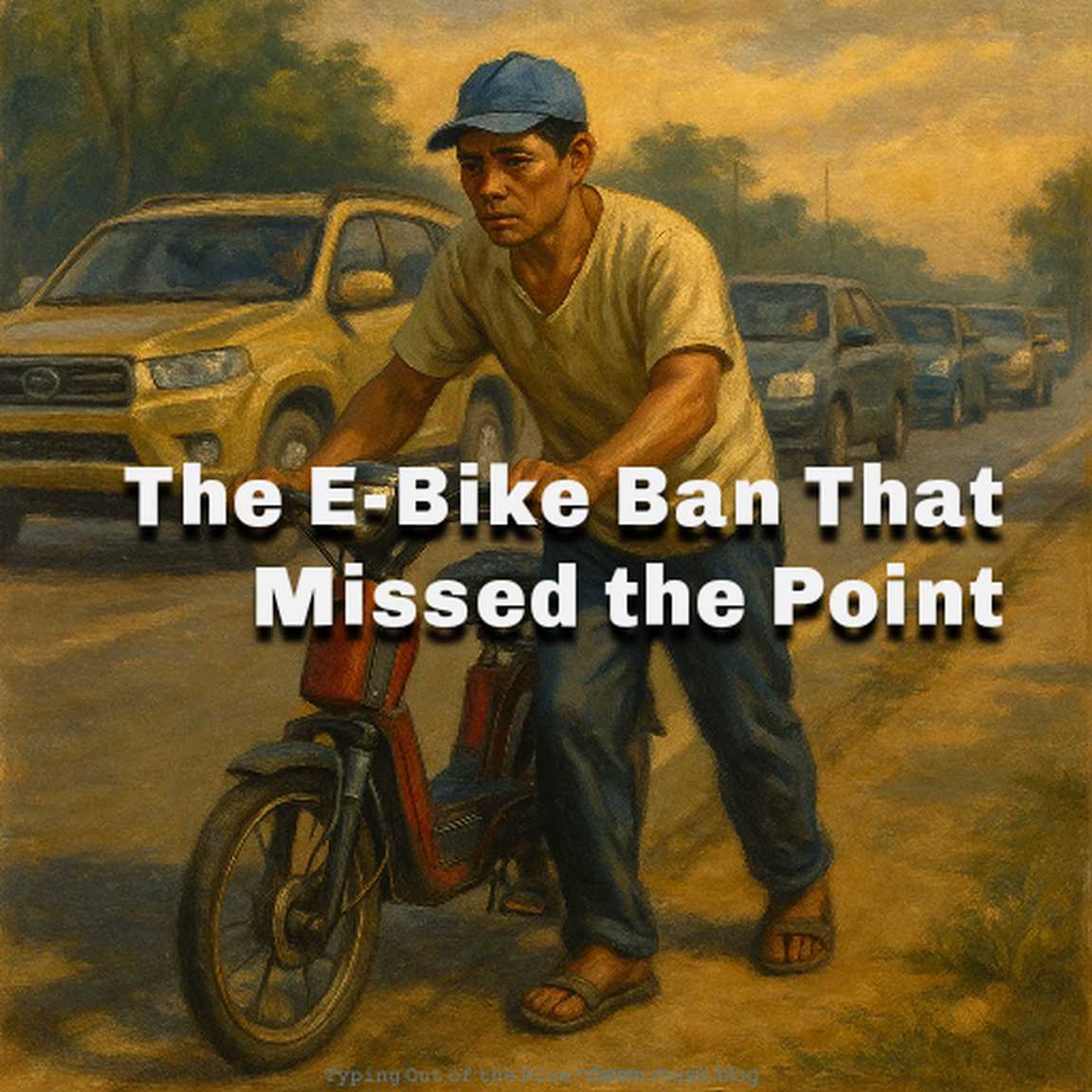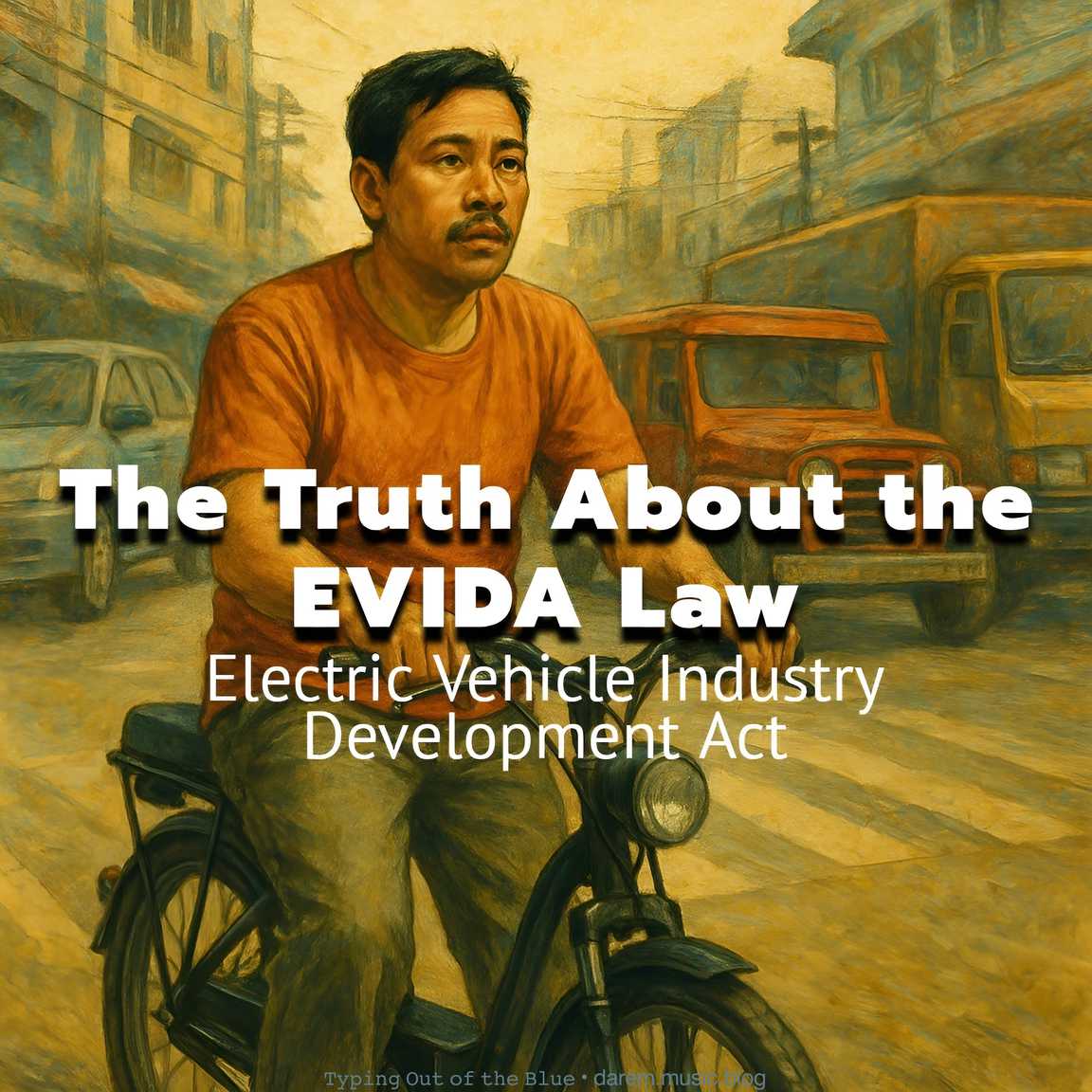
Update (Dec 1, 2025): According to a recent Philstar report, the planned e-bike/e-trike ban/impound on national roads has been reset to January. This postponement underscores the uncertain and changing nature of enforcement—reinforcing that current rules remain unclear, and that riders still face legal ambiguity.
The Electric Vehicle Industry Development Act—better known as EVIDA Law—is Republic Act 11697. Signed in April 2022, it aims to grow the electric vehicle industry, build charging networks, and move the country toward cleaner transport.
It was never meant to punish people who rely on e-bikes. And that’s where the confusion begins.
1. What the EVIDA Law actually is
EVIDA’s purpose is simple: develop the EV industry in the Philippines. It does not:
- ban e-bikes
- require e-bike registration
- mention major roads
- create penalties
- authorize impound
EVIDA focuses on:
- charging stations
- tax incentives
- EV-only parking
- government EV fleet transition
- manufacturing support
- long-term clean mobility planning
Even its 2022 IRR stays within that scope—no bans, no restrictions, and no penalties aimed at e-bikes.
There is nothing in EVIDA that prohibits e-bikes or e-trikes from being used.
2. So why are people reacting to a ban?
Because LTO publicly announced that e-bikes and e-trikes will be impounded if found on major roads starting December 1.
The announcement used broad terms—“e-bikes” and “e-trikes”—without mentioning classes, wattage, speed categories, or wheel count.
This caused the public to assume that:
- the rule is nationwide
- all electric vehicles are included
- EVIDA is the basis
- every e-bike will be stopped
In reality, the announcement lacks definitions, cites no classification standards, and does not refer to any supporting city ordinance—creating a legally unclear and challengeable enforcement scenario.
3. The legal reality
EVIDA does not:
- ban e-bikes
- classify them
- mention allowed roads
- authorize impound
Existing rules come from:
- LTO — classifications + operating guidelines
- MMDA — Metro Manila enforcement
- LGUs — must issue ordinances for penalties
The true classification framework is LTO Administrative Order 2021-039, which defines e-bike classes and the roads they can use — but even AO 2021-039 does not impose a blanket ban.
LTO can regulate how e-bikes operate — but cannot eliminate them.
LGUs may regulate locally — but only through valid ordinances with due process.
4. Why is the Dec 1 enforcement unclear?
The Dec 1 plan has several major gaps:
1. No classifications were mentioned
The announcement never said if it covers Class A, B, C, D, speed-based groups, wattage groups, or 2/3/4-wheel EVs.
This leaves 4-wheel light EVs, NEVs, and golf-cart-style EVs in a legal gray zone.
2. No LGU ordinances exist
Without a city ordinance, there is:
- no defined local violation
- no published penalty
- no legal basis to impound
3. National enforcement requires clear definitions
Agencies cannot impound a vehicle they did not define. Vague announcements are not a legal foundation.
4. Media headlines amplified the fear
Almost all major news outlets reported the announcement, but none clarified classifications, exemptions, or legal prerequisites.
The deeper problem remains: poor road planning, weak bike lane networks, and unreliable transport systems — yet the easiest target becomes the e-bike rider.
It’s like the roof is leaking… and they blame the bucket.
5. The truth about impounding
There is no national law that allows automatic impound of e-bikes simply for entering a major road.
Not EVIDA.
Not its IRR.
Not AO 2021-039.
To legally impound, a city must have:
- a valid ordinance
- a clearly defined violation
- a published penalty
- proper due process
None of these exist for Dec 1.
Even if an ordinance existed, impound is valid only for real violations — wrong class for the road, no helmet (when required), reckless driving, no lights, no brakes, or obstruction.
What is not valid: “You are an e-bike — impound.”
Existence is not a violation.
6. What EVIDA actually wants
EVIDA supports:
- cleaner mobility
- more transport options
- lower fuel dependence
- less pollution
- a future-ready transport system
Banning or impounding e-bikes goes directly against this goal.
7. Where the real problem starts
EVIDA is written for the future.
The Dec 1 announcement reacts to the present.
And the present is messy.
Instead of asking, “How do we make e-bikes safer?”
The reaction becomes, “How do we remove them so we don’t have to deal with them?”
8. Real-world impact
- Workers lose mobility
- Deliveries slow down
- Low-income families struggle
- Climate-friendly commuting weakens
- Traffic remains unchanged
- Enforcement looks strict, but nothing improves
The enforcement targets the symptom — not the cause.
Final Clarification: Can LTO bypass EVIDA?
No.
LTO cannot override EVIDA, and it cannot create bans or penalties that the law itself does not contain.
EVIDA does not ban e-bikes.
It does not restrict them on major roads.
It does not authorize impound.
Announcements can sound absolute — but agencies must still follow:
- the law (RA 11697 – EVIDA)
- the IRR
- LTO AO 2021-039
- LGU ordinances
- due process
Without these, a December 1 enforcement may be loudly announced, but it remains legally weak.
Rules cannot bypass the law — no matter how confidently they are reported.
Sources
Legal & Government:
• Republic Act 11697 (EVIDA Law)
• EVIDA IRR (2022)
• Department of Energy (DOE) – Implementing agency
• Senate Committee on Energy – EVIDA deliberations (2022)
• House Committee on Energy TWG (2023)
• LTO Administrative Order 2021-039
• MMDA press statements
• Metro Manila LGU ordinance databases
• Supreme Court jurisprudence on administrative overreach
• Older, non-EV-specific transportation laws (e.g., RA 4136) were intentionally excluded due to lack of relevance to micro-mobility and inconsistent application in modern EV regulation.
News Reports:
• Inquirer.net – “LTO to impound e-bikes, e-trikes on major roads starting Dec 1”
• Manila Bulletin – “LTO, MMDA to start apprehending e-bikes on major roads December 1”
• Philstar.com – “LTO: E-bikes, e-trikes banned on national roads starting December 1”
• ABS-CBN News – “LTO to impound e-bikes on major roads starting Dec 1”
• GMA News – “LTO, MMDA to enforce ban on e-bikes on national roads Dec. 1”
• CNN Philippines – “Authorities to bar e-bikes, e-trikes on national roads starting Dec. 1”
• Rappler – “E-bikes, e-trikes banned on major roads starting December 1”
⌨ ᴛʸᵖⁱⁿᵍ ᴏᵘᵗ ᵒᶠ ᵗʰᵉ ʙˡᵘᵉ ᵈᵃʳᵉᵐ ᵐᵘˢⁱᶜ ᵇˡᵒᵍ