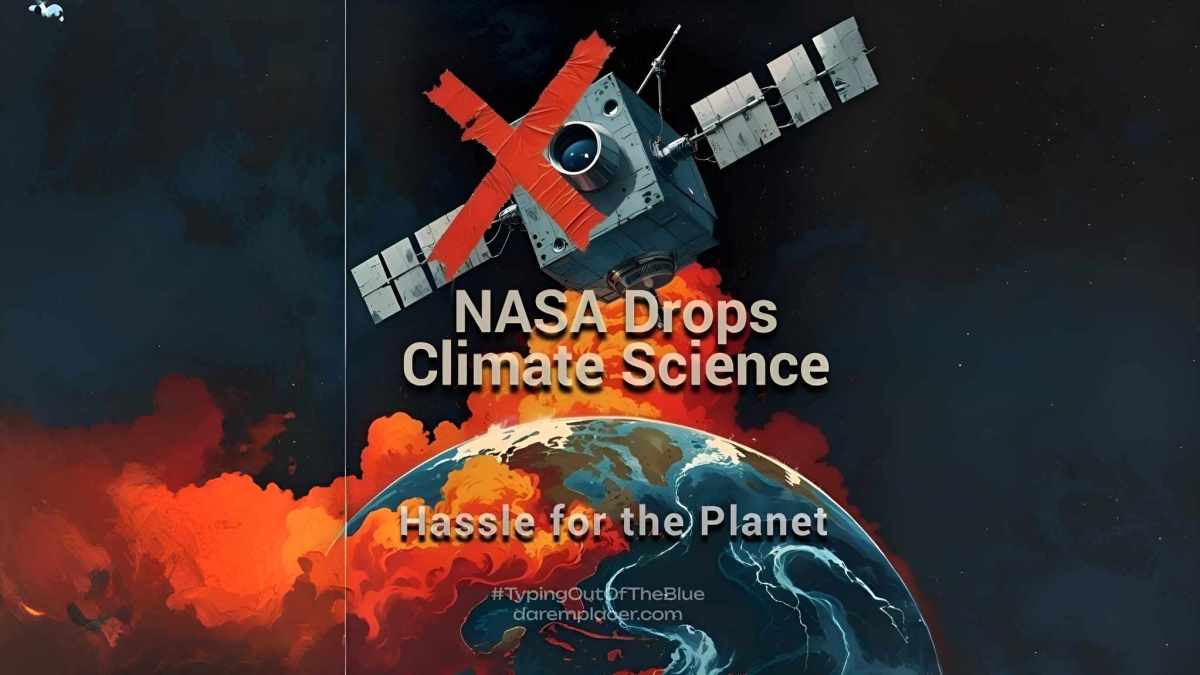
NASA says it will focus on rockets and Mars—but at the cost of cutting climate research almost in half. Two carbon-tracking satellites are being killed off, labs face shutdown, and scientists warn the world will be flying blind into stronger storms and hotter years. Space may inspire us, but what happens when we stop watching our own planet?
Hassle for the Planet
NASA has always had two main jobs: explore space and study Earth. But now, Acting NASA Administrator Sean Duffy announced that they will set aside climate research and focus only on space projects.
At first, it sounds exciting—rockets, Mars, stars! But here’s the real problem: NASA is one of the leading organizations tracking our planet’s climate. They operate satellites that measure carbon dioxide, monitor rising temperatures, and provide warnings about how quickly Earth is changing.
Reports confirm that the Orbiting Carbon Observatory-2 (OCO-2) is already being deorbited and will burn up on reentry, while OCO-3, still attached to the ISS, could shut down completely by the end of September unless Congress or private partners step in. These satellites are critical for measuring carbon in the atmosphere. Losing them is like trying to fight climate change without knowing how much pollution is out there—like treating a patient without checking their temperature.
It doesn’t stop there. Duffy has also proposed cutting NASA’s climate research programs, with the science budget slashed by 52%—from $7.5 billion to $3.9 billion. This would gut Earth science, astrophysics, planetary missions, and even force the shutdown of labs like the Goddard Institute for Space Studies (GISS). Nearly 300 NASA staff—including astronauts—have already signed The Voyager Declaration to protest, warning of “catastrophic effects” on science and safety.
The cuts ripple far beyond NASA. U.S. scientists are already looking for jobs abroad as research funding dries up. Disaster readiness is also at risk—less data means weaker flood predictions, poorer storm tracking, and more lives in danger.
This isn’t only about science—it’s also about politics and profit. Some in power want to sideline climate research, clearing the way for projects like a nuclear reactor on the Moon by 2030 and more commercial space ventures. But critics point out that this directly violates NASA’s charter, which requires the agency to study both Earth and space. Members of Congress are pushing back, but the clock is ticking.
Here’s why this matters:
- Less data means it will be harder to fight climate change. Other countries also depend on NASA’s information.
- Climate change is already here. Storms, heatwaves, and floods are not “future” problems—they’re happening now.
- Politics over science weakens trust. Cutting these programs makes it look like leaders care more about appearances and profit than real solutions.
Yes, space exploration inspires us. But ignoring climate research is like planning to move to Mars while letting our home planet collapse.
And here’s the blunt truth: leaders will not act until they themselves breathe the same polluted air the rest of us do. As long as they remain in comfortable positions, profit will come first—and real solutions will always come last.
𝚃𝚢𝚙𝚒𝚗𝚐 𝙾𝚞𝚝 𝚘𝚏 𝚝𝚑𝚎 𝙱𝚕𝚞𝚎
𝚍𝚊𝚛𝚎𝚖𝚙𝚕𝚊𝚌𝚎𝚛.𝚌𝚘𝚖