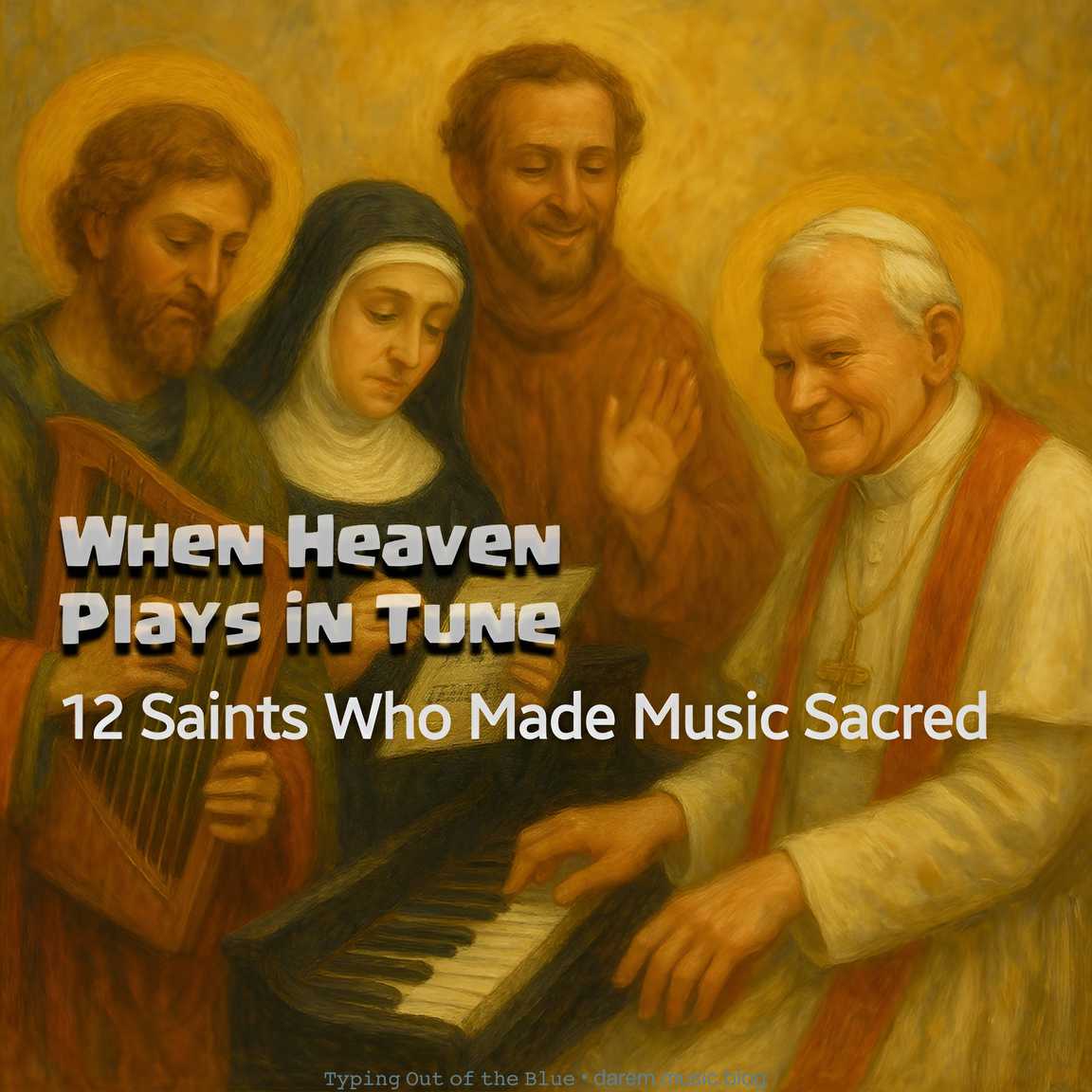
12 Saints Who Made Music Sacred
Music has always been more than sound. It can calm pain, bring peace, and lift hearts closer to God. These saints lived in different times, but their music was real—written, sung, or played with faith that still echoes through history.
1. Saint David the King (around 1000 BC)
He played the harp and wrote many psalms. His songs were honest prayers that still guide people to faith today.
2. Saint Ambrose of Milan (4th century)
A bishop who wrote hymns that shaped early Church music. His style, called Ambrosian chant, made worship sound strong and alive.
3. Saint Ephrem the Syrian (4th century)
He used poetry and melody to teach truth. His hymns about mercy and light are still sung in the Eastern Church.
4. Saint Gregory the Great (6th century)
He organized Church chant into a clear form of prayer now known as Gregorian chant. His work turned music into a way to unite hearts in worship.
5. Saint Romanos the Melodist (6th century)
A deacon and composer who wrote long songs called kontakia. His verses told stories of faith that people remembered through music.
6. Saint Dunstan (10th century)
An English archbishop who played the harp with skill. His music filled his monastery with peace and inspired his monks to pray with rhythm and order.
7. Saint Hildegard of Bingen (12th century)
A visionary nun and composer whose music sounded like light. Her songs joined beauty with prayer and reminded listeners that holiness can sing.
8. Saint Francis of Assisi (13th century)
He wrote The Canticle of the Sun, praising God through nature. His joy turned life itself into a song of gratitude.
9. Saint Philip Neri (16th century)
He used cheerful songs to reach the youth of Rome. From his gatherings grew the Oratorio—a new way of praying through joyful music.
10. Saint Alphonsus Liguori (18th century)
A bishop and musician who wrote hymns for simple people. His best-known carol, Tu Scendi dalle Stelle, still brings peace every Christmas.
11. Saint Elizabeth of the Trinity (19th century)
Before entering the convent, she was a pianist. She saw her soul as a song for God, where every note was praise.
12. Pope Saint John Paul II (20th century)
A poet and actor who loved rhythm and art. His words moved like music, showing that faith can also dance with reason and heart.
From ancient harps to modern hymns, these saints remind us that music is prayer that breathes. Every sound, every silence, can become a path to God. When our music is honest, Heaven listens.
📜 Saint Cecilia is not on this list, though she is known as the patron saint of musicians. She was a Roman martyr with no record of playing music. The title came from a later mistranslation of one Latin line: “Cantantibus organis illa in corde suo soli Domino decantabat” (“While the instruments played, she sang in her heart to the Lord.”). This line first appeared in the medieval text Passio Sanctae Caeciliae —a devotional legend written centuries after her death. The word organis meant “instruments,” not the organ. Artists later painted her playing one, and over time she became the symbol of music born from faith—a song heard only by the heart. While she is honored as the patron of musicians, the musical details of her life remain tradition rather than fact.
⌨ ᴛʸᵖⁱⁿᵍ ᴏᵘᵗ ᵒᶠ ᵗʰᵉ ʙˡᵘᵉ ᵈᵃʳᵉᵐ ᵐᵘˢⁱᶜ ᵇˡᵒᵍ
Listen on Apple Music, Apple Music Classical, and YouTube Music