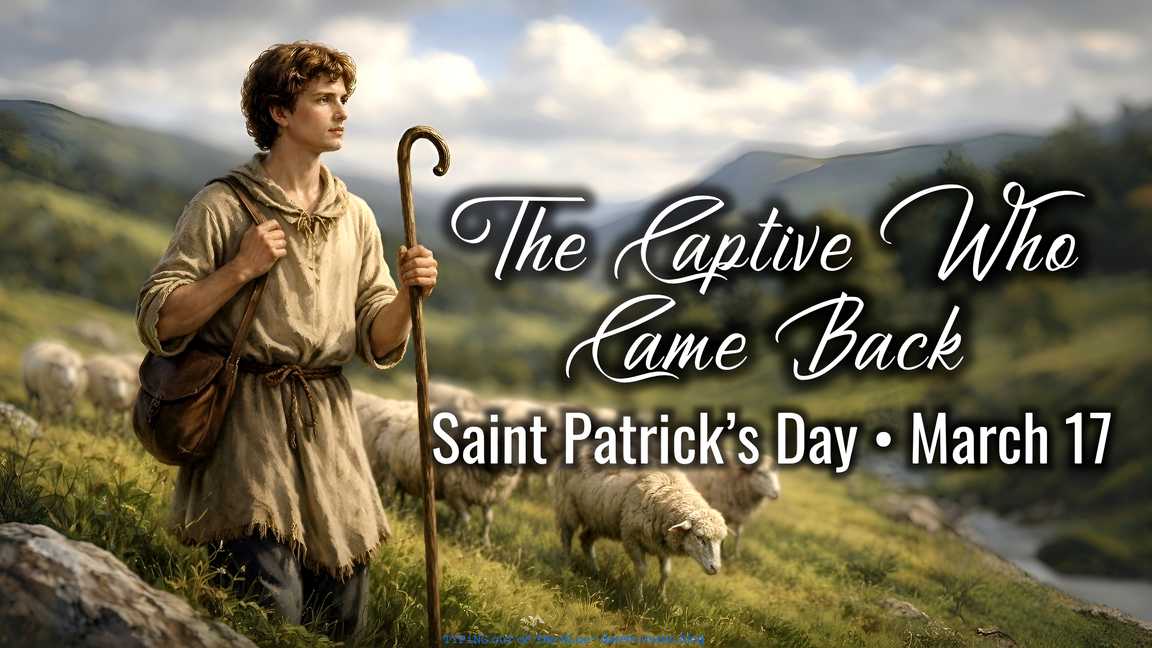
Saint Patrick’s Day • March 17
Saint Patrick is one of the most recognized saints in Christian history, especially in Ireland. But his story did not begin there. He was born in Roman Britain around the late 4th century, probably around 385 AD.
When Patrick was about sixteen years old, his life suddenly changed. Raiders from Ireland attacked his village and kidnapped him. At that time, slave raids between Ireland and the coasts of Roman Britain were common. Young people were taken to work as laborers, especially in farming and herding. Patrick was brought across the sea to Ireland and forced to work as a shepherd.
He spent about six years watching sheep in the countryside. During those long and lonely years in the hills, the faith he once ignored began to grow stronger. Patrick later wrote that he prayed many times each day while tending the sheep.
One night he believed God spoke to him in a dream, telling him that it was time to escape and that a ship was waiting for him. Patrick fled, walked many miles to the coast, and eventually found a ship that brought him back home.
But the story did not end there.
Years later Patrick felt another calling. He believed God wanted him to return to Ireland—the same place where he had once been enslaved. After studying to become a priest and later a bishop, he went back as a missionary.
Patrick spent many years traveling across Ireland, helping strengthen the spread of Christianity and baptizing new believers. One tradition says he used the shamrock, a small three-leaf plant, to explain the mystery of the Holy Trinity: Father, Son, and Holy Spirit—three Persons but one God.
Legends later grew around him. One famous story says he drove all the snakes out of Ireland. Historians believe this is symbolic rather than literal, since snakes were likely never native to the island. The story probably represents the spread of Christianity and the fading of old pagan beliefs.
Patrick died around March 17, 461. That date later became Saint Patrick’s Day.
His story still carries a simple message today. A painful chapter of life does not have to define the rest of the story. Patrick returned to the very place where he once suffered and turned it into a place of mission and service. Sometimes the place where life once wounded us becomes the place where we can bring the most good.
Let’s keep learning the saints’ way—day by day.
⌨ ᴛʸᵖⁱⁿᵍ ᴏᵘᵗ ᵒᶠ ᵗʰᵉ ʙˡᵘᵉ ᵈᵃʳᵉᵐ ᵐᵘˢⁱᶜ ᵇˡᵒᵍ