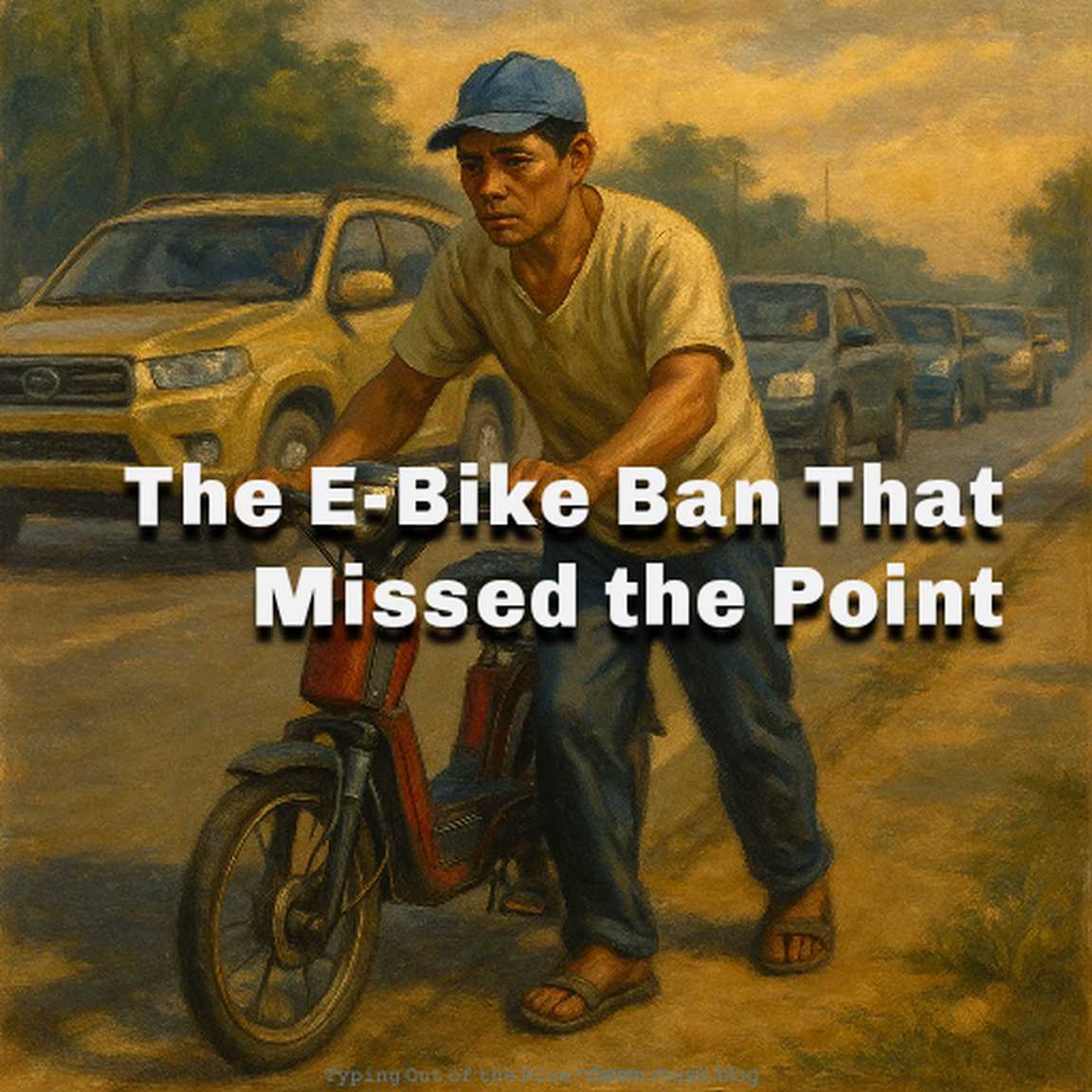
Update (Dec 1, 2025): According to a recent Philstar report, the planned e-bike/e-trike ban/impound on national roads has been reset to January. This postponement underscores the uncertain and changing nature of enforcement—reinforcing that current rules remain unclear, and that riders still face legal ambiguity.
People keep asking why there are so many e-bikes on the road. The answer isn’t complicated: life became harder, and people had to adapt. Fuel prices climbed, public transport turned into a daily struggle, and commuting became a test of endurance—you never knew if a ride would come, if it would be safe, or if you’d even reach work on time. So ordinary people did what they’ve always done: they found a way.
An e-bike isn’t a luxury. It’s survival. It’s the “at least I can make it,” the “this is what I can afford,” the “this keeps my family going.” It’s cheap, quiet, low-maintenance, and far cleaner than any fossil-burning vehicle occupying ten times the road space. In a world drowning in emissions, e-bike riders accidentally became the ones doing something good.
But instead of understanding that, the response was a sudden ban on e-bikes along main roads—the very roads people rely on because there are no real alternatives. No study. No proper analysis. No attempt to ask why the numbers grew or what problems people were trying to escape. Just a blanket rule that treated e-bikes as the source of every issue—traffic, accidents, disorder—as if small electric vehicles created decades of bad road design, undisciplined transport habits, and oversized cars that suffocate these main roads every single day.
It’s striking how the biggest polluters stay untouched—welcomed even—while the cleanest, cheapest mobility option used by workers, delivery riders, and minimum-wage earners becomes the target. It sends a message: if you’re rich enough to drive a car, the road is yours. If you’re poor and trying to survive with an e-bike, you’re the problem.
Nobody stopped to consider the real questions: Why do people choose e-bikes? What good do they bring? How many families depend on them? How much dignity did they restore to people exhausted by a broken transport system? Instead of treating the disease, the government punished the symptom.
If safety were the real goal, the solution would have been lanes, speed rules, alternative routes, education, and a proper transition plan. If order were the goal, there would have been structure instead of sudden punishment. If people mattered, their realities would have been part of the conversation. Instead, the government took the easiest route: a ban, an impound, and a clean escape from responsibility.
And now the truth becomes clearer. Come December 1, 2025—when the ban finally begins, will it truly solve the problem—or simply shift it onto the shoulders of the people who rely on e-bikes to live? Because when the government passed the blame downward, they didn’t fix anything. They just created a new problem on the side of those who depend on e-bikes, while they themselves walked away from their own.
⌨ ᴛʸᵖⁱⁿᵍ ᴏᵘᵗ ᵒᶠ ᵗʰᵉ ʙˡᵘᵉ ᵈᵃʳᵉᵐ ᵐᵘˢⁱᶜ ᵇˡᵒᵍ
