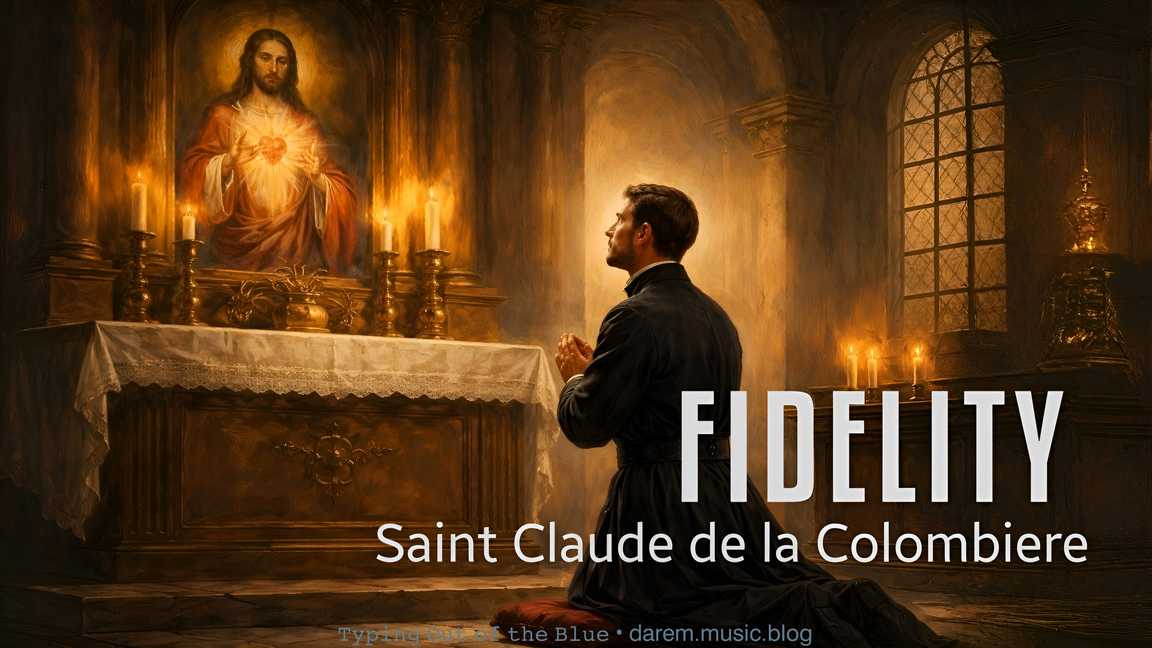
Fidelity

He chose truth over safety and stood by the Sacred Heart.

Saint Claude de la Colombiere

Claude was born in 1641 in France. He became a Jesuit priest and entered the Society of Jesus at a young age. He was intelligent, disciplined, and known for clear preaching. More than talent, he was known for his deep trust in God.

He became the spiritual director of Margaret Mary Alacoque, a nun from the Order of the Visitation of Holy Mary, a Catholic religious order for women. She spoke about visions of the Sacred Heart of Jesus. At that time, many people approached faith with fear and strictness. God was often presented more as judge than as loving Father. When Margaret Mary shared her experiences, many doubted her.

Father Claude did not dismiss her. He examined what she said carefully. He prayed and discerned. After becoming convinced of the truth of the message, he supported her. Because of his support, devotion to the Sacred Heart spread more securely in the Church. He helped people understand that the Heart of Jesus expresses mercy, patience, and faithful love.

Later, he was sent to England as chaplain to the Duchess of York. England was hostile toward Catholic priests. He was arrested and imprisoned during anti-Catholic tensions. The prison conditions were harsh, and his health suffered greatly. Although he was released, he returned to France seriously weakened. He died in 1682 at the age of 41.

Saint Claude chose to stand by what he believed was true, even when it placed him at risk.

This can be lived today in practical ways. Let’s try:

• Take time to understand before judging.
• Stay committed to prayer even when it feels ordinary.
• Support what is true, even if it is unpopular.
• Remain calm under criticism.
• Do our work well whether or not it is noticed.

Let’s keep learning the saints’ way—day by day.

⌨ ᴛʸᵖⁱⁿᵍ ᴏᵘᵗ ᵒᶠ ᵗʰᵉ ʙˡᵘᵉ ᵈᵃʳᵉᵐ ᵐᵘˢⁱᶜ ᵇˡᵒᵍ

Praying Without Words • Darem Placer

Saint Peter Canisius and the Choice to Teach Children

Surrounded by religious conflict, a priest made an unusual choice—he taught children.

Peter Canisius was a Catholic priest and one of the early members of the Jesuits. Born in 1521 in what is now the Netherlands, he lived and worked during a period when Europe was deeply divided over religion.

As a young Jesuit priest, Father Peter was sent to parts of Germany, Austria, and Switzerland—places where religious tension was already part of everyday life.

When he arrived in Germany in 1549, the situation was rough. Many cities had already turned Protestant. Catholic churches were empty. Priests were discouraged. Some people were openly hostile.

Father Peter did not argue. He did not debate in public squares. He did not write angry replies.

Instead, he did something almost boring—he taught kids.

He noticed that most adults arguing about religion barely understood it themselves. So he started writing catechisms that explained Catholic beliefs in plain language. Short questions. Short answers. Nothing flashy.

Some local leaders said his work was useless. Too soft. Too slow. They wanted open confrontation.

He ignored them.

Years later, those same regions began producing new priests, teachers, and believers—people who had grown up using his catechism. Strong foundations. Lasting results.

Here’s the part that still surprises many. His catechisms were so clear that even Protestant parents used them, simply because they explained things better than anything else available.

That’s not winning an argument.
That’s earning trust.

No miracles. No big moments. Just steady work, done patiently, until it mattered.

⌨ ᴛʸᵖⁱⁿᵍ ᴏᵘᵗ ᵒᶠ ᵗʰᵉ ʙˡᵘᵉ ᵈᵃʳᵉᵐ ᵐᵘˢⁱᶜ ᵇˡᵒᵍ

Digital Albums by Darem Placer on Bandcamp
daremplacer.bandcamp.com