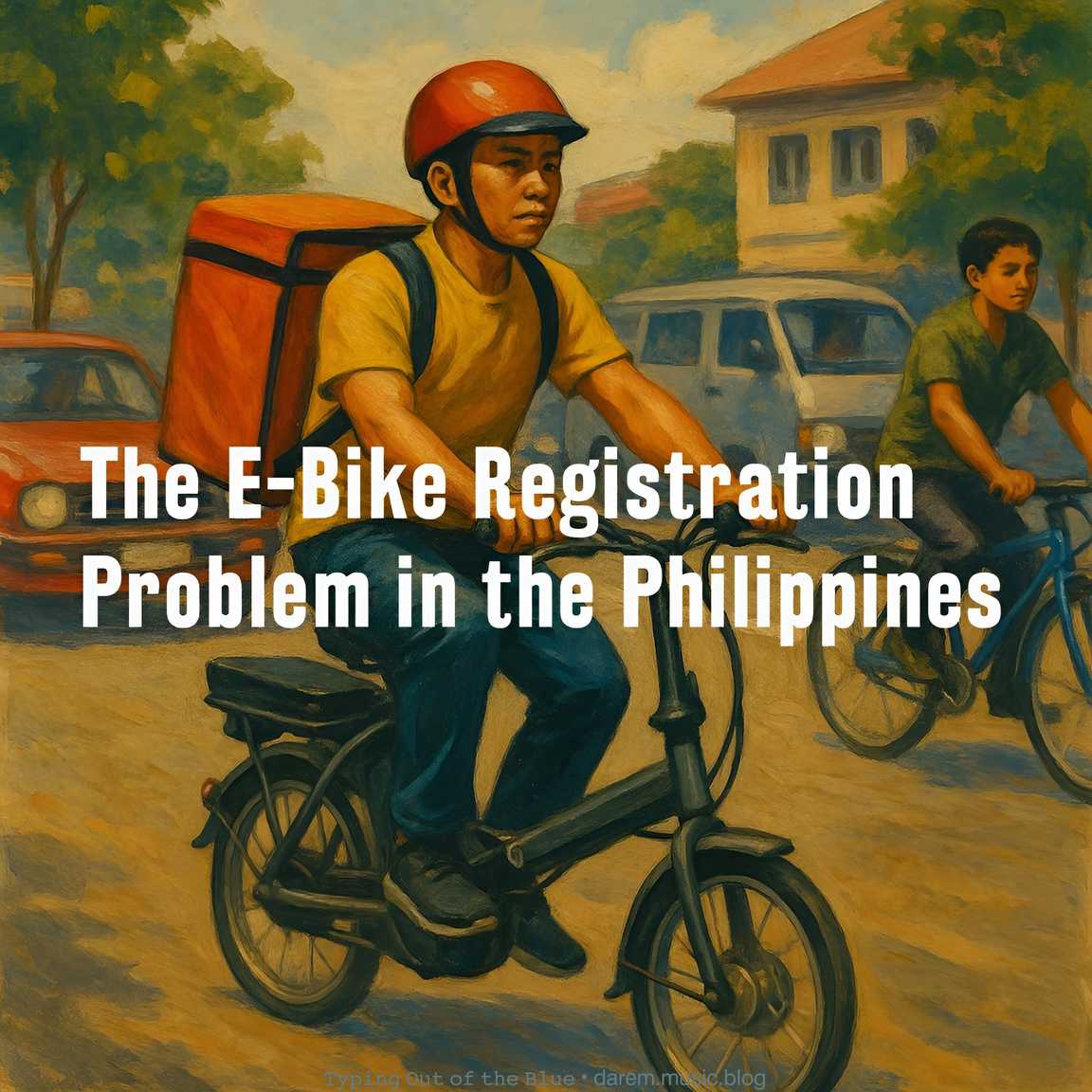
Most e-bikes in the Philippines are low-power. They are used for delivery, short rides, and daily work. High-power models are too expensive, so very few people use them. But the Land Transportation Office (LTO) still wants all e-bikes to be registered and their riders to get a license.
That idea caused confusion. The Metropolitan Manila Development Authority (MMDA) already banned some e-bikes from main roads. Then the LTO announced new registration rules—only to suspend them later because they were unclear. Now, no one really knows what the rule is.
The Real Issue
Low-power e-bikes are not the same as motorcycles. They move slower, carry light loads, and often don’t even have serial numbers or full documents. Treating them like motorcycles doesn’t make sense.
Because there are no clear power or speed limits, law enforcers make their own decisions. This opens the door for corruption. Every new rule in the LTO system can lead to “fixers,” special payments, or slow processing unless people pay extra.
How Other Countries Handle It
Europe
• E-bikes with a motor power of 250 W or less and a speed limit of 25 km/h are treated like bicycles—no registration or license needed.
• They can use bike lanes and normal roads where bicycles are allowed.
• Faster “speed pedelecs” must be registered, require a moped license, and riders must be at least 16 years old.
• Helmets and lights are mandatory for all road use.
United Kingdom
• The same 250 W / 25 km/h rule applies.
• Riders must be at least 14 years old to use electric-assist bikes (EAPCs) on public roads.
• No license, insurance, or registration is needed if the e-bike meets those limits.
• E-bikes can ride anywhere bicycles are allowed, including cycle lanes.
United States and Canada
• Most states and provinces follow a three-class system.
– Class 1 & 2 (pedal-assist or throttle up to 32 km/h): no registration or license required.
– Class 3 (up to 45 km/h): riders must be 16 or older, helmets required, and usually not allowed on bike lanes.
• Motors under 500–750 W count as low-power.
• Federal rules don’t require registration, but local states may set extra safety limits.
Asia
• Japan: Pedal-assist e-bikes under 300 W are treated as bicycles and can use roads and bike lanes. No license needed.
• Singapore: E-bikes up to 250 W / 25 km/h require helmets and a minimum age of 16.
• Philippines: Rules exist but lack clear power and speed limits. Registration may be required for public road use, depending on LTO guidelines.
What Should Be Done
• Set clear limits for power and speed so riders know if registration is required.
• Exempt low-power e-bikes from heavy paperwork and costs.
• Use online systems for registration to prevent fixers and bribery.
• Create safer lanes for e-bikes to reduce road accidents.
• Focus law enforcement on high-powered and unsafe vehicles, not the small ones used for daily work.
• Add clear age and safety rules—like helmet use, night lights, and proper training—without forcing every rider to get a full driver’s license.
The Bottom Line
The goal of any law should be safety and fairness. Most Filipinos use e-bikes because they can’t afford motorcycles or fuel. Making them register like big vehicles only adds burden and opens new chances for corruption.
Other countries already found balance. They allow low-power e-bikes on regular roads and bike lanes with simple rules—minimum age, helmets, and lights—without making riders go through expensive registration.
If the Philippines can adapt that kind of system, it will protect both riders and pedestrians without hurting those who just want to earn or go home safely.
⌨ ᴛʸᵖⁱⁿᵍ ᴏᵘᵗ ᵒᶠ ᵗʰᵉ ʙˡᵘᵉ ᵈᵃʳᵉᵐ ᵐᵘˢⁱᶜ ᵇˡᵒᵍ
