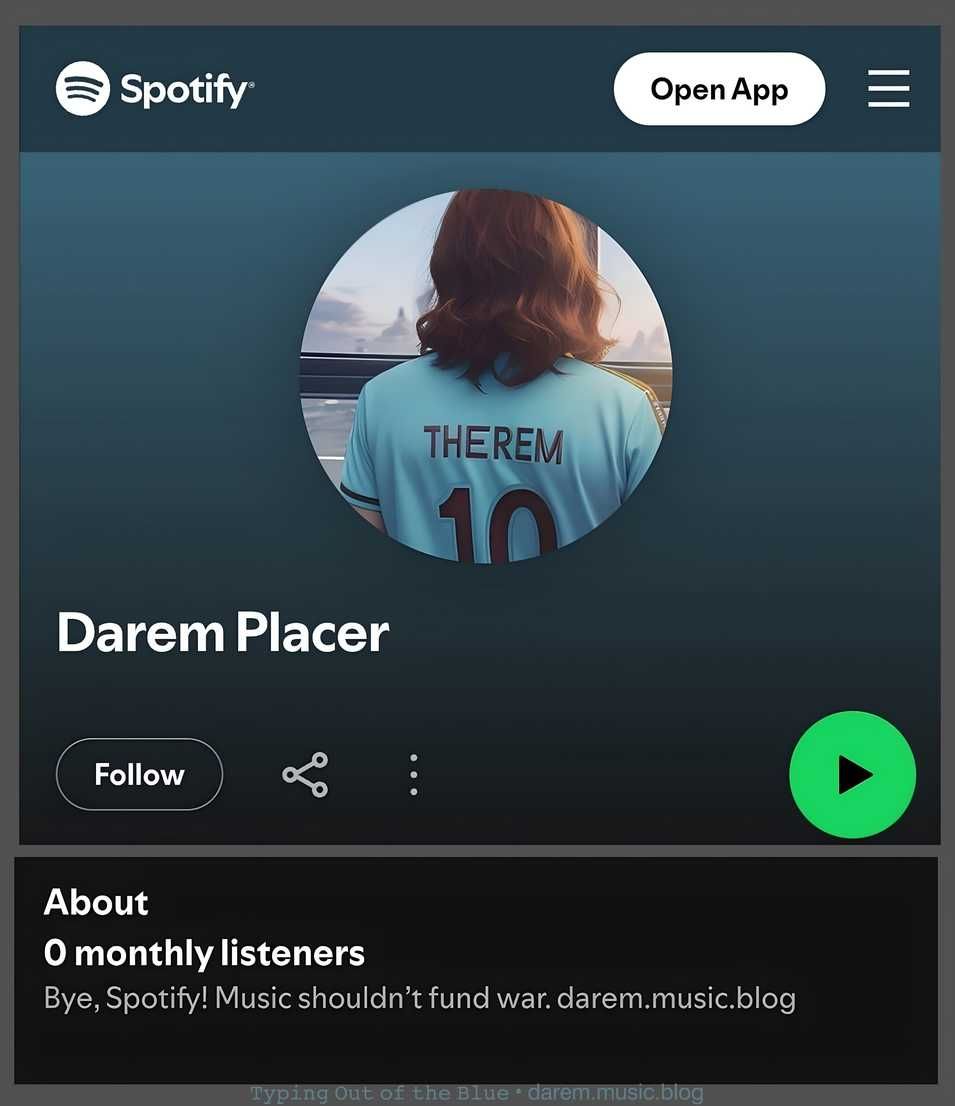
I already pulled all my music out of Spotify. So technically, I should not care anymore. I am no longer chasing streams, playlists, or numbers. I am out—free from the hustle and hassle.
But seeing how the system actually works—the unfairness, the strange logic, the quiet monkey business—I cannot stay silent. Being out does not mean being blind. This is why I still choose to speak, and why I believe Spotify deserves to be boycotted.
I did not leave Spotify with drama. No announcement. No rant. I just stopped.
Back then, I honestly thought the rule was harsher than it really was. I believed you had to hit 1,000 streams every single month. That would have been brutal. Anyone would call that unfair.
Later, I understood it better. It is not monthly. It is cumulative. A rolling twelve-month window. Hit 1,000 total streams anytime within a year, and the track becomes eligible.
Once that is clear, the rule feels manageable. One thousand streams is not a mountain. It is a few listens a day. If the music has direction and the artist actually moves—shares it, talks about it, shows up—it is doable.
So no, the rule is not unfair to artists who try.
What bothered me came after that.
If a track stays below 1,000 streams, the money from those listens does not wait. It does not pile up. It does not respect intent. It gets redirected. People listened to your music. The value was real. But the payout went somewhere else, to artists who were already above the line.
I agreed to that. Every artist did. We clicked yes because there was no other door. That makes it legal. It does not make it clean.
I come from a time when one album sold meant one artist supported. Even one buyer mattered. The exchange was simple and honest. Streaming changed that.
Now attention itself is currency. Even unpaid attention. Even tracks that earn nothing still feed the system—data, growth, market value. Your music may not pay you, but it still works for the platform. And the platform does not share your values. It shares its investors’ values.
That is where it started to feel wrong.
What pushed me to speak is deeper than streams or payouts. Spotify, directly or indirectly, helps fund Helsing (a European defense tech company developing AI systems for modern warfare). Once I saw that, the 1K debate stopped mattering.
Music is personal. Releasing it is a choice. I do not want my work contributing to something I fundamentally disagree with.
So this is not about numbers or payout formulas. It is about where the value generated by music ends up.
Boycotting Spotify, for me, is simply a line I chose to draw.
I would rather have fewer listeners and clean hands than wider reach.
That choice is not for everyone.
But it is mine.
🔲 UNINSTALL SPOTIFY.
🔲 BOYCOTT SPOTIFY.
🔲 CHOOSE PEACE.
⌨ ᴛʸᵖⁱⁿᵍ ᴏᵘᵗ ᵒᶠ ᵗʰᵉ ʙˡᵘᵉ ᵈᵃʳᵉᵐ ᵐᵘˢⁱᶜ ᵇˡᵒᵍ