Back in 1979, Pink Floyd shouted against the cold, strict school system: “We don’t need no education, hey teacher, leave them kids alone.” It was rebellion against rulers on hands, chalks thrown at heads, and teachers using fear instead of guidance. The song wasn’t against learning—it was against cruelty.
Roger Waters, who wrote the lyrics, used the double negative on purpose. It wasn’t bad grammar—it was rebellion. “We don’t need no education” sounds raw, fits the rhythm, and captures the street voice of protest. I think the point was not to say “stop going to school,” but telling the school to “stop killing creativity and be human.” Roger Waters aimed his words at oppression. My view looks at what happened after—when protest turned into practice.
Fast forward today—the protest became the policy. Schools are now pro-students, hyper-sensitive to emotions, and allergic to any form of harsh discipline. The wall of fear is gone, but what replaced it is a wall of fragility.
Gen X grew up tough, with scars to prove it. Gen Z grew up safe, with feelings front and center. Both carry weight—one endured too much, the other often escapes too soon.
So what happened when the system followed Pink Floyd’s song Another Brick in the Wall (Part 2)? Balance was lost. We moved from discipline without feelings to feelings without discipline. And that, too, is not good.
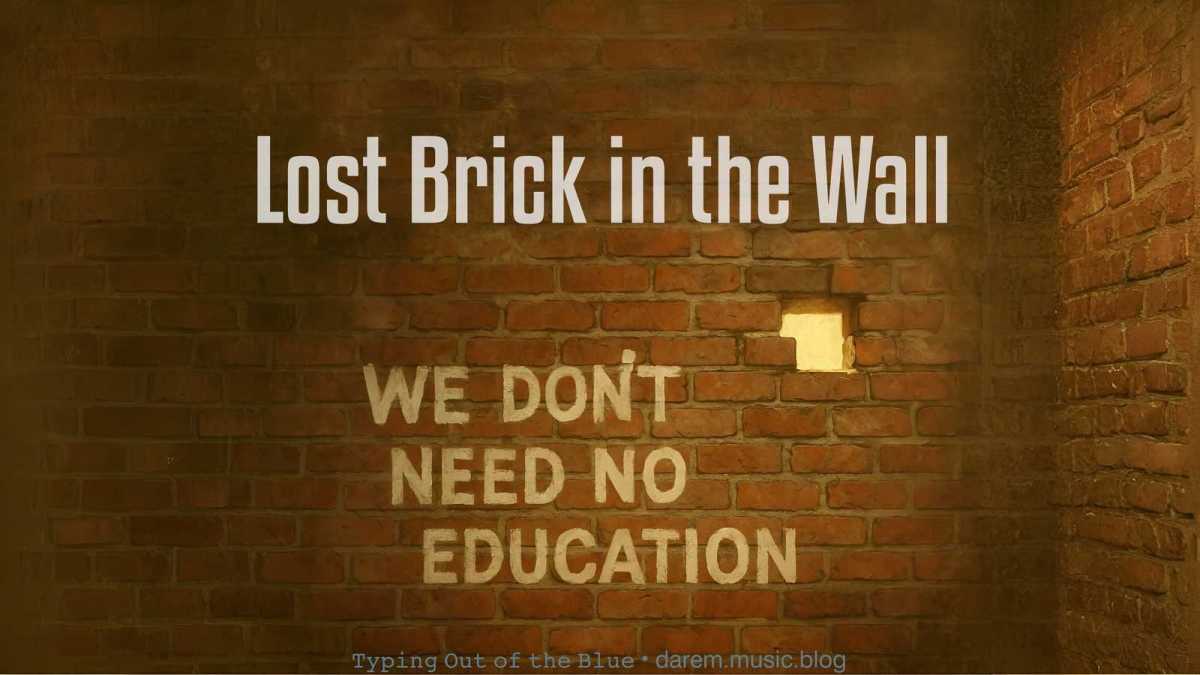
The irony? The song fought for creativity and humanity. Humanity was pushed, but creativity slipped away. Today, with AI doing the thinking for many students, the cry Pink Floyd started feels left unfinished—like a lost brick in the wall.
Another Brick in the Wall, Part 2
We don’t need no education
We don’t need no thought control
No dark sarcasm in the classroom
Teacher, leave them kids alone
Hey, teacher, leave them kids alone
All in all, it’s just another brick in the wall
All in all, you’re just another brick in the wall
We don’t need no education
We don’t need no thought control
No dark sarcasm in the classroom
Teachers, leave us kids alone
Hey, teacher, leave us kids alone
All in all, you’re just another brick in the wall
All in all, you’re just another brick in the wall
ᴛʸᵖⁱⁿᵍ ᴏᵘᵗ ᵒᶠ ᵗʰᵉ ʙˡᵘᵉ ᵈᵃʳᵉᵐ ᵐᵘˢⁱᶜ ᵇˡᵒᵍ