Trees Will Not Save Us—But They Still Matter

Climate change is not a planting problem. So what actually works?

There is a popular idea that says, “Plant more trees and climate change is solved.”

It sounds comforting. But it is not true.

No serious scientist ever said plants can save us from climate change.

What they said was simpler—and more honest: plants help, but only a little.

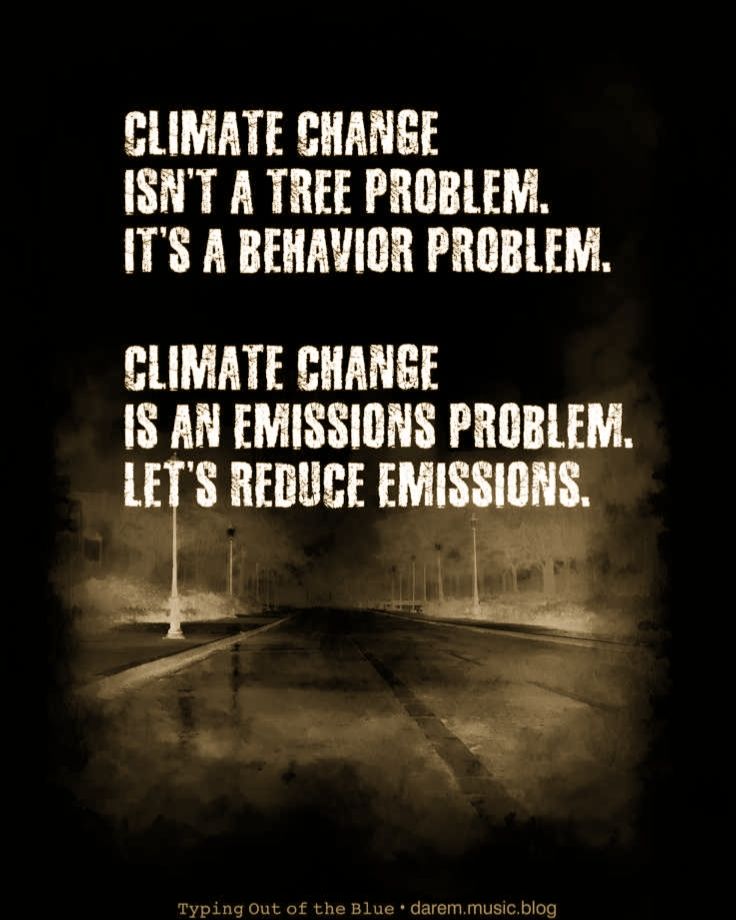
Climate change is an emissions problem.

It comes from fossil fuels, factories, transport, and endless consumption.

Trees cannot absorb carbon faster than humans release it. Even if the planet were filled with trees, as long as emissions continue, we still lose.

Recently, new studies showed that plants actually absorb less CO₂ than climate models once assumed¹.

This corrected an old belief that nature could take in more carbon as CO₂ levels rose.

But this is not the turning point some people think it is.

Even if the old belief were true—even if plants really could absorb much more CO₂—the impact on climate change would still be limited. Human emissions are simply too large and too constant for plants to offset in any meaningful way.

So the new finding does not change the conclusion.

It only removes a false sense of comfort that should never have existed.

So what is the real role of trees?

Trees are protectors, not saviors.

They:

  • limit floods
  • hold soil and prevent erosion
  • cool cities
  • protect water systems
  • reduce damage during storms

That is their true strength—local, physical, and immediate.

Think of trees as a shield, not a reset button.

They help us survive the impact—but they do not erase the cause.

So what is the easiest smart thing to do?

  • Use less electricity you do not need.
  • Drive less when walking or one short ride is enough.
  • Buy less, keep things longer.
  • Plant trees, but stop using them as excuses for bad habits.
  • Support rules that limit pollution, even when they are inconvenient.
  • Talk about climate change without panic or preaching—just facts.

Bottom line:

Plant trees, yes.

But cut emissions, always.

Nature helps us cope.

Only humans can choose to change.

¹ Kou-Giesbrecht, S., et al. Nitrogen limitation reduces the CO₂ fertilization effect. PNAS.
⌨ ᴛʸᵖⁱⁿᵍ ᴏᵘᵗ ᵒᶠ ᵗʰᵉ ʙˡᵘᵉ ᵈᵃʳᵉᵐ ᵐᵘˢⁱᶜ ᵇˡᵒᵍ

Digital Albums by Darem Placer on Bandcamp
Listen. Buy. Download.

COP30: What Countries Agreed On—the Good and the Bad

Countries made progress at COP30, but the final deal still left major gaps in the world’s climate response.

COP30 was held in Belém, Brazil, from November 10 to 21, 2025. For two weeks, countries talked about what the world should do next to deal with climate change. In the end, they created a plan called the Mutirão. It has some strong points—and some weak ones.

The Good Side—the helpful progress

Countries spent more time talking about adapting to climate change, not just reducing emissions. They agreed to triple the money for helping poorer countries deal with heatwaves, floods, storms, and unusual weather. This support should help people stay safe, protect their homes, and recover faster when disasters happen.

They also created a better system for checking progress. This means the world will know which countries are actually doing something—and which ones are only making promises.

Another positive step: countries officially agreed on the idea of a “just transition.” This means that when the world shifts to clean energy, workers and communities should not lose their jobs or get left behind.

Indigenous groups—especially important in the Amazon—had a stronger voice. Their knowledge about forests and nature was included in the final plan.

The Bad Side—the parts that did not improve

The biggest problem was simple: countries did not agree on a plan to slowly stop using fossil fuels like coal, oil, and gas.

Many leaders wanted a clear decision, but some powerful countries blocked it. Because of this, the final message became soft and unclear. This was a major disappointment because fossil fuels are the main cause of global warming.

Some parts of the agreement were also too vague. They sound nice, but they don’t have exact steps or exact deadlines—which means progress could stay slow and uneven.

The usual divide between rich countries and vulnerable countries also continued, mostly about money and support. Funds were promised again, but poorer nations want to see real action, not just speeches.

The Overall Result

COP30 made progress in areas like adaptation, fairness, and tracking real action. But the world expected more—especially because the summit was held in the Amazon, a place that shows how serious climate change has become.

COP30 moved things forward. But it wasn’t the big breakthrough people were hoping for.

⌨ ᴛʸᵖⁱⁿᵍ ᴏᵘᵗ ᵒᶠ ᵗʰᵉ ʙˡᵘᵉ ᵈᵃʳᵉᵐ ᵐᵘˢⁱᶜ ᵇˡᵒᵍ

👉 Download Sky-Low on Bandcamp

💿 Just type 0 if you want to download the album for free.

Sky-Low
“Sky-Low” is not just an album—it’s an awareness campaign about climate change and a challenge to protect our planet.