Saint John Damascene and the Miracle of the Restored Hand

A monk in 700s Damascus loses his hand, prays through the night, and wakes with a miracle that shapes his whole mission.

John Damascene lived in the early 700s in Damascus, a major city in the Umayyad Caliphate (present-day Syria). At that time, the Christian world was divided over the use of holy images. John defended icons through clear, steady writing that reached far beyond his city.

But his words angered Emperor Leo III of Constantinople in the Byzantine Empire. Around 720–730 AD, the emperor forged a letter that made it look like John was plotting against Damascus. The forged letter reached the Umayyad ruler, who believed it.

Without trial or explanation, the ruler ordered that John’s right hand—his writing hand—be cut off. The punishment was carried out in public. His hand was displayed to show the sentence had been done.

John brought the severed hand back to Mar Saba Monastery near Jerusalem. He placed it before an icon of Mary and prayed through the night. His prayer was simple: that he might write again.

By morning, the monks found something impossible. John’s hand was fully restored—joined back to his arm without any sign of injury. It was warm, living, and able to move as before.

When the Umayyad ruler saw the restored hand, he realized the accusation had been false. He reversed the sentence and apologized. But John didn’t return to public service. Instead, he devoted his life completely to prayer, teaching, and writing inside the monastery.

To remember the miracle, John added a silver hand to the icon of Mary. This icon became known as Our Lady of the Three Hands, and it still exists today.

The story spread not because it was dramatic, but because it felt unmistakably real to the people who saw it: a man losing everything, praying in the dark, and waking up with a restored hand in a way no one could explain.

⌨ ᴛʸᵖⁱⁿᵍ ᴏᵘᵗ ᵒᶠ ᵗʰᵉ ʙˡᵘᵉ ᵈᵃʳᵉᵐ ᵐᵘˢⁱᶜ ᵇˡᵒᵍ
Traces of courage, silence, and sacrifice—this is Saints.

Listen on Apple Music, Apple Music Classical, and YouTube Music
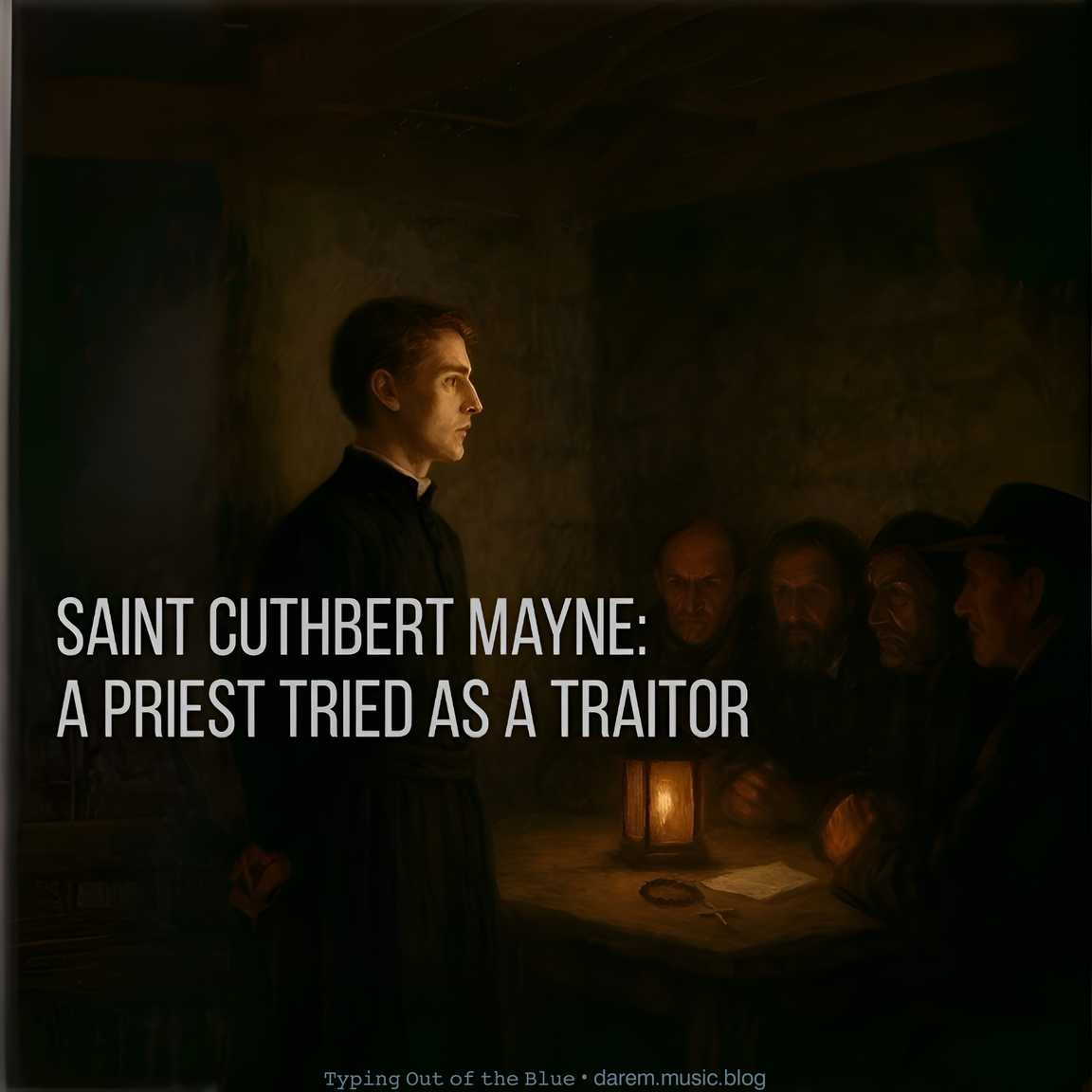
Saint Cuthbert Mayne: A Priest Tried as a Traitor

He lived in a time when being a Catholic priest was treated as disloyalty, yet he stood firm and chose faith over fear.

Cuthbert Mayne was an English priest who lived during a time when the government treated Catholic priests as criminals. He was born in Devon, England, around 1544 and studied at Oxford, England, where he first served as a Church of England minister. Later, after meeting Catholics who quietly kept the old faith alive, he left England and went to the English College at Douai—a town that was then part of the Spanish Netherlands, a Catholic territory ruled by Spain (today it belongs to France). There he became a Catholic priest.

In 1576, he returned secretly to England. His mission was simple: bring the sacraments to Catholics who could not worship publicly, offer Mass in homes, strengthen families in their faith, and help them stay hopeful in a dangerous time. He moved quietly from house to house across southern England, always careful, always exposed to danger.

After a year, he was arrested. The government charged him not with any violent act, but with the “crime” of being a Catholic priest trained abroad. At that time, the law was extremely harsh. Admitting that you were a priest was automatically treated as disloyalty to the Crown, even if you were innocent of everything else. Because of this, the authorities did not ask simple questions like “Are you a priest?” They asked loaded questions designed to make him look like a political enemy.

A typical question was framed like this: “Are you a seminary priest sent by the Pope to turn the Queen’s subjects away from her?”

This was not a religious question—it was a political accusation. Saying “yes” meant admitting to a rebellion you never planned. Saying “no” did not deny the faith. It simply rejected the false accusation. The court still needed “evidence,” which is why small items like a rosary or a papal document were used against him. Under the law, even these objects could be twisted into proof that he was working against the authorities.

Father Cuthbert was convicted and sentenced to death. He was executed at Launceston, England, on November 29, 1577. And this is where his courage becomes clear. At the moment of execution, when no legal tricks remained and no questions could trap him, he declared the full truth. He professed his Catholic faith, affirmed that he was a priest, forgave his accusers, and faced death calmly.

His death became historic. He was the first seminary priest from the English College at Douai to be martyred in England, opening a long line of English martyrs who chose faith over fear.

He is honored as a saint because he stayed faithful even when the law treated his mission as a crime. He never denied Christ or the priesthood that shaped his life. He rejected only the political trap placed on him, not the truth he lived for. In the final moment, he chose courage over survival.

He was canonized in 1970 as one of the Forty Martyrs of England and Wales.

⌨ ᴛʸᵖⁱⁿᵍ ᴏᵘᵗ ᵒᶠ ᵗʰᵉ ʙˡᵘᵉ ᵈᵃʳᵉᵐ ᵐᵘˢⁱᶜ ᵇˡᵒᵍ

Traces of courage, silence, and sacrifice—this is Saints.

Listen on Apple Music, Apple Music Classical, and YouTube Music