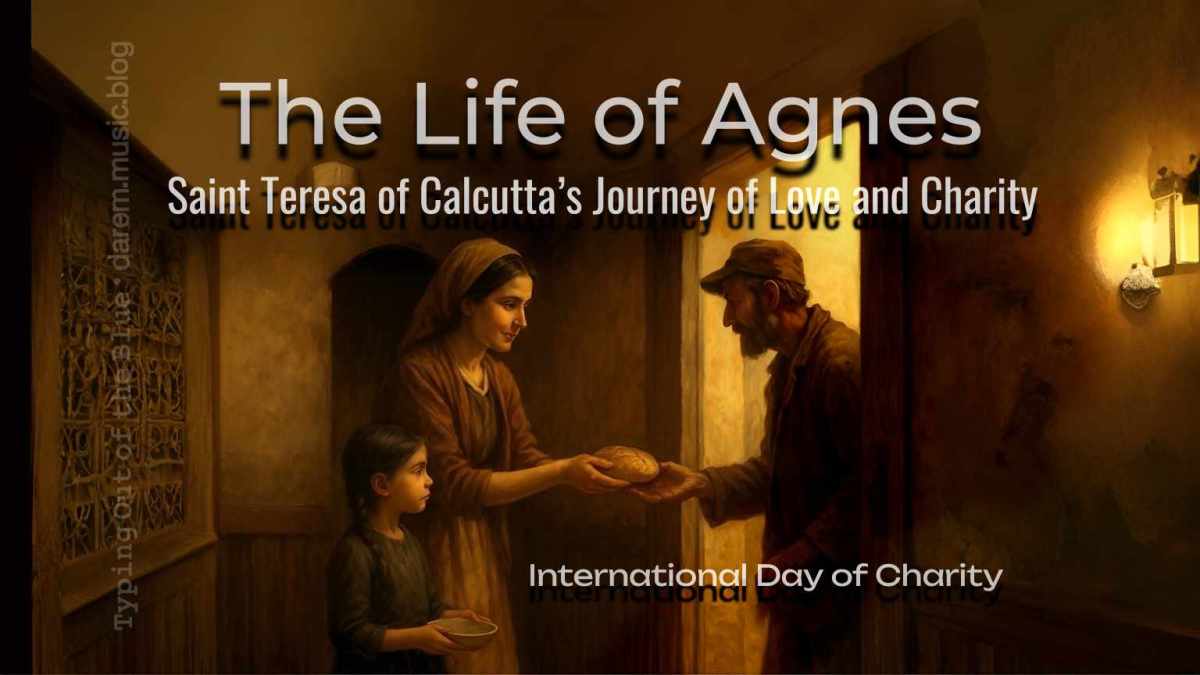
Saint Teresa of Calcutta’s Journey of Love and Charity
Before she was called Mother Teresa, she was Agnes Gonxha Bojaxhiu—born on August 26, 1910, in Skopje, a small city in what is now North Macedonia. She grew up in a Catholic family where generosity was a way of life. Her mother, Drana, often welcomed the poor into their home. Agnes once recalled her words: “My child, never eat a single mouthful unless you are sharing it with others.” That simple rule of love shaped her forever.
As a teenager, Agnes joined the Sodality of the Blessed Virgin Mary in her parish, visiting the sick and helping the poor. By age 12, she already felt a call to serve God as a missionary. At 18, she left home to join the Sisters of Loreto. First, she went to Ireland to learn English. Then she traveled to India, where she taught at St. Mary’s School in Calcutta. Her students loved her, but her heart was drawn to the people outside the classroom walls.
In 1946, during a train ride, she experienced what she later called her “call within a call”: God asking her to serve the poorest of the poor. Two years later, in 1948, she stepped out wearing a simple white sari with a blue border. That sari became her lifelong uniform of love.
In 1950, she founded the Missionaries of Charity, an order dedicated to serving the sick, the dying, and the abandoned. What began with a handful of sisters grew into thousands working in over a hundred countries.
Her work did not go unnoticed. She received the Nobel Peace Prize in 1979, but accepted it “in the name of the poor.” She often said, “Not all of us can do great things. But we can do small things with great love.”
Even as her health declined in the 1980s and 1990s—with heart problems, pneumonia, and broken bones—she never stopped serving. On September 5, 1997, at age 87, she passed away in Calcutta. Nineteen years later, on September 4, 2016, Pope Francis canonized her as Saint Teresa of Calcutta, fixing her feast day on September 5.
The girl named Agnes, who once shared meals with strangers at her family table, had become a mother to the world’s forgotten. That’s why the International Day of Charity, observed every September 5, does more than honor her memory. It calls us to live the truth she carried from childhood to sainthood: charity begins with a single act of love, and grows when we choose to share it.
𝚃𝚢𝚙𝚒𝚗𝚐 𝙾𝚞𝚝 𝚘𝚏 𝚝𝚑𝚎 𝙱𝚕𝚞𝚎 • 𝖽𝖺𝗋𝖾𝗆.𝗆𝗎𝗌𝗂𝖼.𝖻𝗅𝗈𝗀
In a world drowning in noise and division, they embraced silence and unity. No fear. No turning back. Just love…

Listen on Apple Music, Apple Music Classical, and YouTube Music