Dark Night

Walking through spiritual darkness, letting go of attachment, and trusting love when sight and certainty are gone.

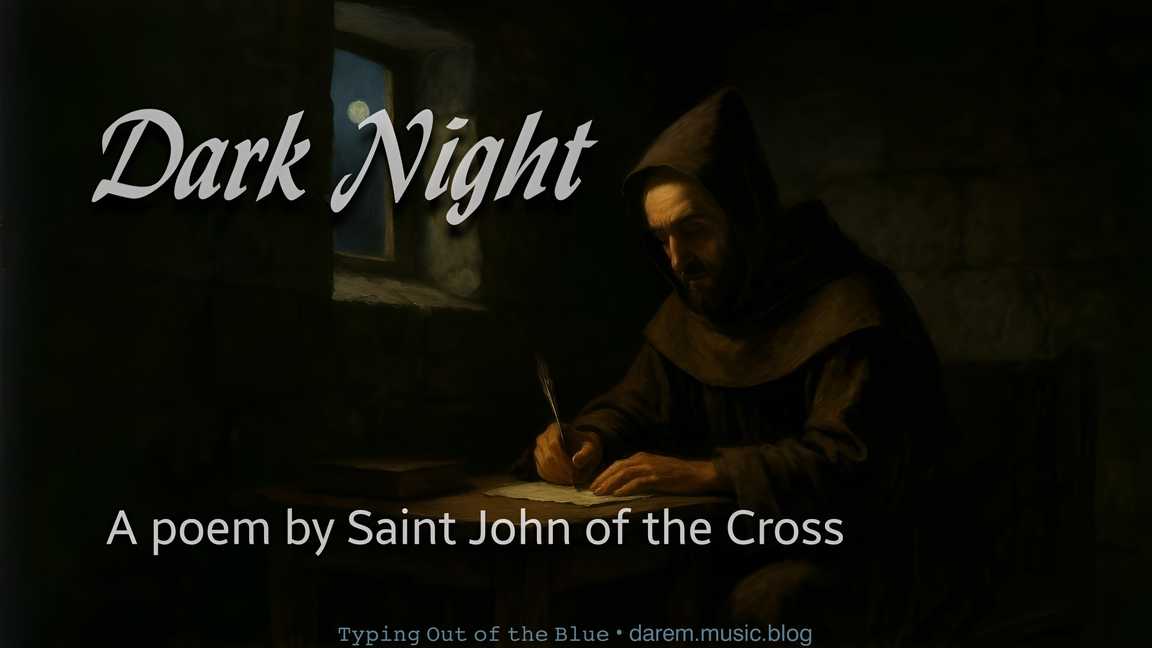
Saint John of the Cross was a Spanish Carmelite friar and poet who lived in 16th-century Spain. Long before his spiritual writings were studied, he expressed his deepest experiences of God through poetry, written in his native Spanish and shaped by prayer, silence, and suffering.

“Dark Night” is one of his most well-known poems, later translated into English. It reflects the inner journey of detachment—the quiet letting go of comfort, certainty, and even spiritual consolation. The darkness he writes about is not despair, but trust. A passage where love moves forward without relying on sight or feeling.

Dark Night
by Saint John of the Cross

On a dark night,
fired with love’s urgent longings—
ah, the sheer grace!—
I went out unseen,
my house being now all still.

In darkness and secure,
by the secret ladder, disguised—
ah, the sheer grace!—
in darkness and hidden,
my house being now all still.

In that happy night,
in secret, for no one saw me,
nor did I look at anything,
with no other light or guide
than the one that burned in my heart.

This light guided me
more surely than the noon-day sun
to where He waited for me—
Him I knew so well—
in a place where no one else appeared.

O night that guided me,
O night more lovely than the dawn,
O night that joined
Beloved with lover,
lover transformed in the Beloved.

Upon my flowering breast,
which I kept wholly for Him alone,
there He lay sleeping,
and I caressed Him,
and the breeze from the fanning cedars refreshed Him.

As I fanned Him,
with my hand upon His neck,
the breeze blew from the turret,
and as He felt it,
He slept peacefully, and I remained lost.

I stayed and forgot myself,
my face resting on the Beloved.
All things ceased.
I left myself behind,
forgotten among the lilies.

⌨ ᴛʸᵖⁱⁿᵍ ᴏᵘᵗ ᵒᶠ ᵗʰᵉ ʙˡᵘᵉ ᵈᵃʳᵉᵐ ᵐᵘˢⁱᶜ ᵇˡᵒᵍ

Merely Christmas • Darem Placer
Out this season on Bandcamp.

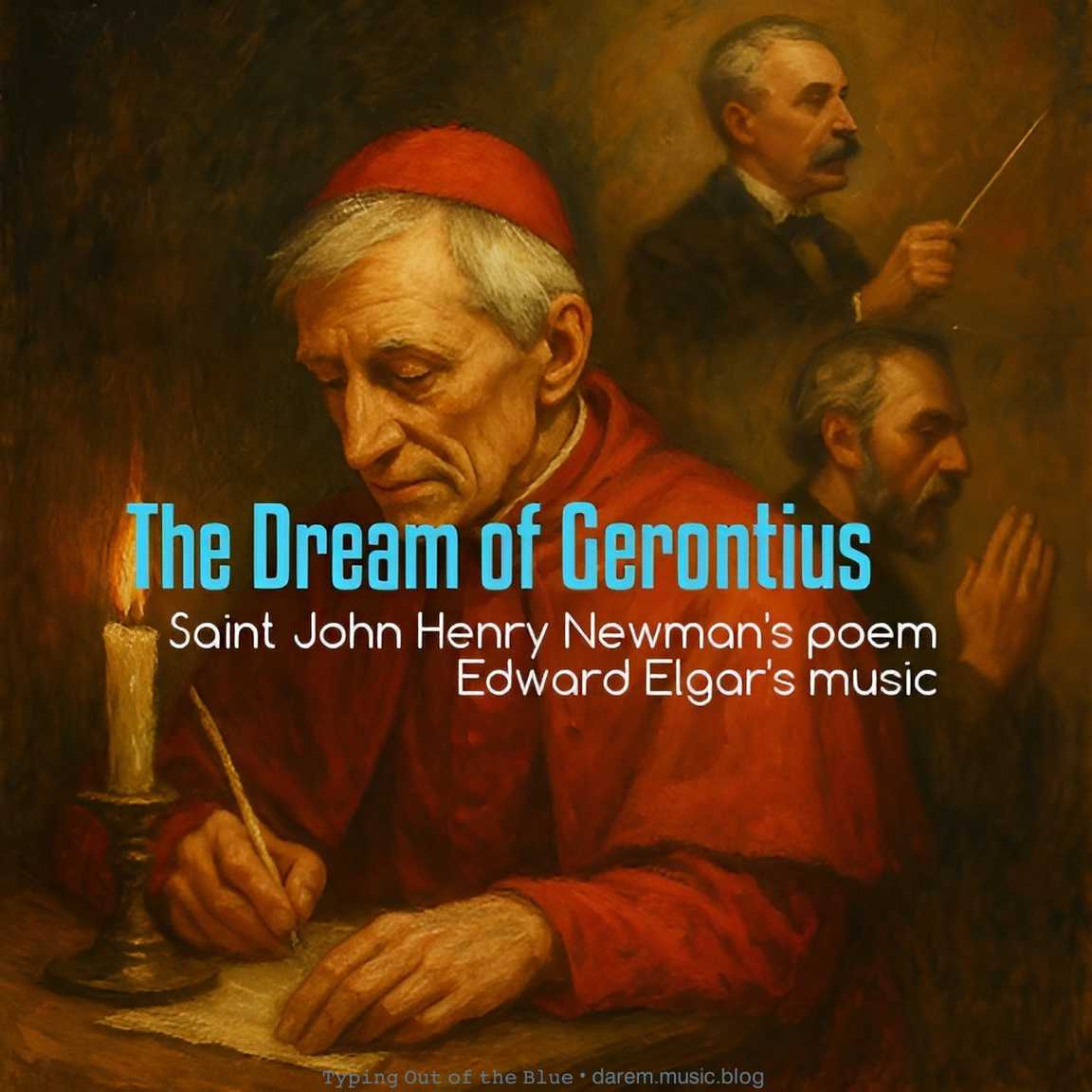
The Dream of Gerontius

A dying man’s dream becomes a journey of light—Newman’s vision of the soul reborn through Elgar’s music.

Saint John Henry Newman wrote The Dream of Gerontius in 1865—after years of searching for truth that led him from the Church of England to the Catholic faith. He wasn’t trying to impress scholars. He was trying to understand what happens when the soul lets go.

This poem became his answer. It tells the journey of one dying man, Gerontius, whose dream reveals what every heart quietly fears yet secretly longs for—the moment we meet God.

🕯 Part 1 – The Last Breath

Gerontius is dying. His friends pray. The priest whispers the old words of faith. Fear mixes with peace.

He knows he’s small before eternity, but still he trusts. The angels begin to move. Heaven is already near.

🌌 Part 2 – The Soul’s First Light

He opens his eyes again—but now as a soul. No pain, no weight, just wonder.

His Guardian Angel is there, calm and strong, guiding him past mocking voices and into waves of angelic song. Each sound brings him closer to the Light that no one can fully describe.

☀️ Part 3 – The Gaze of God

Then silence. One glimpse of God—and it’s too much beauty to bear. Gerontius cries out in love and awe.
He asks to be purified before he can stay in that Presence. The Angel holds him and whispers rest, carrying him into Purgatory where healing begins.

🎶 From Poem to Symphony

Decades later, Edward Elgar gave Newman’s vision a voice. His oratorio The Dream of Gerontius turned the poem into living sound—music that trembles, soars, and finally falls into peace.

Newman imagined it. Elgar let the world hear it.

The Dream of Gerontius by Sir Edward Elgar
Live from the BBC Proms, 24th July 2005.
Halle Orchestra conducted by Mark Elder
Allice Coote (Mezzo-soprano)
Paul Groves (Tenor)
Matthew Best (Bass)
Halle Choir
London Philharmonic Choir
Halle Youth Choir

⌨ ᴛʸᵖⁱⁿᵍ ᴏᵘᵗ ᵒᶠ ᵗʰᵉ ʙˡᵘᵉ ᵈᵃʳᵉᵐ ᵐᵘˢⁱᶜ ᵇˡᵒᵍ