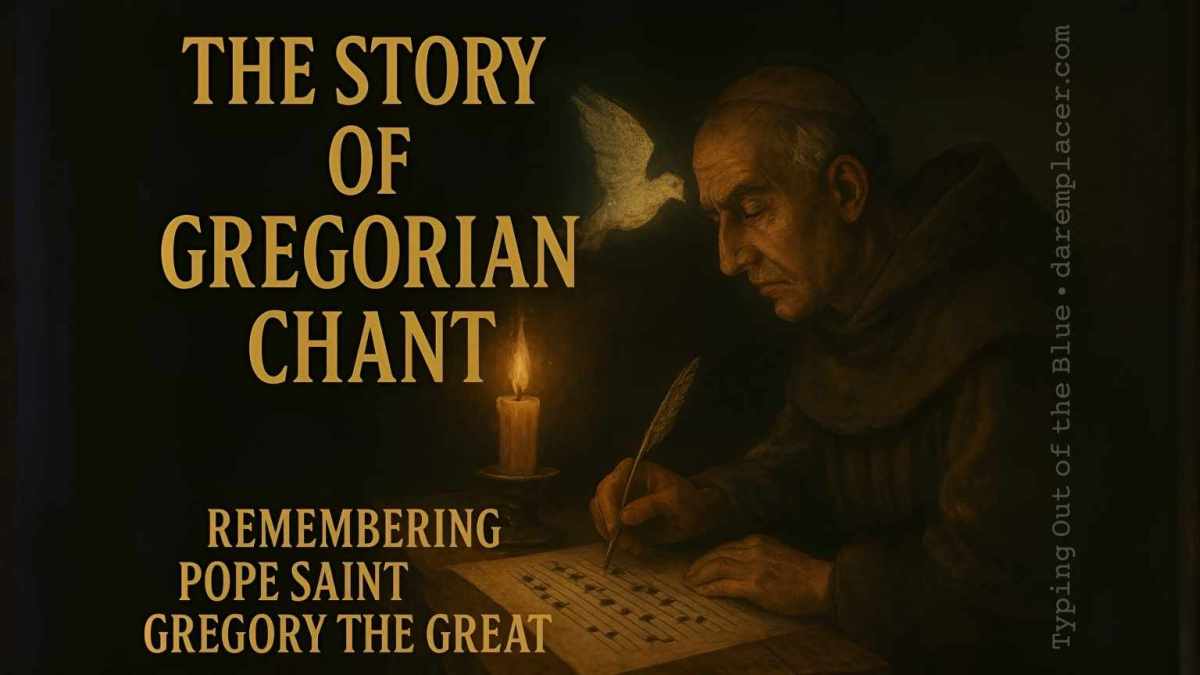
Remembering Pope Saint Gregory the Great
When we look back at the history of music, one name rises from the early centuries—Gregorian chant. Many call it the first written music in the Western world. The starting point. The ground where everything else would later grow.
But why is it called Gregorian? The answer takes us to Pope Saint Gregory the Great (590–604 AD), a leader remembered not only for guiding the Church but also for shaping how worship would sound for centuries.
One Voice
In Gregory’s time, the Church sang in many different ways. Each region had its own melodies, its own flow. Beautiful, but scattered. Gregory dreamed of unity. He began to collect and arrange the chants, giving them order, and teaching the Church to sing with one voice. He even founded a school of singers in Rome—the schola cantorum—to carry this vision forward.
The Dove
A legend tells us that Gregory wrote while a dove whispered in his ear—the Holy Spirit guiding him note by note. Maybe he didn’t actually compose the melodies himself, but the story captures something true: people felt this music was not just human, but divine.
More Than Sound
Gregorian chant was prayer in melody. One pure line of sound, sung together in unison. No instruments, no extra layers—just voices moving as one, carrying words of Scripture. In monasteries and cathedrals, this music shaped the rhythm of worship and the soul of a people.
Why It Matters
To remember Pope Gregory is to remember a beginning. Gregorian chant is not just old music—it is the seed from which Western music grew. Every symphony, every song, in some way traces back to these simple lines sung in stone halls long ago.
At the heart of it was a man who wanted unity, who listened for the Spirit, and who left us the gift of a music that still whispers of heaven. And every September 3, the Church remembers him—not only as a pope and a saint, but as the one whose name became forever linked with the first music of the West.
That spirit of pure melody still speaks today. One of my own pieces, Yearning Thoughts from Voices Across the Field, carries a trace of that same yearning. It’s not Gregorian chant, but it feels like a modern echo of it.
For the rest of the album Voices Across the Field, you can listen on Apple Music and Apple Music Classical

𝚃𝚢𝚙𝚒𝚗𝚐 𝙾𝚞𝚝 𝚘𝚏 𝚝𝚑𝚎 𝙱𝚕𝚞𝚎 • 𝚍𝚊𝚛𝚎𝚖𝚙𝚕𝚊𝚌𝚎𝚛.𝚌𝚘𝚖
