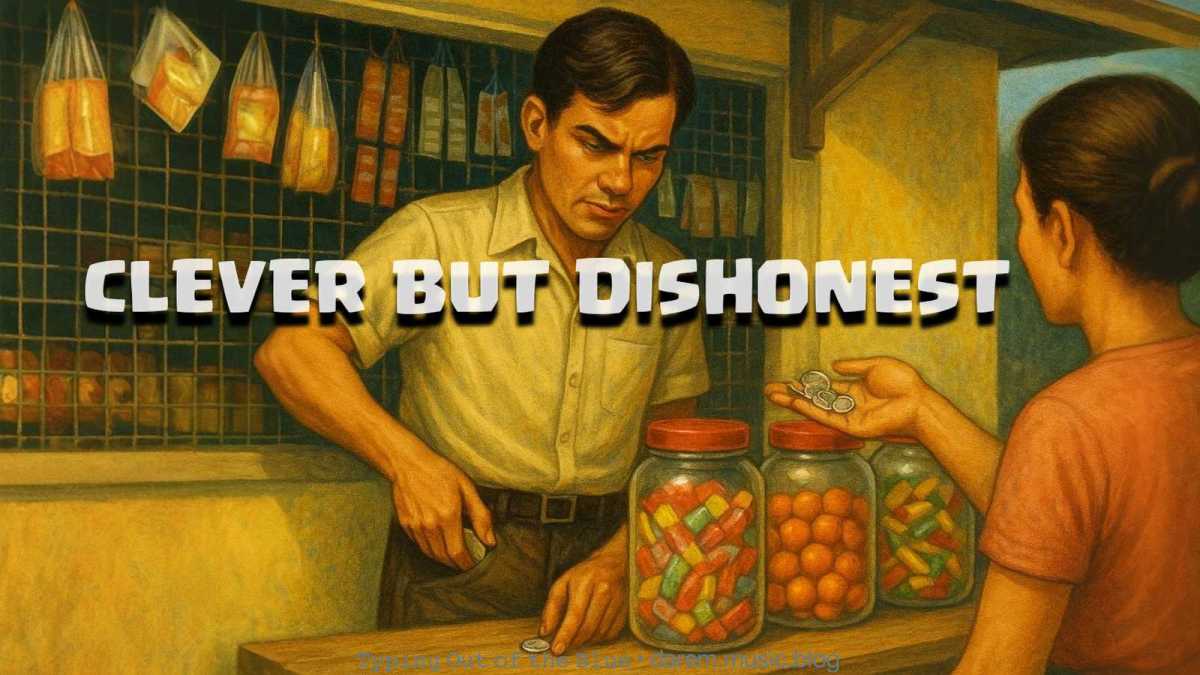
Clever but Dishonest

He thought quick tricks could save him, but where does corruption always end?

In a small store, candy really costs ₱5. But the helper tells customers, “That’s ₱6,” and slips the extra peso into his pocket. It’s small enough not to be noticed—like loose change rolling on the floor.

One day, the store owner finds out: “You can’t keep working like this. Bring me the logbook—you’re done here.”

The helper panics. Before losing his job, he changes his plan. To the customers he says, “Good news—candy is only ₱5 today. Don’t tell the owner, it’s my special discount for you.”

The customers are happy. The helper is still fired. But when the owner hears what he did, he shakes his head with a half-smile: “Clever move, you crook.”

He didn’t fix his life. He only fixed his trick. Smart, yes—but still dishonest.

This is the same in the Parable of the Dishonest Steward. A steward was caught pocketing part of what people owed his master and was about to lose his job. To secure his future, he quickly called in the debtors and cut their bills—one who owed a hundred jars of oil was told to write fifty, and one who owed a hundred measures of wheat was told to write eighty. The master found out and admired the steward’s clever thinking, not the evil he had done.

The lesson is not “be like him.” The lesson is: don’t waste your chance. He cared more about money than about doing right—and in the end, money will not really save him. He lost his job, his honor, and his soul. Corruption might look clever for a while, but it always fails.You cannot serve both God and money”—but you know it’s never right to center our life on money.

ᴛʸᵖⁱⁿᵍ ᴏᵘᵗ ᵒᶠ ᵗʰᵉ ʙˡᵘᵉ ᵈᵃʳᵉᵐ ᵐᵘˢⁱᶜ ᵇˡᵒᵍ

Hate to Love

Jesus says something that sounds impossible: “Hate your parents? Hate your own life?” It feels harsh, but behind those words is the hard truth that makes love real.

The Hard Truth That Makes Love Real

If you’ve read the Bible, you may have stumbled on this line: “If anyone comes to me and does not hate father and mother, wife and children, brothers and sisters—yes, even their own life—such a person cannot be my disciple” (Luke 14:26).

“Hate your parents? Hate your own life? That sounds crazy.”

So what did He really mean?

Jesus wasn’t attacking family. He was making a point: even the strongest love you know can’t take first place over Him.

At first, it feels impossible. But He wasn’t saying “hate” as in anger or disrespect. He was saying: don’t let even your closest ties pull you away from what’s most important.

Because love bends when it takes the wrong shape. It turns into control. Into jealousy. Into fear of losing. That’s not real love—it’s love gone heavy.

Picture it like a ladder. Family, friends, even yourself—those are the steps. But if God isn’t the top, you stop halfway. You think it’s enough. But it gets tiring. It doesn’t reach higher.

Take this example: a father who steals to feed his children. On the surface, it looks like love. His kids even defend him, saying, “He only did it so we could eat.” But that’s misdirected love. It breaks God’s truth for the sake of family. It feels justified, but it isn’t. That kind of love may solve hunger for a day, but it plants harm that lasts far longer.

When God isn’t the center, love becomes fragile. It may shine for a while, but it slips into possession, jealousy, or fear—and in the end, it chokes the very people it tries to hold.

Without God, love burns out. It clings. It demands too much. It asks people to fill a space only He can fill. And no one can carry that weight.

With God first, love breathes. You can hold without choking. Give without drowning. Care without turning anyone into a “god.”

That’s why Jesus used a hard word. Not to tear family apart. But to wake us up.

So what’s the takeaway? Real love only survives when God is above everything else. That’s the only way it stays pure, strong, and free.

𝚃𝚢𝚙𝚒𝚗𝚐 𝙾𝚞𝚝 𝚘𝚏 𝚝𝚑𝚎 𝙱𝚕𝚞𝚎 • 𝖽𝖺𝗋𝖾𝗆.𝗆𝗎𝗌𝗂𝖼.𝖻𝗅𝗈𝗀