Virtual Jesus: Silence, Curiosity, and the Strange New World of AI Faith

Curiosity met silence-breaking answers as AI entered faith—reminding people of God in the strangest way.

When people pray, they often meet silence. Faith has always asked us to wait, to trust, to listen in the quiet. But today, something unusual appeared: a Virtual Jesus booth in Switzerland, and even an AI-led church service in Finland. Suddenly, the silence feels broken—there are instant answers, like chatting with God through a screen.

Many people lined up out of curiosity, not desperation. Some walked out touched, others walked out weirded out. That’s the fuss: for the first time, technology pretends to speak as Jesus.

Is it replacing priests and pastors? Not yet. The booth was an art experiment, the service was a demo. But it does reveal something deep: people crave conversation with the divine. They want responses, not just silence.

Critics say it’s shallow, generic, even dangerous. But let’s be honest: even Bible studies today often rely on Google or AI for notes. Theologians debate, small groups share personal opinions, and most people research with the same tools—just dressed in tradition. Depth doesn’t come from the source, but from the heart that receives it.

Think about how we’ve researched through the years:

• Library days — one encyclopedia could limit your world.

• Google days — endless links, you pick what feels right.

• AI days — neat summaries, but unpopular views get erased.

It’s like food from a stranger: don’t swallow everything, test first. Wisdom is not in the tool, but in discernment.

And here’s a reality check: the AI Jesus booth in Lucerne, Switzerland was never meant as a permanent confessional. It was created by a Catholic parish team with artists and tech researchers, designed as a conversation starter—not as sacrament, not as blasphemy. By late 2024, it was already taken down. But the idea didn’t die: other experiments keep surfacing, like the AI-led Lutheran service in Finland or online “Jesus chatbots” appearing around the world.

And maybe that’s the secret gift here. An AI Jesus, as strange as it sounds, didn’t really pull people away from God. If anything, it pushed them closer. It reminded them of faith, sparked questions, and maybe even opened space for prayer again.

So yes, it’s weird. Yes, it’s risky. But if it leads someone back to wonder about God, then maybe even a machine can point toward heaven—just not replace it.

ᴛʸᵖⁱⁿᵍ ᴏᵘᵗ ᵒᶠ ᵗʰᵉ ʙˡᵘᵉ ᵈᵃʳᵉᵐ ᵐᵘˢⁱᶜ ᵇˡᵒᵍ

Praying Without Words, the album is on Apple Music and YouTube Music.

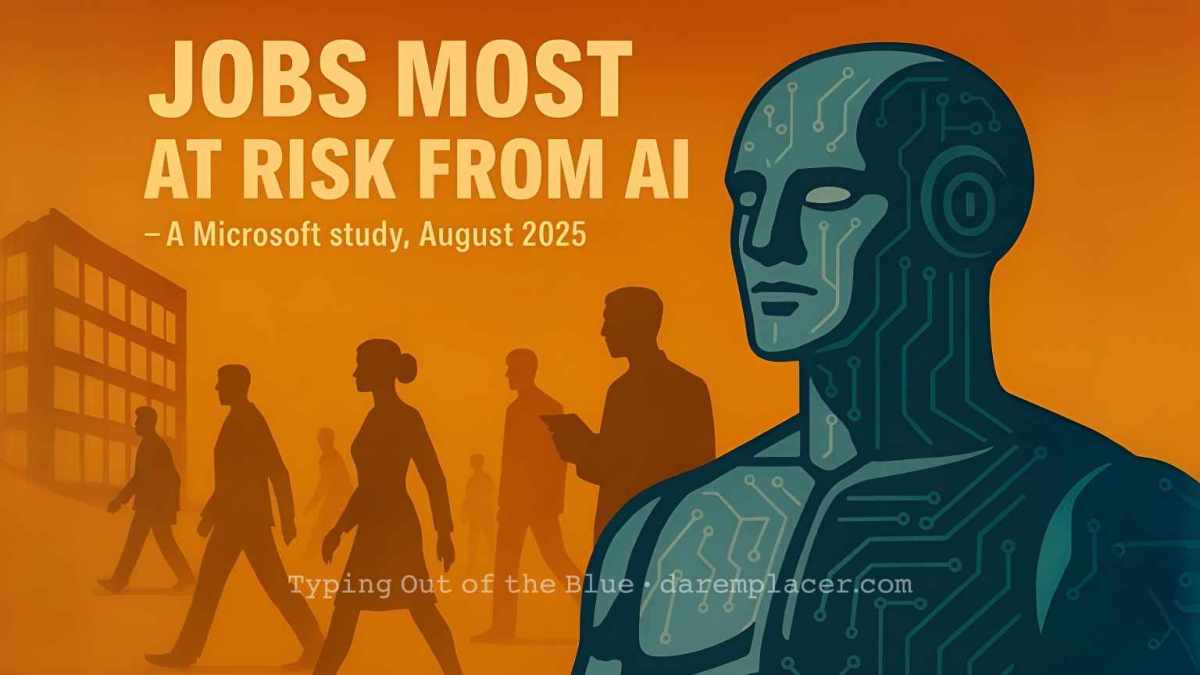
Jobs Most at Risk from AI

AI is changing the way people work. A Microsoft study shows which jobs are most at risk—and which ones may still be safe.

—A Microsoft study, August 2025

AI isn’t coming for every job—but for some, it’s already knocking. A new Microsoft study reveals which roles face the most risk, and which remain safer for now.

Jobs Most Affected by AI (alphabetical order)

These jobs depend on writing, communication, or analysis—areas where AI already performs strongly:

• Advertising sales agents
• Broadcast announcers and radio DJs
• Brokerage clerks
• CNC tool programmers
• Concierges
• Customer service representatives
• Data scientists
• Demonstrators and product promoters
• Editors
• Farm and home management educators
• Historians
• Hosts and hostesses
• Interpreters and translators
• Management analysts
• Market research analysts
• Mathematicians
• News analysts, reporters, and journalists
• Passenger attendants
• Political scientists
• Postsecondary business teachers
• Proofreaders and copy markers
• Public relations specialists
• Sales representatives (services)
• Technical writers
• Telemarketers
• Telephone operators
• Ticket agents and travel clerks
• Web developers
• Writers and authors

Jobs Least Affected by AI (alphabetical order)

These roles require hands-on skills, physical presence, or a human touch:

• Bridge and lock tenders
• Cement masons and concrete finishers
• Dishwashers
• Dredge operators
• Floor sanders and finishers
• Foundry mold and coremakers
• Gas compressor and pumping station operators
• Helpers-roofers
• Industrial truck and tractor operators
• Logging equipment operators
• Machine feeders and offbearers
• Massage therapists
• Medical equipment preparers
• Motorboat operators
• Ophthalmic medical technicians
• Orderlies
• Packaging and filling machine operators
• Pile driver operators
• Rail-track maintenance equipment operators
• Roofers
• Roustabouts, oil and gas
• Supervisors of firefighters
• Surgical assistants
• Tire builders
• Water treatment plant and system operators

Extra Findings

Historians push back – They argue AI can assist research but can’t replace human judgment in understanding history.

Data scientists under pressure – Once seen as future-proof, their role is now highly exposed.

Young workers hit hardest – A Stanford study shows people in their early 20s in customer service, software, and accounting are already losing jobs to AI.

AI won’t erase every job, but it will reshape many. Success depends on learning to work with it instead of resisting. And while machines can handle tasks, only people bring creativity, empathy, and judgment—the qualities that will always matter in the future of work.

𝚃𝚢𝚙𝚒𝚗𝚐 𝙾𝚞𝚝 𝚘𝚏 𝚝𝚑𝚎 𝙱𝚕𝚞𝚎 • 𝚍𝚊𝚛𝚎𝚖𝚙𝚕𝚊𝚌𝚎𝚛.𝚌𝚘𝚖