
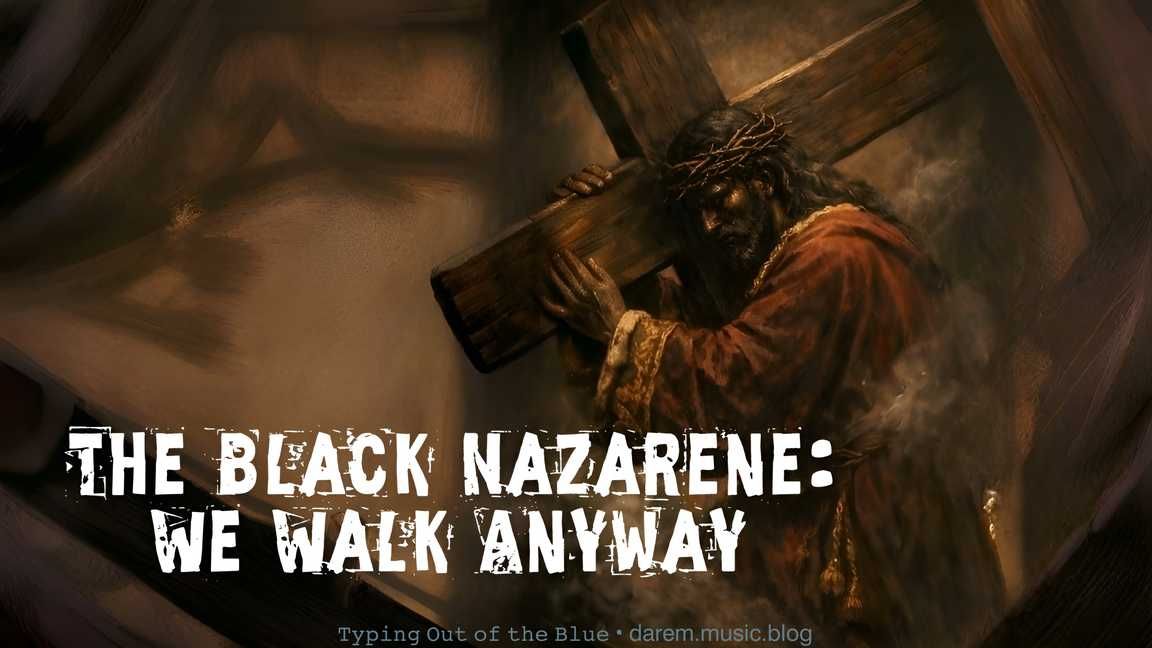
The Black Nazarene is the image of Jesus carrying the cross, venerated in Quiapo Church in Manila. The statue came from Mexico to the Philippines in the early 1600s through the galleon trade. It was already dark in color, most likely carved from dark mesquite wood, a material commonly used by Mexican artisans then. Over centuries, candle smoke, incense, and constant devotion deepened its blackened appearance.
A popular story says the ship carrying the image caught fire and the statue survived. While the story strengthened devotion, the dark color itself is not mainly from that event, but from its material and long exposure to smoke and time.
Quiet in appearance, loud in meaning.
This devotion is not mainly about miracles. It is not about the crowd, the injuries, or the sweat. It goes deeper than that. It is about choosing to walk with Christ in suffering. Not a distant God. Not untouchable. But Jesus who falls, gets wounded, and still moves forward.
That is why people join the Traslacion despite the danger. Not because they are careless. But because they are carrying something. Pain. Promises. Gratitude. Some carry words. Others walk in silence, letting their steps become the prayer.
People ask, “Why does faith have to look like this?” The answer is simple. Not all faith is quiet. Some faith moves. Pushes forward. Struggles.
The Black Nazarene reminds us of an old truth we often avoid. Faith is not a comfort zone. It is not aesthetic. It is not made for display. Sometimes it is sweat. Sometimes it is blood. Sometimes it is silent endurance.
Even if we never join the Traslacion or touch the rope, we can still live its meaning. We carry our cross. We walk anyway. We keep going, even when it is heavy.
It is not about one day.
It is a way of walking, every day.
⌨ ᴛʸᵖⁱⁿᵍ ᴏᵘᵗ ᵒᶠ ᵗʰᵉ ʙˡᵘᵉ ᵈᵃʳᵉᵐ ᵐᵘˢⁱᶜ ᵇˡᵒᵍ
