When “Never Too Late” Sends the Wrong Message

Messages shape the choices people make while they’re still building their future.

Every few months, a story goes viral about someone achieving a long-delayed dream at an old age. People celebrate it online, repeating the same comforting line: “It’s never too late to chase your dreams.”

It sounds encouraging. It feels warm and hopeful. But when this message reaches the youth, the effect isn’t always what adults imagine.

Many young people end up thinking, “If they can do it that late, then I can take my time. I’ll enjoy life now and worry about my goals when I’m older.” The message gets flipped. What was meant to motivate becomes an excuse to delay.

Late achievements are inspiring, but early decisions still matter.

Starting young gives you room to grow. You have more energy, fewer responsibilities, and more time to make mistakes without breaking your future. You get years to build real skill instead of rushing everything when life is heavier and the window is smaller.

Late success should bring hope—not a loophole.

It was never meant to tell the youth, “Relax, you’ll get there eventually.” It was meant to say, “Even if you’re behind, you can still rise.” Those are two very different messages.

These stories should remind young people of something practical: it feels good to achieve a dream early, while you still have the full strength to enjoy the journey.

“Never too late” is comfort for those already catching up.

“Start now” is guidance for those who still have time.

The youth deserve the right message—one that moves them forward, not one that lets them drift.

⌨ ᴛʸᵖⁱⁿᵍ ᴏᵘᵗ ᵒᶠ ᵗʰᵉ ʙˡᵘᵉ ᵈᵃʳᵉᵐ ᵐᵘˢⁱᶜ ᵇˡᵒᵍ

Saint Nicholas and How He Turned Into Santa

A bishop shaped the roots of Santa through simple acts, lasting stories, and a tradition that grew across the world.

Saint Nicholas lived in the early 300s in Myra, a port city in southern Turkey. He served as a bishop, and people around him saw a leader who carried faith, strength, and generosity in a natural way.

Picture a friend who helps right away. That was Nicholas. A family reached a hard stretch, and he placed gifts in their home during the night. A person faced heavy pressure, and he stepped in with steady courage. He gave with intention, and people felt the impact. His actions stayed in memory, and stories about him moved from place to place. He offered material gifts—coins, food, simple essentials—and each one carried deeper value because it helped people rise again with real hope.

As these stories traveled across Europe, each culture shaped his name in its own style. In the Netherlands, he became Sinterklaas (their form of “Saint Nicholas”). Dutch settlers then sailed to New York and brought the name with them. English speakers formed a new version from it, and Santa Claus emerged (the English form of “Sinterklaas”).

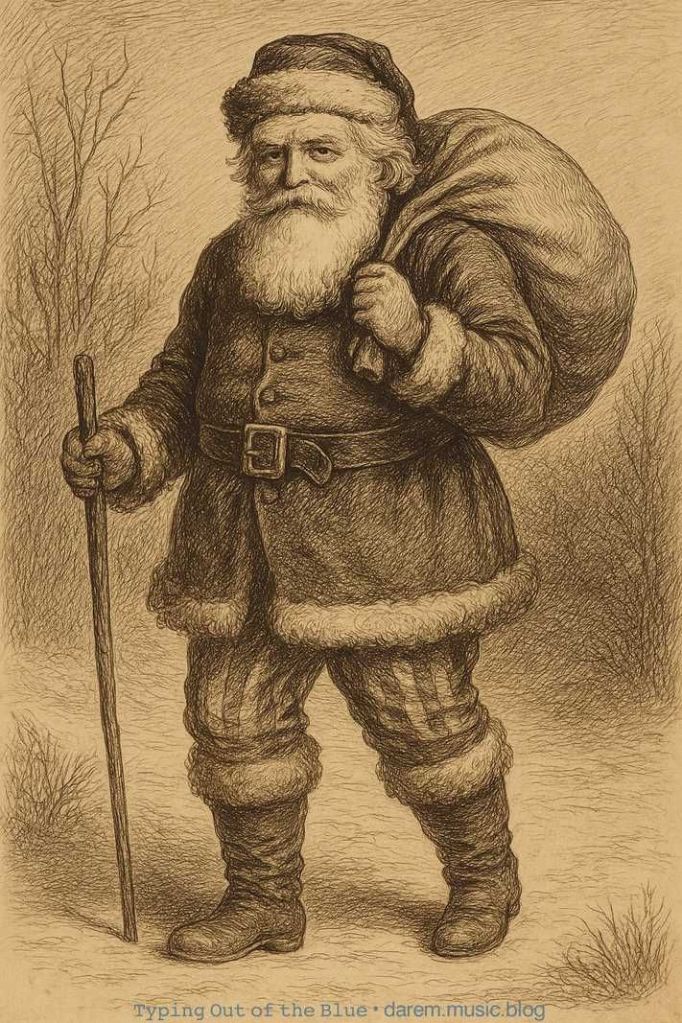
Santa as drawn in the 1860s, during the years when his modern form started to take shape.

By the 1800s, artists and writers shaped Santa’s look, and many illustrators used red because the color stood out on printed pages and matched old European images of Nicholas in red bishop robes. The shade carried well across holidays and became the familiar image the world now knows.

Santa grew from that one man—Nicholas, the figure behind the Christmas carol Jolly Old Saint Nicholas, a bishop whose day-to-day kindness shaped a tradition that reached the entire world.

Jolly Old Saint Nicholas • Darem Placer
Merely Christmas includes Jolly Old Saint Nicholas. Out this season on Bandcamp.

⌨ ᴛʸᵖⁱⁿᵍ ᴏᵘᵗ ᵒᶠ ᵗʰᵉ ʙˡᵘᵉ ᵈᵃʳᵉᵐ ᵐᵘˢⁱᶜ ᵇˡᵒᵍ