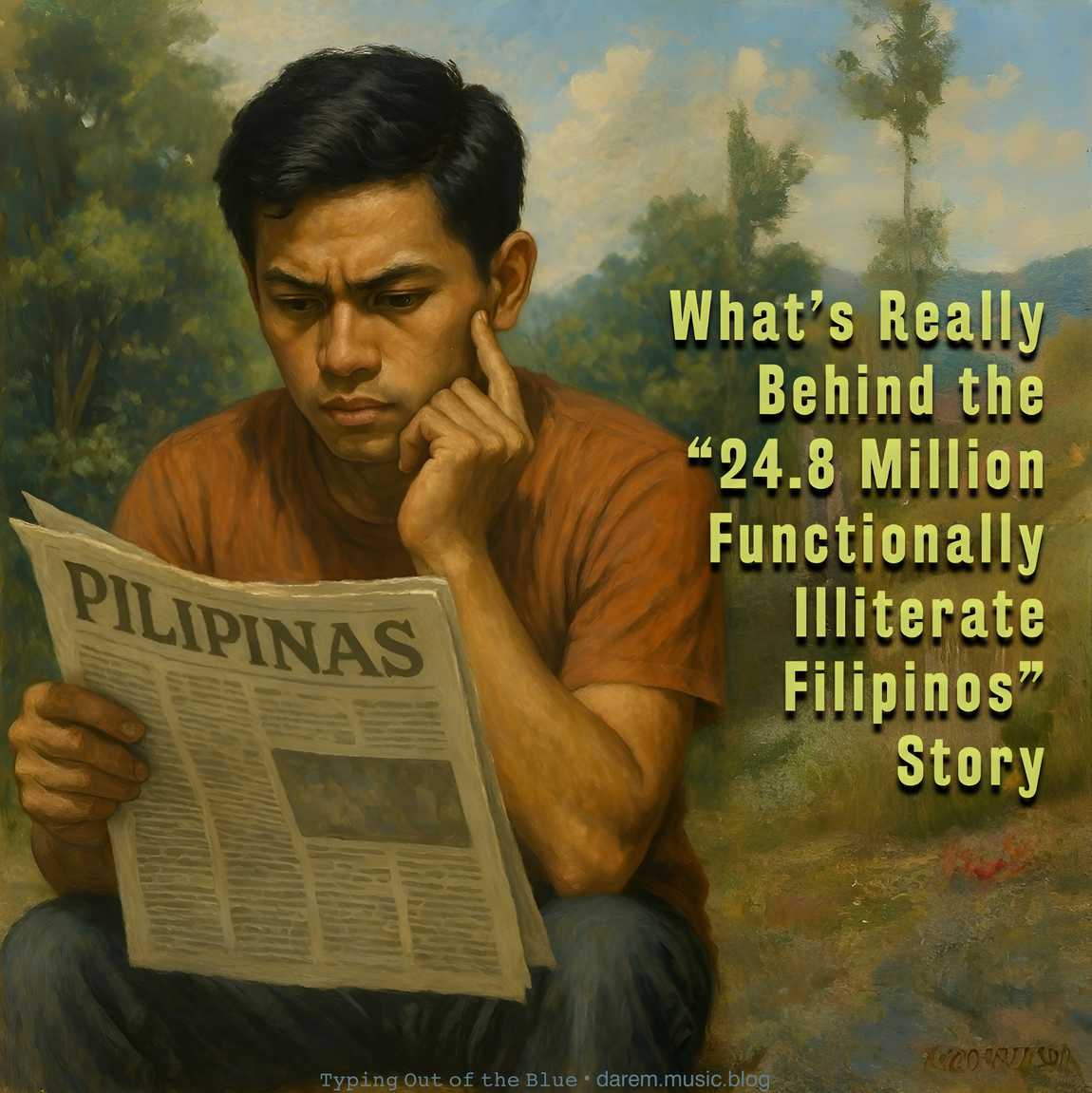
The number shocked many in November 2025: 24.8 million Filipinos are functionally illiterate.
But before believing the worst, it helps to look at what that figure truly means—and what quietly changed behind it.
While many reports highlighted “24.8 million Filipinos” to sound alarming, the PSA actually presented it as a percentage—70.8% functional literacy. The number only looks huge because it covers the entire population aged 10 to 64. In truth, the focus is not the count, but the rate of comprehension.
Some reports turned that percentage into population figures to grab attention. Based on PSA data, the literacy rate of 70.8% covers about 81 million Filipinos aged 10 to 64. That means roughly 23 to 25 million still struggle with comprehension—not because they can’t read, but because understanding remains a challenge.
The New Definition
In 2024, the Philippine Statistics Authority (PSA) released the latest Functional Literacy, Education and Mass Media Survey (FLEMMS).
This survey redefined what it means to be “functionally literate.”
Old rule: If you finished at least four years of high school, you were automatically counted as functionally literate, even if your comprehension wasn’t tested.
New rule: You must prove you can read, write, compute, and understand what you read. That last word—understand—changed everything.
Because of this stricter measure, the percentage dropped from roughly 91 % in 2019 to about 71 % in 2024. It’s not a national collapse—it’s a tougher, more accurate test.
What the Number Really Means
The 24.8 million refers to Filipinos aged 10 to 64 who can read and write basic text but struggle with comprehension or applying what they learn in daily life.
They’re not “illiterate” in the usual sense—they’re functionally limited.
This gap matters: It affects how people follow instructions, manage finances, or even vote with full understanding of what they read.
The Reporting Problem
The issue resurfaced in November 2025, when new headlines claimed “millions of high-school graduates can’t read.”
That’s misleading. The PSA clarified that the 24.8 million figure includes everyone in the 10-64 age group, not just graduates.
The dramatic tone came from comparing the new 2024 definition with old-method data. Once you know the difference, the “crisis” looks exaggerated.
Why It Still Matters
Even if the headlines overreacted, the concern remains real. Too many Filipinos can read words but not meaning—a quiet problem that affects jobs, learning, and daily life.
Lawmakers and educators are now using the 2024 survey to push for stronger reading-comprehension programs and better teacher support.
The Real Message
This isn’t a story of failure—it’s progress in honesty.
The Philippines isn’t losing readers—it’s finally measuring literacy for what it truly is: the ability to understand.
The headlines should have read: “Around 24.8 million Filipinos aged 10 to 64 can read and write but struggle to fully understand or apply what they read, based on the PSA’s 2024 literacy survey.”
Reading without understanding builds noise. Understanding builds a nation.
⌨ ᴛʸᵖⁱⁿᵍ ᴏᵘᵗ ᵒᶠ ᵗʰᵉ ʙˡᵘᵉ ᵈᵃʳᵉᵐ ᵐᵘˢⁱᶜ ᵇˡᵒᵍ
