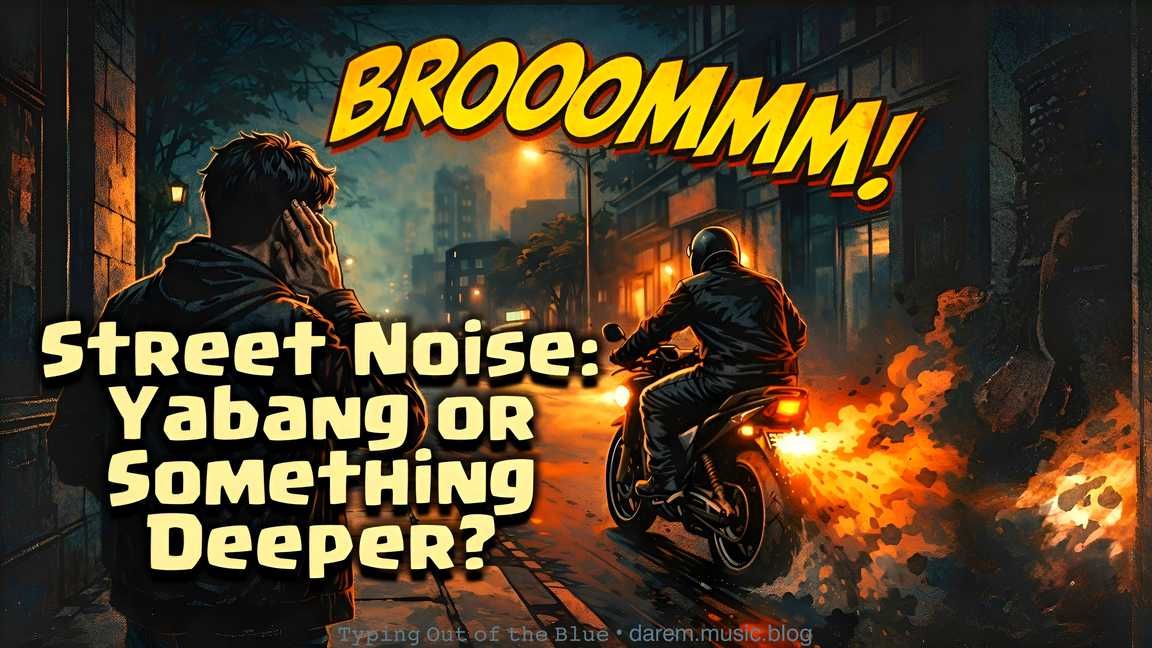
Most people see loud vehicles as showing off. A few look deeper—and find psychology behind the noise.
When a loud motorcycle or car passes by, most people have the same reaction: “That’s just showing off.” Attention-seeking, trying to look cool, no respect for others. And honestly, that reaction is valid, because that’s exactly what people experience.
On the street, the logic is simple. Quiet means respect. Loud means disturbance. End of discussion. That’s why most people don’t even ask why. They don’t need to. It’s already annoying.
But a small group of people—very few—still ask the question why. Not to excuse the behavior, but to understand it. That’s where psychology comes in.
From a psychological view, loudness isn’t judged first as arrogance. It’s seen as behavior. The questions become: What is the person seeking through noise? Sensation, control, emotional release, identity, belonging, or simple desensitization—being so used to noise that its impact on others is no longer noticed.
In psychology, noise is treated as a symptom, not immediately as a personality flaw. But let’s be clear—this doesn’t make the disturbance disappear. For the people affected, sleep is broken, focus is interrupted, and rest is stolen. All of that is real.
So two worlds collide. On the street, the judgment is simple: that’s just showing off. In psychology, the view is different: there’s something behind that behavior. Both perspectives make sense. They just use different lenses.
The problem is that once noise hits, there’s no room for encounter anymore. No listening happens. The body goes into defense mode—covering ears, irritation, tension. That’s where the conversation ends.
So this remains true. Most people see loud vehicles as arrogance. Only a few try to understand the psychology behind them—not because they are kinder, but because they are more curious. And in the end, no matter the explanation, noise is still noise. On the street, impact matters more than intention.
A study on street noise and the human behavior behind it.
A Behavioral and Social Examination of Vehicular Sound in Urban Environments
Abstract. Vehicular noise is commonly framed as a technical or regulatory issue. However, this paper argues that street noise—particularly the intentional amplification of vehicle sound—reflects deeper psychological, social, and cultural dynamics. By examining sensory behavior, identity formation, emotional regulation, and group belonging, this study positions vehicular noise as a form of human expression shaped by urban stressors and social norms rather than mere mechanical modification.
1. Introduction
Urban environments are inherently loud, yet not all noise is incidental. Certain forms of vehicular sound—deliberately modified exhausts, aggressive revving, and amplified engine noise—suggest intentional participation rather than accidental disturbance. This paper explores why individuals are drawn to producing such noise and how these behaviors relate to psychological needs within dense urban settings.
2. Sensory Stimulation and Arousal
Auditory stimulation has a direct effect on the human nervous system. Loud, low-frequency sounds can trigger heightened alertness and pleasure through physiological arousal.1 For some individuals, vehicular noise provides sensory input similar to loud music or bass-heavy environments. In this context, sound functions as stimulation rather than communication.
3. Perceived Control in Constrained Environments
Urban life often limits individual autonomy through traffic congestion, time pressure, and spatial restriction. Producing loud sound can momentarily reverse this experience. The ability to dominate an auditory space offers a brief perception of control, allowing individuals to assert presence within an otherwise regulated environment.2
4. Emotional Discharge and Stress Regulation
Noise can serve as an outlet for emotional tension. Psychological studies on aggression and stress suggest that externalizing emotion—through sound or motion—may temporarily reduce internal pressure.3 Vehicular noise, in this sense, becomes a mechanical substitute for verbal expression.
5. Identity Construction and Masculinity Norms
Sound has long been associated with power and dominance in social contexts. In many cultures, loudness is unconsciously linked to strength, while restraint is misinterpreted as weakness. Vehicles may act as extensions of personal identity, amplifying traits that individuals wish to project.4
6. Group Belonging and Social Reinforcement
Behavior is strongly influenced by peer groups. Within certain subcultures, loud vehicles function as markers of membership. Shared sound profiles reinforce belonging and normalize behaviors that may otherwise be considered disruptive.5
7. Desensitization and Perceptual Shift
Repeated exposure to loud environments leads to auditory desensitization. What is perceived as excessive by the public may feel ordinary to the individual producing the sound. This perceptual shift reduces awareness of impact and complicates moral judgment regarding noise pollution.6
8. Societal Impact of Persistent Noise
Chronic exposure to street noise has been linked to sleep disruption, increased stress levels, and reduced cognitive performance.7 When individual coping mechanisms impose costs on the broader community, noise transitions from personal expression to public health concern.
9. Conclusion
Vehicular noise is not solely a problem of enforcement or mechanical regulation. It is a behavioral phenomenon rooted in sensory desire, emotional release, identity signaling, and social belonging. Effective responses must therefore address cultural norms and psychological drivers, reframing quietness not as submission but as civic respect.
—
1. Goldstein, E. B. Sensation and Perception. Cengage Learning, 2014.
2. Lefebvre, H. The Production of Space. Blackwell Publishing, 1991.
3. Anderson, C. A., & Bushman, B. J. “Human Aggression.” Annual Review of Psychology, 2002.
4. Connell, R. W. Masculinities. University of California Press, 2005.
5. Tajfel, H., & Turner, J. C. “An Integrative Theory of Intergroup Conflict.” The Social Psychology of Intergroup Relations, 1979.
6. Basner, M. et al. “Auditory and Non-Auditory Effects of Noise.” The Lancet, 2014.
7. World Health Organization. Environmental Noise Guidelines for the European Region. WHO Press, 2018.