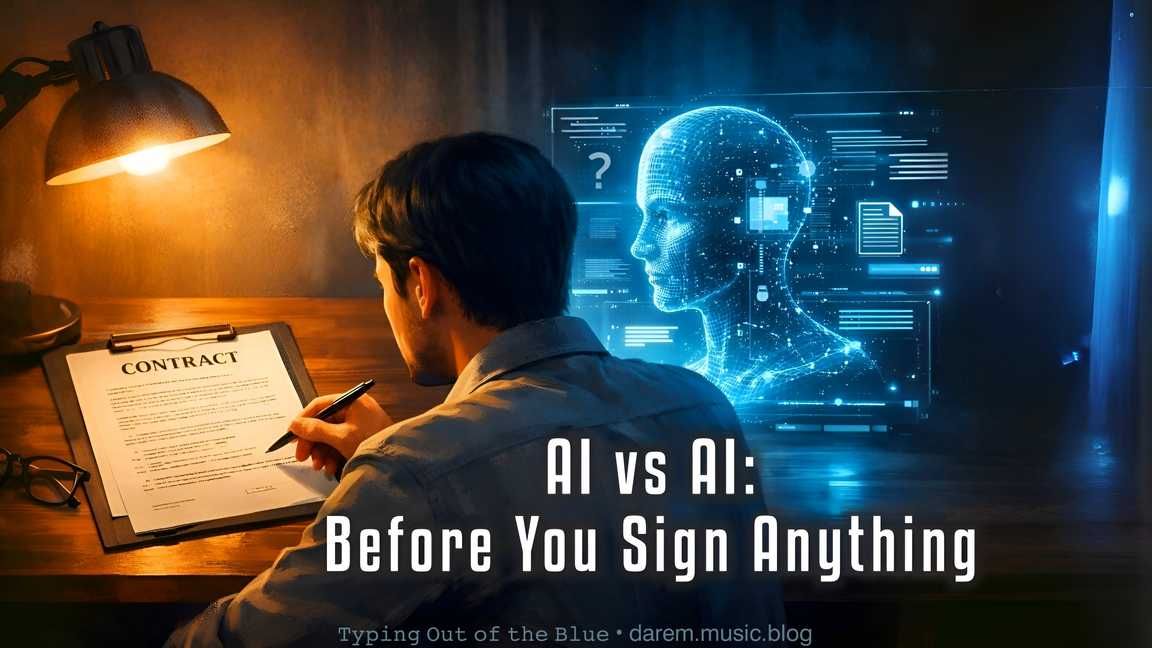
AI vs AI: Before You Sign Anything

Contracts today are often written with AI. Reading them without help may no longer be enough before you sign.

For those who’d rather listen.

Almost everything today comes with a contract, even the simplest things. A small service, a quick signup, a basic agreement. Then suddenly you are handed a document that is more complicated than the thing you are agreeing to.

That is not accidental. Many modern contracts are no longer written purely by humans. They are assisted by AI, built from templates, optimized for risk, and filled with language designed to survive future changes. Polite tone. Clean structure. Harmless-looking clauses that quietly cover a lot of ground.

So if the contract was likely drafted with AI tools, why would you read it without help?

Depending on AI in this situation is not laziness. It is balance.

This is not about letting AI decide for you. It is about using AI as a lens. A pattern spotter. A way to test language that was designed to be flexible, expandable, and protective of the other side.

A simple way to do this is to scan or photograph the contract, upload it to an AI you trust, and ask direct questions. What is the worst-case scenario for me here? Which clauses quietly favor the other side? What parts could be used differently if technology changes? You are not asking AI to decide for you. You are using it to spot risks before you sign.

Modern contracts are no longer built around specific situations. They are built around concepts. Access. Use. Distribution. Derivatives. Training. Reuse. These words do not expire. They adapt.

The real danger is not AI. The danger is speed reading. Contracts today are written slowly and strategically, but signed quickly by people who assume the document matches the simplicity of the product.

A simple rule still applies. If you cannot explain a clause back to yourself in plain language, you did not understand it. And if you did not understand it, signing becomes a gamble.

The side asking you to sign is already inside an AI-built safe zone. Using AI before you sign is not about beating them. It is about finding where you stand, what you gain, and where the balance actually is.

This is why AI vs AI makes sense in this era. They wrote the maze with tools. You bring your own tools to read it.

Depending on AI here is not surrender. It is awareness. The signature is still yours, but now your eyes are open.

⌨ ᴛʸᵖⁱⁿᵍ ᴏᵘᵗ ᵒᶠ ᵗʰᵉ ʙˡᵘᵉ ᵈᵃʳᵉᵐ ᵐᵘˢⁱᶜ ᵇˡᵒᵍ

What AI May Bring by 2026

AI is already shaping daily life. By 2026, the changes may feel small—but their impact could be deep.

Based on how AI works today

AI can already write, talk, translate, draw, and help with everyday tasks. It is inside phones, apps, offices, and schools. It is not perfect, but it is improving fast. If this pace continues, 2026 may feel normal on the surface, but different underneath.

The helpful side

AI will feel less like a feature and more like a helper. It will assist with messages, planning, explaining things, and saving time. Like calculators or map apps, it will work in the background without asking for attention.

One person will be able to do more on their own. Writing, designing, planning, and creating will take less effort and fewer tools. AI will not replace people, but it will reduce friction.

Language will matter less as a barrier. People from different countries will understand each other more easily. Translation will feel natural instead of mechanical.

Daily work will feel lighter. Repetitive tasks will take less time. People can focus more on decisions, judgment, and ideas.

Help and information will be easier to reach. Learning something new will feel less intimidating.

The hidden risks

There will be too much content everywhere. Text, images, videos, and voices will be produced endlessly. Over time, people may care less about who made something or whether it is real.

Work will change quietly, not suddenly. Jobs may not disappear overnight, but tasks will slowly shrink or fade. Hours may be reduced. Roles may become smaller without clear announcements.

Tracking will feel normal. Speed, habits, and behavior will be measured in the name of productivity. Privacy may not vanish, but it will slowly become thinner.

Truth may feel harder to agree on. Different people will see different versions of the same story. Not always lies, but not always the full picture either.

People may rely on AI too much. Thinking through problems, writing carefully, and remembering details may start to feel optional. Skills fade when they are not practiced.

The deeper shift

AI will not force people to change. People will choose convenience because it feels easier.

Doing things yourself may start to feel slow. Silence may feel uncomfortable. Effort may seem unnecessary. “Good enough” may become the standard.

2026 will not be about robots taking over. It will be about how humans live with tools that make life easier.

AI will quietly ask the same question every day:

Do you still want to do this yourself?

How people answer will shape what comes next.

⌨ ᴛʸᵖⁱⁿᵍ ᴏᵘᵗ ᵒᶠ ᵗʰᵉ ʙˡᵘᵉ ᵈᵃʳᵉᵐ ᵐᵘˢⁱᶜ ᵇˡᵒᵍ
Digital Albums by Darem Placer on Bandcamp
daremplacer.bandcamp.com