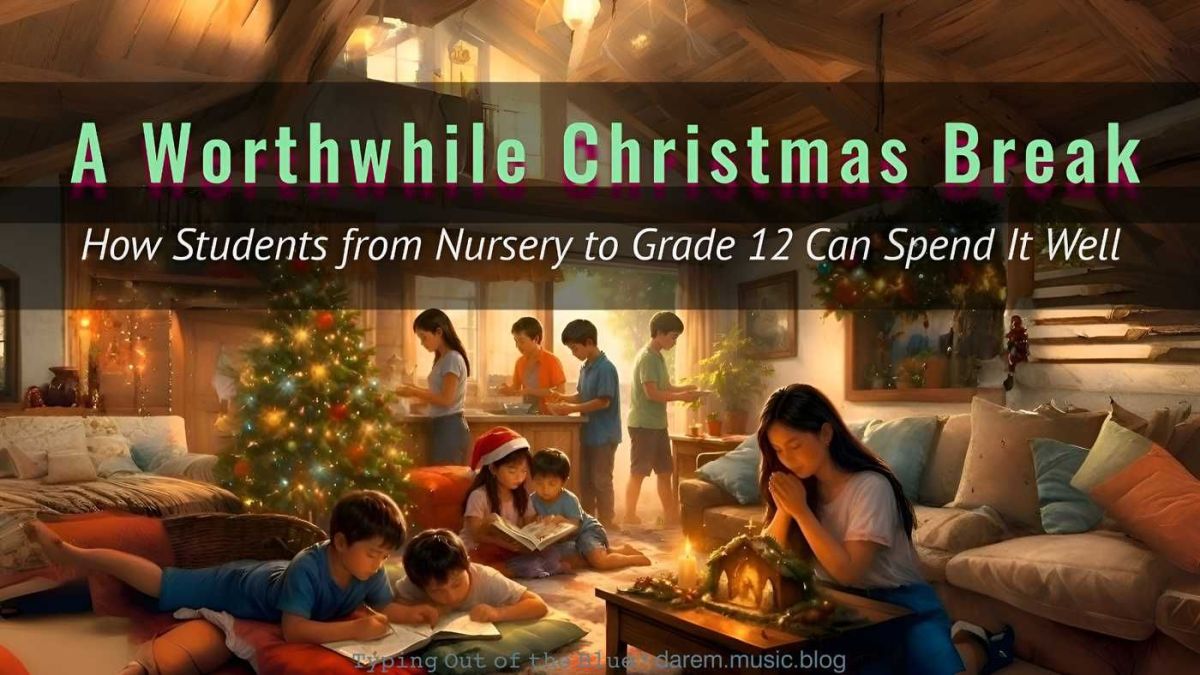
🎄 A Worthwhile Christmas Break

A guide for students on using Christmas break wisely as Christmas Day draws near.

How Students from Nursery to Grade Twelve Can Spend It Well 🎁

Christmas break is not a pause from learning.

It is a shift in how learning happens ✨

For students—from Nursery to Grade Twelve—this season is less about doing more and more about growing right. Growth does not always look like homework. Sometimes, it looks like rest, play, simple habits, and a quiet moment of prayer as Christmas Day draws near 🕯️

🎨 Nursery and Kindergarten

For young children, Christmas break is about safety, joy, and routine 🎠

Play is not wasted time. It is how they learn. Drawing, coloring, building blocks, and listening to stories help their minds grow naturally 📖 At home, parents can also guide them to say a short prayer each day—before sleeping or before meals—so they slowly learn that Christmas is a time to thank God 🙏

At this age, the goal is not achievement. The goal is joy, security, and early faith 🎄

📚 Grades One to Three

At this stage, curiosity starts to form ✨

Reading short storybooks builds imagination and language. Writing simple sentences builds confidence. Helping with small chores teaches responsibility without pressure 🧹 Alongside these, students are encouraged to pray once a day, offering simple words of thanks or asking for help, as part of preparing their hearts for Christmas 🕯️

The goal here is confidence, curiosity, and gratitude 🎁

✏️ Grades Four to Six

Older grade-school students are ready for light structure 📘

Reading for pleasure matters more than nonstop reviewing. A short review of basics can help, but rest remains important. This is also a good time to form the habit of daily prayer—taking a quiet moment to reflect, to thank God, and to remember the meaning of Christmas beyond gifts and vacations 🌟

The goal is discipline, independence, and reflection 🎄

🎧 Grades Seven to Ten

Junior high students begin to form identity 🧠

Christmas break gives them space to slow down. Reflecting on the year, improving one weak area, and exploring interests help them grow 🎨🎵 Daily prayer, even if brief, helps them process stress, find direction, and prepare inwardly for Christmas Day 🕯️

The goal is self-awareness, balance, and purpose ✨

🎓 Grades Eleven to Twelve

Senior high students need rest more than they admit 😴

Proper sleep, organizing school materials, and learning life skills prepare them for what comes next. Daily prayer becomes especially important at this stage—not as obligation, but as a moment of grounding, clarity, and trust as they look ahead and prepare for Christmas 🎄🙏

The goal is readiness, maturity, and inner steadiness 🌟

Christmas break is not about getting ahead of others.

It is about becoming more whole—mind, body, and spirit 💛

Slow days, simple habits, and daily prayer prepare students well 🕯️

That is a Christmas break well spent 🎁🎄

⌨ ᴛʸᵖⁱⁿᵍ ᴏᵘᵗ ᵒᶠ ᵗʰᵉ ʙˡᵘᵉ ᵈᵃʳᵉᵐ ᵐᵘˢⁱᶜ ᵇˡᵒᵍ

Digital Albums by Darem Placer on Bandcamp
daremplacer.bandcamp.com

When Music Opens Doors: Why Playing Instruments Matters Most

Singing fades, listening calms—but playing transforms. When sound is shared, music turns belonging into action.

Music changes lives—but how we experience it makes the difference. We can play, sing, or listen. Each has beauty, but when it comes to real inclusion and personal growth, instrumental music stands out. It’s not just sound—it’s connection, focus, and freedom.

🎸 Playing: When sound becomes action

Learning to play an instrument gives students control. That’s powerful—especially for those with intellectual or developmental disabilities.

• A drum hit, a guitar strum, or a single piano note lets them see and feel the result of their effort.

• It builds coordination, patience, and confidence.

• Mistakes don’t break the moment—they just become part of the rhythm.

Instrumental music gives space for success at every level. You don’t need perfect pitch—the rare ability to name or play notes by ear alone—just the will to play. Everyone can join, and everyone contributes something real.

🎤 The limits of singing

Singing has its place, but it’s not always open for all.

• Some students struggle with speech, tone, or breath control—it can make singing stressful instead of joyful.

• Vocal work depends heavily on physical condition—even small health issues can silence participation.

• In group settings, louder or more confident singers often dominate, leaving others unheard.

Unlike instruments, the voice can’t be redesigned or adapted. A broken voice means silence. A broken drumstick just needs tape.

🎧 The quiet comfort—and its wall

Listening brings peace. It soothes emotions and fills silence with warmth. But it’s still passive.

• Listeners can feel connected for a moment, but they stay on the outside looking in.

• There’s no movement, no teamwork, no personal creation—just reaction.

• Once the song stops, the effect fades fast.

That’s why therapists often move from listening to playing—because real healing begins when the listener becomes part of the sound.

🌍 Why instruments win

Instrumental music doesn’t depend on a “good voice,” perfect hearing, or clear speech.

It’s flexible, visual, physical, and emotional all at once.

It teaches timing, patience, and unity—values that reach beyond music itself.

When a group of students pick up instruments, no one is left out. The quiet one can keep rhythm. The shy one can guide the melody. The group learns harmony by doing, not just by hearing.

🎶 The truth

Music that only a few can join isn’t real music—it’s performance.

But when every hand has a role, when sound becomes shared creation—that’s music with a soul.

Real music begins when you hold the sound in your hands.

⌨ ᴛʸᵖⁱⁿᵍ ᴏᵘᵗ ᵒᶠ ᵗʰᵉ ʙˡᵘᵉ ᵈᵃʳᵉᵐ ᵐᵘˢⁱᶜ ᵇˡᵒᵍ