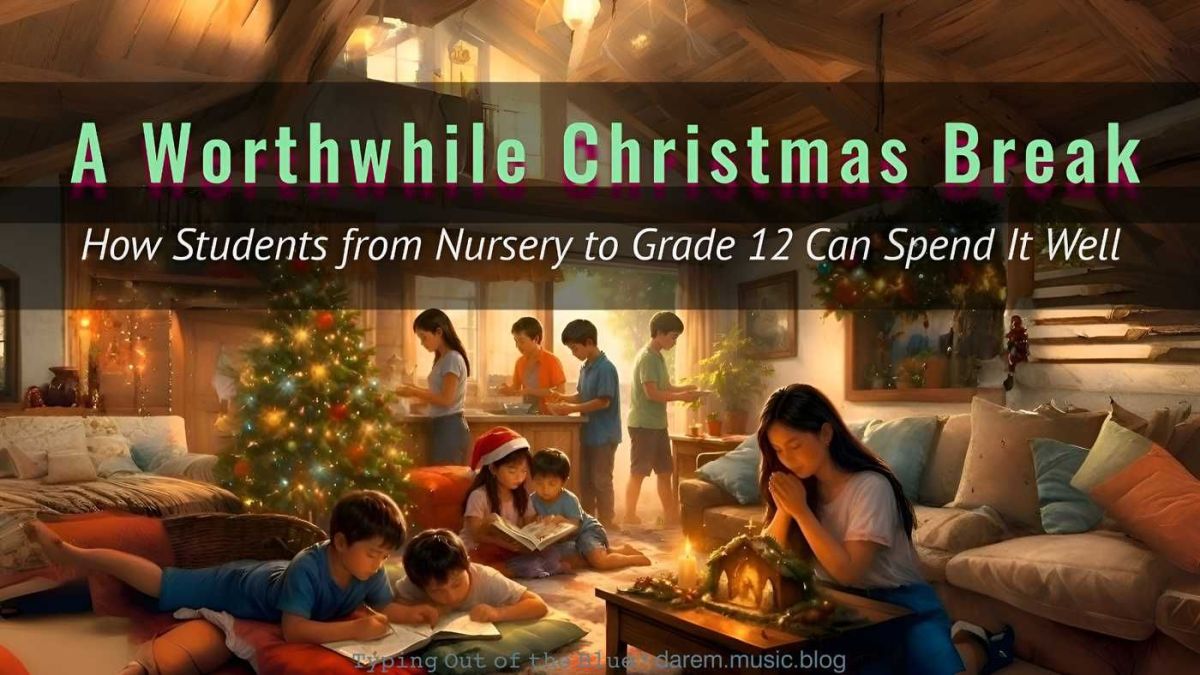
🎄 A Worthwhile Christmas Break

A guide for students on using Christmas break wisely as Christmas Day draws near.

How Students from Nursery to Grade Twelve Can Spend It Well 🎁

Christmas break is not a pause from learning.

It is a shift in how learning happens ✨

For students—from Nursery to Grade Twelve—this season is less about doing more and more about growing right. Growth does not always look like homework. Sometimes, it looks like rest, play, simple habits, and a quiet moment of prayer as Christmas Day draws near 🕯️

🎨 Nursery and Kindergarten

For young children, Christmas break is about safety, joy, and routine 🎠

Play is not wasted time. It is how they learn. Drawing, coloring, building blocks, and listening to stories help their minds grow naturally 📖 At home, parents can also guide them to say a short prayer each day—before sleeping or before meals—so they slowly learn that Christmas is a time to thank God 🙏

At this age, the goal is not achievement. The goal is joy, security, and early faith 🎄

📚 Grades One to Three

At this stage, curiosity starts to form ✨

Reading short storybooks builds imagination and language. Writing simple sentences builds confidence. Helping with small chores teaches responsibility without pressure 🧹 Alongside these, students are encouraged to pray once a day, offering simple words of thanks or asking for help, as part of preparing their hearts for Christmas 🕯️

The goal here is confidence, curiosity, and gratitude 🎁

✏️ Grades Four to Six

Older grade-school students are ready for light structure 📘

Reading for pleasure matters more than nonstop reviewing. A short review of basics can help, but rest remains important. This is also a good time to form the habit of daily prayer—taking a quiet moment to reflect, to thank God, and to remember the meaning of Christmas beyond gifts and vacations 🌟

The goal is discipline, independence, and reflection 🎄

🎧 Grades Seven to Ten

Junior high students begin to form identity 🧠

Christmas break gives them space to slow down. Reflecting on the year, improving one weak area, and exploring interests help them grow 🎨🎵 Daily prayer, even if brief, helps them process stress, find direction, and prepare inwardly for Christmas Day 🕯️

The goal is self-awareness, balance, and purpose ✨

🎓 Grades Eleven to Twelve

Senior high students need rest more than they admit 😴

Proper sleep, organizing school materials, and learning life skills prepare them for what comes next. Daily prayer becomes especially important at this stage—not as obligation, but as a moment of grounding, clarity, and trust as they look ahead and prepare for Christmas 🎄🙏

The goal is readiness, maturity, and inner steadiness 🌟

Christmas break is not about getting ahead of others.

It is about becoming more whole—mind, body, and spirit 💛

Slow days, simple habits, and daily prayer prepare students well 🕯️

That is a Christmas break well spent 🎁🎄

⌨ ᴛʸᵖⁱⁿᵍ ᴏᵘᵗ ᵒᶠ ᵗʰᵉ ʙˡᵘᵉ ᵈᵃʳᵉᵐ ᵐᵘˢⁱᶜ ᵇˡᵒᵍ

Digital Albums by Darem Placer on Bandcamp
daremplacer.bandcamp.com

Ninoy Aquino’s School Days

Ninoy Aquino’s school days were far from ordinary—valedictorian in elementary, a fast-tracked San Beda student, varsity baller, debate champ, and even a war correspondent at just fifteen.

Before Ninoy Aquino became a senator and an icon of the opposition, he was already building an extraordinary story as a student. His school days weren’t ordinary. They already carried signs of the drive, curiosity, and charisma that would later define him.

He began at St. John’s Academy in Pampanga, where he graduated as valedictorian in elementary. When he moved to San Beda for high school, he didn’t just go through the motions—he sped through. By cross-enrolling in summer classes at FEU and NU, he finished the four-year program in only two and a half. By the time he graduated, he was just fifteen.

People in his neighborhood called him “T-V-T,” short for Tribune, Vanguardia, Taliba—the newspapers of the time. It was their way of saying he was like a walking news feed, always curious and always with a story to tell. He admitted he was only in the “middle bracket” academically, not the honor-student type, but he had other ways of standing out.

Public speaking was his arena. Ninoy loved oratorical contests and debates, and he often won—thanks to his quick wit and confidence. At the same time, he played varsity basketball. Imagine him stepping off the court, jersey drenched in sweat, hair sticking from the heat of the game, and then heading into a debate still sharp and unstoppable. That mix of energy and charm was pure Ninoy.

Right after high school, he jumped straight into history. At fifteen, he became the youngest war correspondent of The Manila Times. His first big story was the surrender of Huk leader Luis Taruc. Taruc wasn’t just another headline—he was the face of a feared guerrilla movement. Many veteran reporters kept a safe distance, but Ninoy, barely out of his school uniform, walked up to him with nothing but courage and a notebook. A teenager interviewing one of the country’s most notorious figures—it was bold, almost unthinkable. That single scoop pushed Ninoy into the spotlight and proved that even at fifteen, he already had the nerve to stand at the frontlines of national history.

The interesting thing about Ninoy’s school life is how it shows that brilliance doesn’t always come in medals or straight A’s. Sometimes it shows in curiosity, in confidence, and in courage. And every August 21, Ninoy Aquino Day, we remember not just the man who gave his life for freedom, but also the young student—valedictorian, debater, varsity baller, reporter—whose extraordinary journey had already begun long before politics.

𝚃𝚢𝚙𝚒𝚗𝚐 𝙾𝚞𝚝 𝚘𝚏 𝚝𝚑𝚎 𝙱𝚕𝚞𝚎
𝚍𝚊𝚛𝚎𝚖𝚙𝚕𝚊𝚌𝚎𝚛.𝚌𝚘𝚖