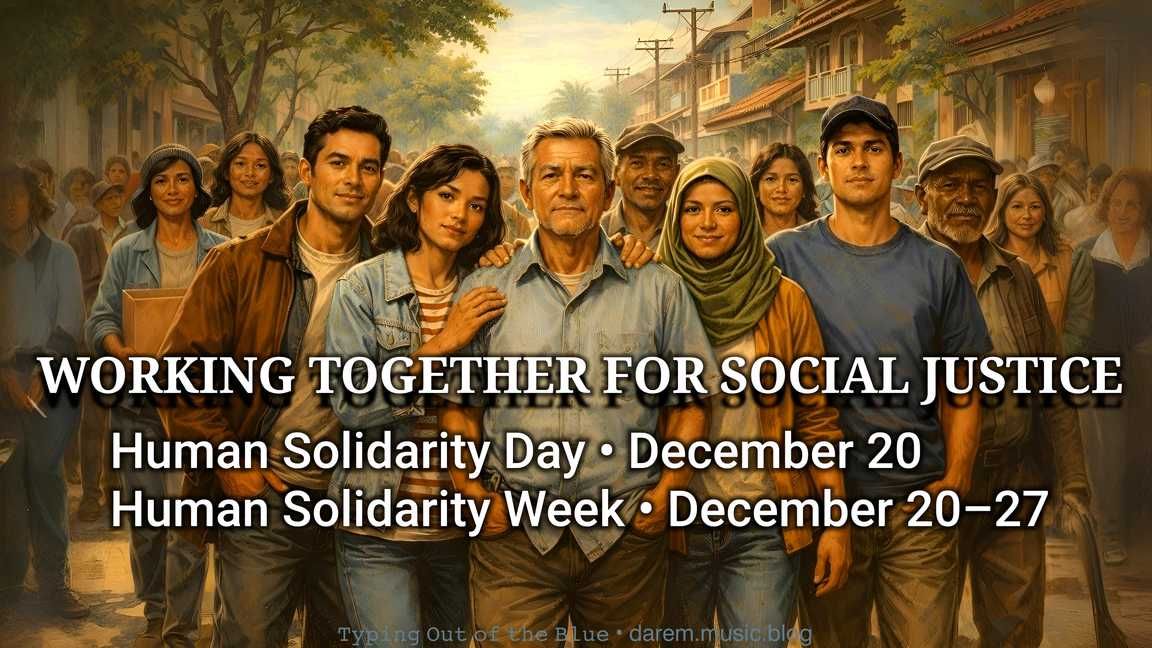
Working Together for Social Justice

Are Humans Solid for Justice?

Human Solidarity Day • December 20
Human Solidarity Week • December 20–27

Working together for social justice means caring beyond posting and moving on.

Many people see something wrong and choose to record it. Sharing videos helps others see the problem, and awareness matters. But real change happens when people stay involved, not just online.

Getting involved is not always safe. That fear is real. This is why working together matters. When people stand alone, it is risky. When people act as a group, responsibility is shared and voices become stronger.

This often starts in small groups—families, classrooms, workplaces—where people choose to support one another instead of looking away.

Social justice becomes real when people agree on what comes first—doing good. Not attention. Not comfort. Not views. Just what is right.

This starts early. Children learn fairness by watching adults. When they see respect, honesty, and care practiced daily, justice becomes normal, not forced.

Being a role model matters more than making noise. Calm actions, repeated daily, teach others how to act when something is wrong.

Human solidarity means moving in one direction. Not scattered efforts. Not competing ideas. Just people choosing good first and supporting one another in doing it.

And not just today.
Not just this week.
But every time it matters.

⌨ ᴛʸᵖⁱⁿᵍ ᴏᵘᵗ ᵒᶠ ᵗʰᵉ ʙˡᵘᵉ ᵈᵃʳᵉᵐ ᵐᵘˢⁱᶜ ᵇˡᵒᵍ

Digital Albums by Darem Placer on Bandcamp
daremplacer.bandcamp.com

Contributing Complaints

Complaining feels easy—until we realize we are also part of what we criticize.

We complain every day—about traffic, noise, delays, behavior, systems. Complaining has become almost automatic.

But there is a specific kind of complaint that often goes unnoticed: contributing complaints. These are complaints about problems we also help create.

• Complaining about traffic while parking on the street.
• Complaining about noise while playing videos on speaker in public.
• Complaining about pollution while littering or wasting resources.
• Complaining about bad drivers while ignoring basic road rules.
• Complaining about long lines while cutting when possible.
• Complaining about crowded places while choosing peak hours.
• Complaining about slow replies while leaving messages on seen.
• Complaining about fake news while sharing posts without reading.
• Complaining about screen addiction while endlessly scrolling.
• Complaining about shallow content while rewarding it with attention.
• Complaining about gossip while spreading it.
• Complaining about toxic work culture while pressuring others.
• Complaining about weak leadership while avoiding responsibility.
• Complaining about bad service while being rude to staff.
• Complaining about food while having no role in choosing or buying it.
• Complaining about being spoken to with bad words while using them yourself.
• Complaining about stress while refusing rest or boundaries.
• Complaining about an unanswered prayer after praying only once.
• Etceteras…

These complaints feel valid, because the problems are real. But contributing complaints blur responsibility. They criticize without change.

Most problems do not persist because no one complains. They persist because many people contribute—then complain. The uncomfortable truth is simple: we are often both the victim and the cause.

Complaining is easy. Self-awareness is harder. Real improvement does not begin with louder complaints. It begins when we stop contributing.

And maybe the most useful question to ask is not, “Who is causing this?” but:

Am I part of this?

⌨ ᴛʸᵖⁱⁿᵍ ᴏᵘᵗ ᵒᶠ ᵗʰᵉ ʙˡᵘᵉ ᵈᵃʳᵉᵐ ᵐᵘˢⁱᶜ ᵇˡᵒᵍ

Digital Albums by Darem Placer on Bandcamp
daremplacer.bandcamp.com