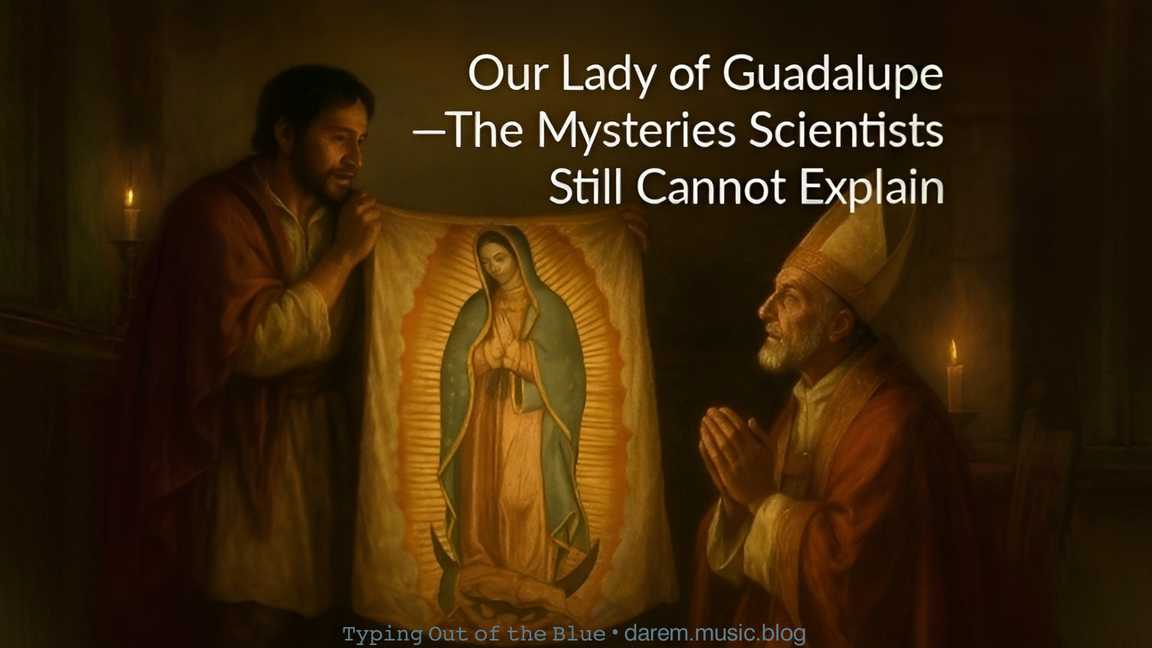
1531, Mexico.
On the day Juan Diego brought his tilma to the bishop, no one expected anything unusual. It was just a worker’s cloak made from simple fiber, the kind that wore out quickly. But this was the cloth he carried after a strange and moving encounter he couldn’t explain. When the bishop opened it, the plain fabric suddenly revealed the image now known as Our Lady of Guadalupe—soft colors, delicate details, and a presence far beyond what any ordinary cloak could hold. A moment earlier, it looked like nothing special. In the next moment, it became one of the most examined and enduring images in history.
When people talk about Our Lady of Guadalupe, many remember the story behind the image. But there’s another side to it—the part that scientists, historians, and researchers have been studying for decades. They approach the tilma not as a religious symbol first, but as an object they expect to behave like any other cloth.
Yet the more they examine it, the more questions appear.
The tilma is made from cactus fiber, a material that normally breaks down in less than twenty years. But this one has lasted almost five hundred. It has survived humidity, smoke from candles, and even accidents that should have caused serious damage. Until now, the fibers remain strong, almost as if they were protected from decay.
Researchers also noticed that the image has no visible brush strokes. Under magnification, the colors don’t behave like paint. They don’t soak the fibers, and they don’t sit on the surface like normal pigments. They seem to rest on the cloth in a way that doesn’t match any known method of painting. No one has found the exact materials used to create the colors.
Then there are the eyes. When experts looked closely, they found tiny reflections of human figures inside them, shaped exactly the way reflections appear in real eyes. The detail is so precise that it follows optical laws discovered many years after the image appeared. It’s as if the tilma captured a moment, not just a picture.
Even the temperature of the cloth surprised them. Instruments show it stays around the warmth of human skin. Not hot, not cold—just a steady warmth that doesn’t match the environment around it.
Many tests have been done, yet every study ends the same way. The image behaves like something natural and supernatural at the same time. It refuses simple explanations. It doesn’t fade. It doesn’t crack. It doesn’t fall apart.
For believers, these mysteries are not meant to prove anything by force. They simply invite a moment of wonder. They suggest that this image carries more than paint and fiber—that it carries a presence meant to stay close to people through change and hardship.
And after almost five centuries, the tilma still stands quietly, unchanged, as if waiting for anyone willing to look a little closer.
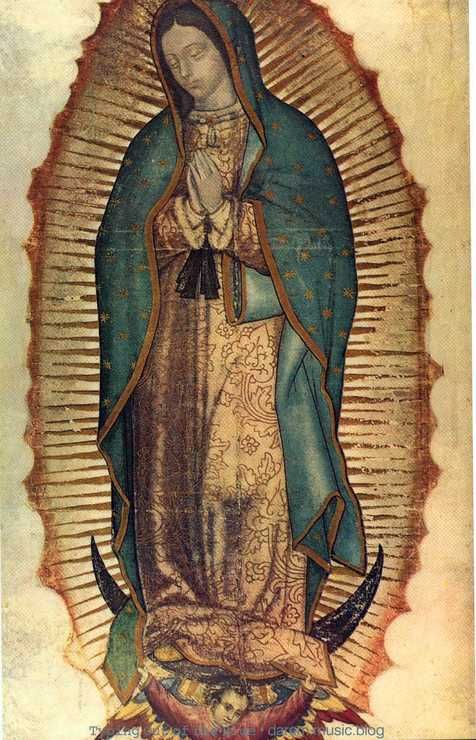
What Did Saint Juan Diego Even Have?
This is the part that makes the forgery theories fall apart fast.
Juan Diego wasn’t a painter, wasn’t trained, and had no studio, no pigments, no tools. His entire “art supply list” was basically:
• a cloak
• made of cactus fiber
• and nothing else
Yet the image on that cloak shows techniques no known painter in Mexico—or Europe—used in 1531. No underdrawing, no brush strokes, no known pigments, and a durability cactus fiber should never have.
If someone wanted to fake a miracle, they would need skill, materials, secrecy, and time.
⌨ ᴛʸᵖⁱⁿᵍ ᴏᵘᵗ ᵒᶠ ᵗʰᵉ ʙˡᵘᵉ ᵈᵃʳᵉᵐ ᵐᵘˢⁱᶜ ᵇˡᵒᵍ

Out this season on Bandcamp.