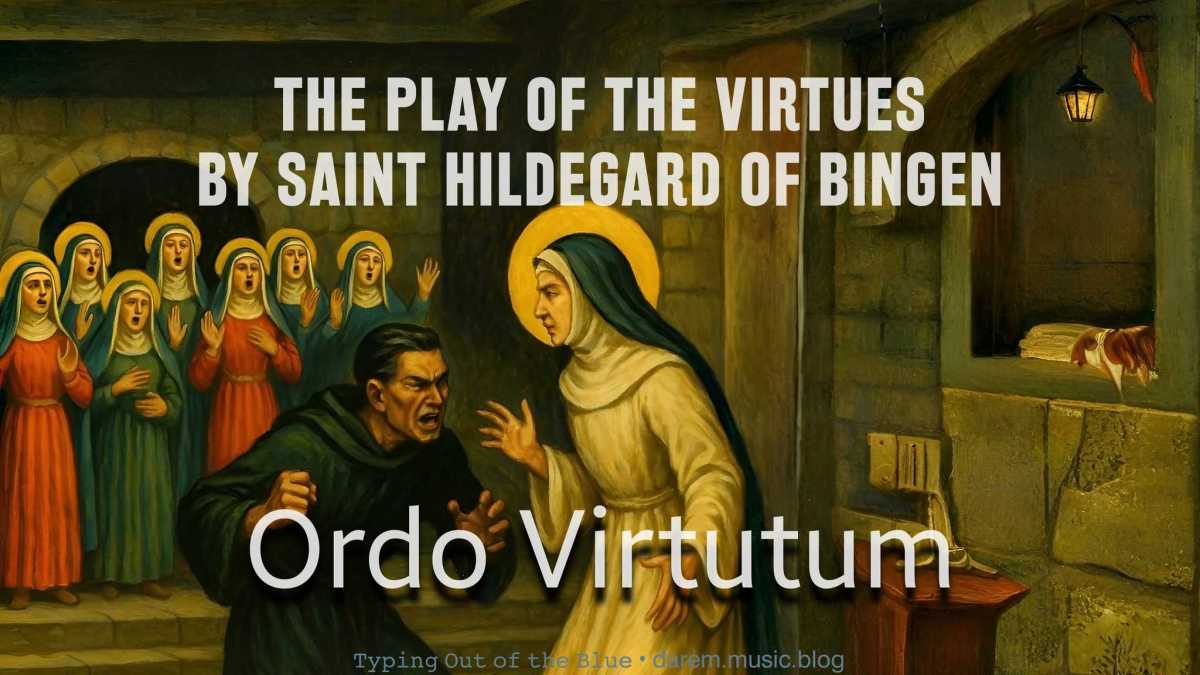
The Play of the Virtues by Saint Hildegard of Bingen (A short retelling)
There’s this Soul. She’s hanging with the Virtues—Humility, Charity, Patience—the good crowd. They’re all singing together, and it’s not just music, it’s like the whole vibe of heaven. Everything clicks.
Then the Devil shows up. And here’s the funny part: he can’t sing. Not a single note. He just yells, spits promises, tries to sound cool. “Come with me, I’ve got freedom, I’ve got pleasure.” But it’s all noise. No rhythm, no tune.
The Soul falls for it. Steps out of the harmony, follows the noise. For a while, she thinks she’s winning. But the deeper she goes, the more empty it gets. Just chains. No beat.
Finally, she snaps out of it. “I wanna go back.”
The Virtues don’t shame her. They don’t say, “Told you.” They just welcome her back, and their music rises again. Stronger this time, bright enough to drown out the Devil’s noise. He rages, but he’s powerless—because noise can’t beat music.
And that’s how it ends: the Soul restored, the harmony alive, and the Devil stuck in silence.
Evil makes noise. Love makes music. You decide which crowd you wanna jam with.
We remember Saint Hildegard not only through her memorial on September 17, but also through her play that still sings of mercy and truth.
ᴛʸᵖⁱⁿᵍ ᴏᵘᵗ ᵒᶠ ᵗʰᵉ ʙˡᵘᵉ ᵈᵃʳᵉᵐ ᵐᵘˢⁱᶜ ᵇˡᵒᵍ
Written around 1151, Ordo Virtutum remains the earliest known morality drama with music.
WATCH: A full staged performance of Ordo Virtutum by Saint Hildegard of Bingen. Performed live at St. John’s Cathedral, Los Angeles, directed by Patricia McKee, Katina Mitchell, and Ned Tipton.
