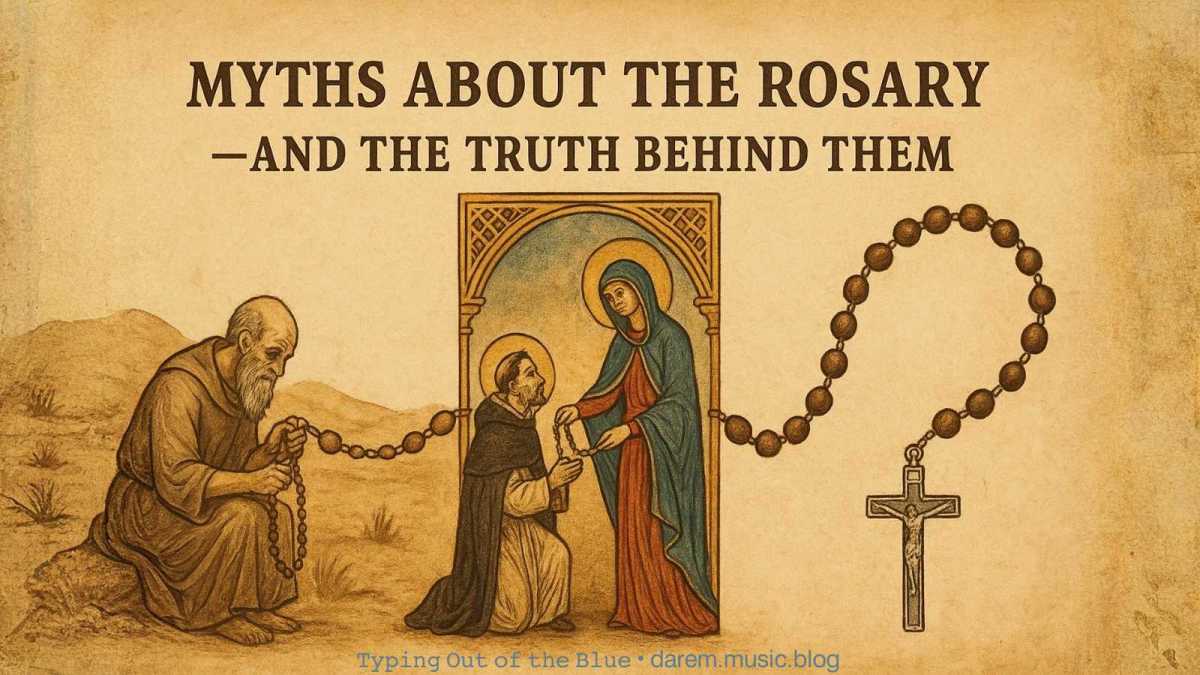
The rosary is one of the most loved Catholic prayers, but many of the stories around it are legends told for inspiration. Here are the most common myths—and the real history behind them.
🧩 Myth 1: Mary gave the rosary to Saint Dominic in 1208.
The popular story says Our Lady appeared to Saint Dominic and gave him the rosary as a weapon against heresy.
👉 Truth: Historians note there is no record of this in Dominic’s time. The story only appears in the 1400s through Dominican preacher Alan de la Roche. The rosary grew slowly, starting with desert monks in the 3rd–4th century who prayed 150 Our Fathers with stones or knotted ropes.
🧩 Myth 2: The rosary was always 15 mysteries.
Many believe the rosary has always been fixed with 15 mysteries from the start.
👉 Truth: At first, people simply prayed 150 Hail Marys without set mysteries. The fixed Joyful, Sorrowful, and Glorious mysteries were shaped by the Dominicans in the 15th century. In 2002, Pope John Paul II wrote Rosarium Virginis Mariae (The Rosary of the Virgin Mary), adding the Luminous Mysteries and reminding the Church that the rosary is above all a prayer centered on the life of Christ.
🧩 Myth 3: The Hail Mary has always been the same.
Many Catholics assume the Hail Mary we pray today has always existed in full, unchanged since the beginning.
👉 Truth: The Hail Mary actually developed in stages:
• 6th century: only the angel’s words—“Hail, full of grace, the Lord is with you” (Luke 1:28).
• 11th century: Elizabeth’s greeting was added—“Blessed are you among women, and blessed is the fruit of your womb” (Luke 1:42).
• 14th–15th century: the final petition appeared—“Holy Mary, Mother of God, pray for us sinners, now and at the hour of our death.”
It only reached its full form in the late Middle Ages.
🧩 Myth 4: Repetition is empty prayer.
Some think repeating words again and again makes prayer meaningless.
👉 Truth: Jesus warned against vain repetition, not against repeating with faith. He Himself repeated His prayer in Gethsemane (Matthew 26:44). Angels in heaven repeat “Holy, holy, holy” without end (Isaiah 6:3). Repetition in the rosary is focus, not emptiness.
🌹 The Meaning of the Legends
The Dominic story is a pious legend—a devotional tale told for inspirational value, not historical proof. It reminds believers that the rosary is seen as Mary’s gift to the Church, even if it developed gradually.
The truth is even richer: the rosary was not dropped from heaven in one piece. It was born through centuries of prayer—monks, lay people, Dominicans, and popes—all shaping it until it became the “portable Gospel” we hold today.
Legends may add color, but the rosary’s true power is not in old stories—it’s in prayer itself. Each bead is a step closer to Christ, each repetition a breath of love, each mystery a window into the Gospel. Whether born in the desert with monks, or shaped by centuries of devotion, the rosary remains a simple chain that binds us to God.
—
Endnotes
1. Herbert Thurston, SJ, The Rosary (Catholic Encyclopedia, 1912).
2. Palladius, Lausiac History (5th century).
3. Pope John Paul II, Rosarium Virginis Mariae (2002).
4. Jaroslav Pelikan, Mary Through the Centuries (1996).
ᴛʸᵖⁱⁿᵍ ᴏᵘᵗ ᵒᶠ ᵗʰᵉ ʙˡᵘᵉ ᵈᵃʳᵉᵐ ᵐᵘˢⁱᶜ ᵇˡᵒᵍ
