
Saint Winefride: The Legend That Flowed Like a Spring

A Welsh legend of faith and healing that still flows through time—Saint Winefride, the woman who chose purity over pride.

In 7th-century Wales lived a young woman named Winefride—known in Welsh as Gwenfrewi. Born to a noble family, she chose a quiet and devoted life, turning away from wealth to live for faith. History remembers her as a woman of purity and prayer, guided by Saint Beuno, a respected priest of her time.

But around her life grew a story so powerful that it outlived the centuries.

According to legend, a man named Caradoc, angered by her refusal to marry him, struck her down and severed her head. The head rolled down the hill, and where it came to rest, a spring burst from the ground. Saint Beuno found her lifeless body, took her head, placed it back on her neck, and prayed with deep faith. The story says she opened her eyes—and lived again.

From that moment, the spring was said to carry healing power—a gift that drew pilgrims from across Britain.

Whether this miracle truly happened or simply became part of the faith’s poetry, no one can say for sure. But the place remains: Holywell, in Flintshire, Wales. For more than a thousand years, it has been called the “Lourdes of Wales,” a well where people still come to pray, hoping to find healing for the body and peace for the soul.

Legend or truth, Saint Winefride’s story endures because it speaks of something timeless—the rise of faith after violence, purity stronger than pride, and grace flowing even from pain.

⌨ ᴛʸᵖⁱⁿᵍ ᴏᵘᵗ ᵒᶠ ᵗʰᵉ ʙˡᵘᵉ ᵈᵃʳᵉᵐ ᵐᵘˢⁱᶜ ᵇˡᵒᵍ

Traces of courage, silence, and sacrifice—this is Saints.

Listen on Apple Music, Apple Music Classical, and YouTube Music
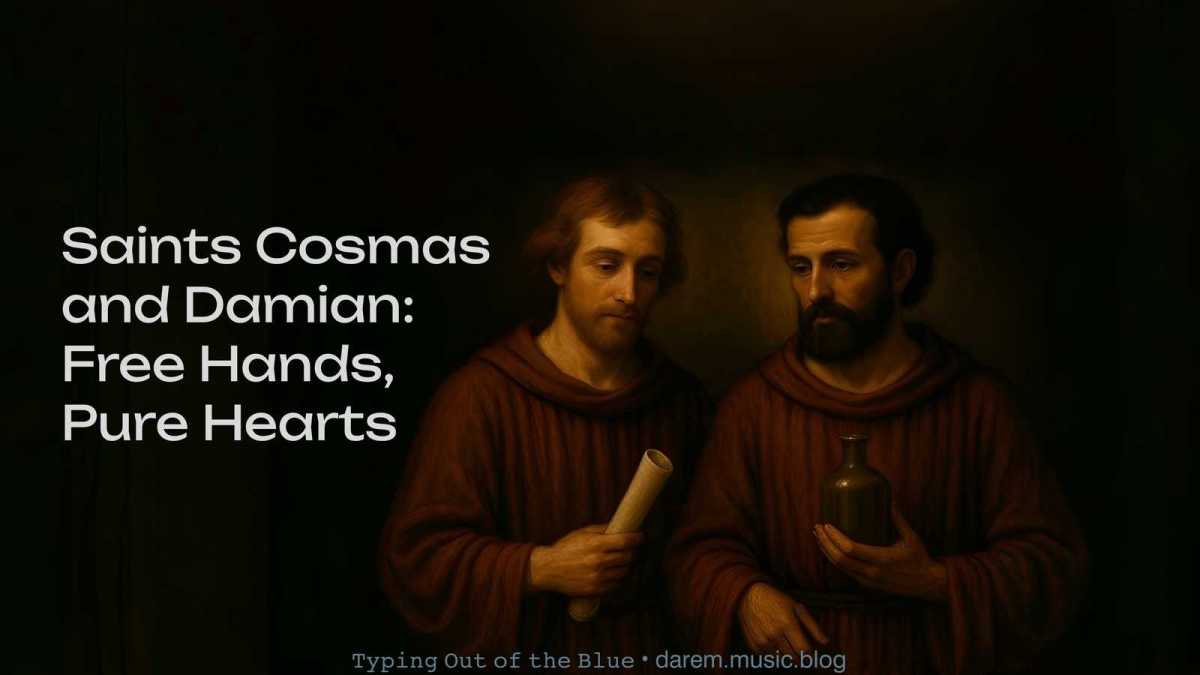
Saints Cosmas and Damian: Free Hands, Pure Hearts

In a world that charged for every cure, two brothers dared to give healing away for free.

They were twins, Cosmas and Damian, born in Syria around the 3rd century. Both studied medicine, both became physicians.

Like other doctors of their time, they learned how to treat sickness, mend wounds, and ease pain. But unlike the rest, they never took a coin. Healing was gift, not trade. People began to call them Anargyroi, a Greek word that means “without silver.”

They healed the sick with skill, and they prayed as they worked. Body and soul together. Stories spread about them, stories that felt larger than life—like the one where they replaced a diseased leg with a new one from someone already dead. It is told as a legend, a miracle that medicine could not explain.

But the empire turned against Christians. The Roman emperor Diocletian, known for his brutal persecution of the Church, ordered them arrested. Chains, torture, threats—nothing could break them. The twins refused to give up their faith. So they were killed.

Still, their names lived on. Churches built, prayers whispered, doctors and pharmacists claiming them as patrons. Saints Cosmas and Damian—two brothers who proved healing could be more than science, more than silver.

ᴛʸᵖⁱⁿᵍ ᴏᵘᵗ ᵒᶠ ᵗʰᵉ ʙˡᵘᵉ ᵈᵃʳᵉᵐ ᵐᵘˢⁱᶜ ᵇˡᵒᵍ

Traces of courage, silence, and sacrifice—this is Saints.

Listen on Apple Music, Apple Music Classical, and YouTube Music