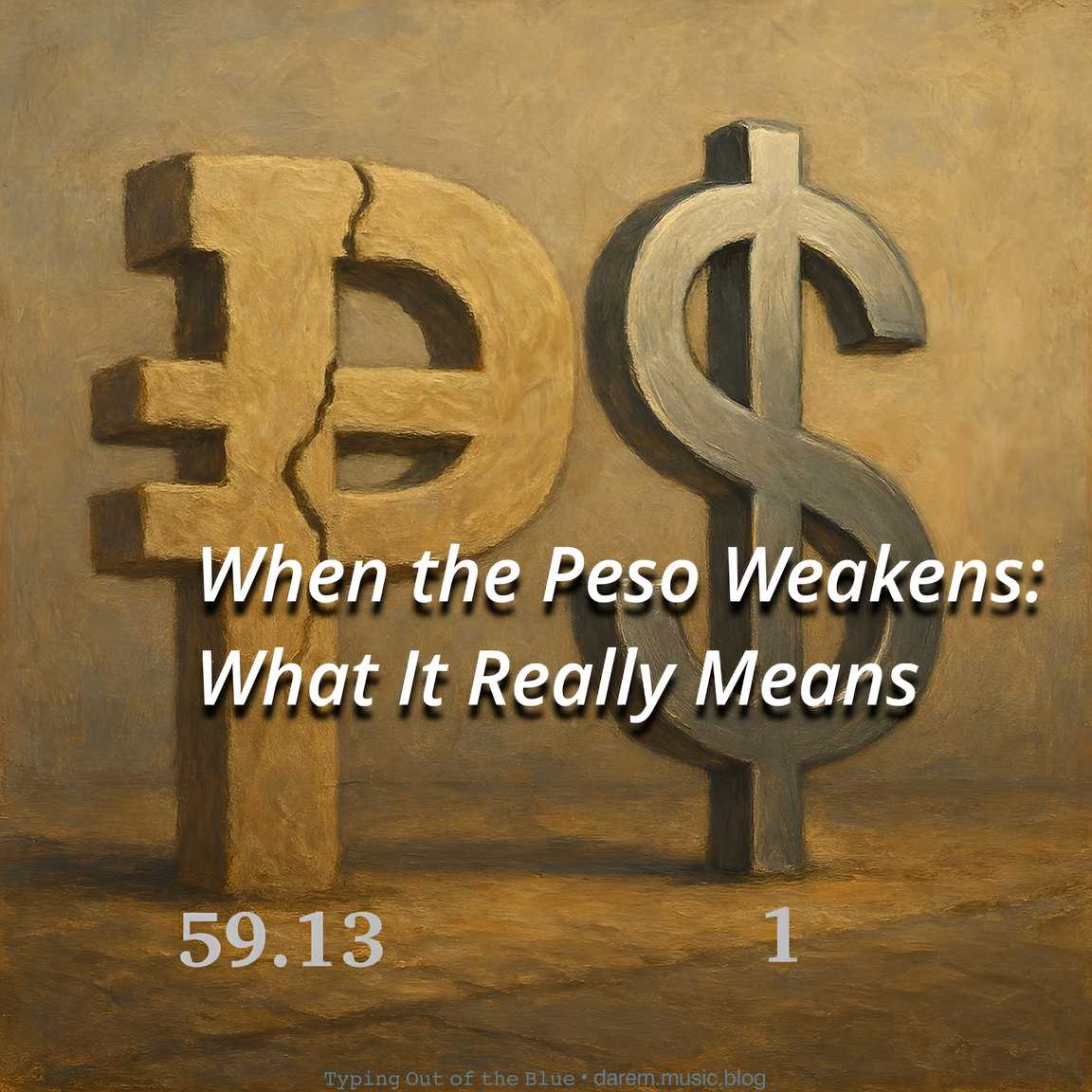
When the Peso Weakens: What It Really Means

The peso fell to ₱59.13, the weakest in its history. What does that mean for daily life, for prices, and for everyone’s pocket?

October 28, 2025—The Philippine peso closed at ₱59.13 against the US dollar today—its weakest value in history based on Bangko Sentral ng Pilipinas (BSP) data. Some people online disagree, saying it already hit ₱60.66 before. But that number came only from foreign market trackers, not from the BSP.

According to official BSP records, the peso’s rate in November 2022 ranged between ₱57.35 and ₱58.55 per dollar. It never crossed ₱60. That’s why today’s ₱59.13 is officially the weakest peso on record.

So what does this actually mean for ordinary people and the country’s economy?

When the Peso Falls but Helps

Exports gain – Philippine goods become cheaper abroad, bringing in more dollars.

Tourism grows – Foreign visitors get more value for their money. Local businesses benefit.

Local industries move – Imports cost more, so more companies start buying local.

OFW families earn more – Each dollar remitted home now converts to more pesos.

Investors see opportunity – A weaker peso can attract foreign investors since running a business here becomes more affordable.

⚠️ When the Fall Hurts

Imports cost more – Fuel, medicine, and gadgets get pricier since they’re paid in dollars.

Prices rise – Inflation hits, making daily life tighter.

Peso loses power – Same cash, fewer groceries.

Dollar debts hurt – The government and companies pay more pesos for the same loans.

Businesses face uncertainty – Rapid changes in the exchange rate make it hard to plan and keep prices steady.

💡

A weak peso isn’t just bad—it’s a message. It tells us to depend less on imports and to build more at home. The peso may have fallen, but it’s also a reminder to rise in smarter ways.

⌨ ᴛʸᵖⁱⁿᵍ ᴏᵘᵗ ᵒᶠ ᵗʰᵉ ʙˡᵘᵉ ᵈᵃʳᵉᵐ ᵐᵘˢⁱᶜ ᵇˡᵒᵍ

Paper Without Roots

A child once asked why we can’t just print more money. The answer isn’t found in paper—but in what stands behind it.

The real reason printing more money never works

Dad, why don’t they just make more money so everyone can be rich?” A simple question every child asks—and the kind every parent struggles to answer.

During the war in 1942–1945, Japan flooded the Philippines with new pesos—fresh ink, bold promise, no soul. They called it “Japanese Government-issued money.” But Filipinos called it Mickey Mouse money—because it looked real but had no roots.

Every real peso must stand on something called reservesgold, dollars, or anything of real value kept by the government. Those reserves prove a country can pay what it prints. Japan printed and printed without gold or trust to back it up. Soon, prices exploded. People carried baskets of bills to buy rice. When the war ended, the paper turned worthless.

In the old days, money was backed by gold bars locked in vaults. Today, it’s backed by trust—our belief that the economy, businesses, and people are working honestly. If that trust breaks, money collapses again, just like before.

Imagine there are only ten cupcakes in town and ₱1,000 total. Each cupcake costs ₱100. Now someone prints another ₱1,000, but no one bakes more cupcakes. Suddenly, people are willing to pay ₱200 per cupcake. Did we get richer? Nope. We just made the same cupcakes more expensive. That’s inflation—more paper, same value.

Money gets its worth not from the printing machine but from real work and honest trade. Gold and paper may change, but the real reserve is trust. Lose that—and even the brightest bills turn into cartoon money again.

⌨ ᴛʸᵖⁱⁿᵍ ᴏᵘᵗ ᵒᶠ ᵗʰᵉ ʙˡᵘᵉ ᵈᵃʳᵉᵐ ᵐᵘˢⁱᶜ ᵇˡᵒᵍ