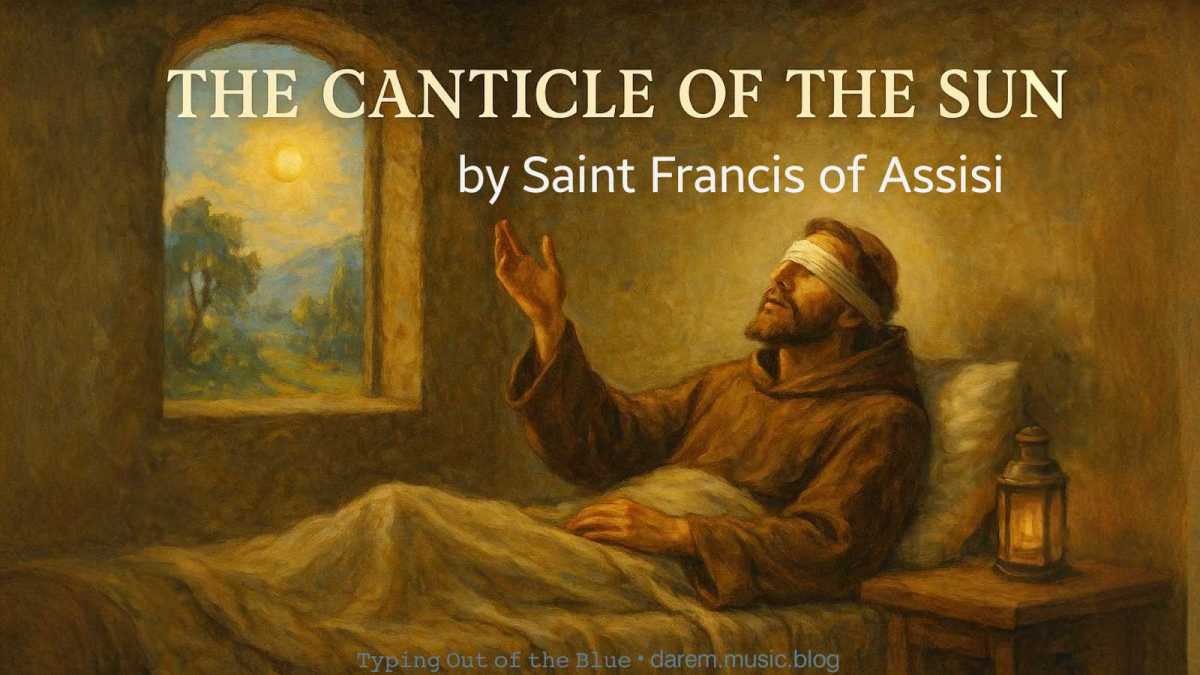
In 1224, Francis of Assisi was sick, weak, and almost blind. He stayed in a small hut near San Damiano, close to Clare and his brothers. Life was slipping away, but his heart was still burning. Out of that darkness came light—a hymn of joy, calling the sun his brother, the moon his sister, even death his friend.
This hymn, The Canticle of the Sun, is one of the earliest pieces of Italian writing. But more than history, it is a vision of the world as family—everything and everyone pointing back to God.
The Canticle of the Sun (Laudes Creaturarum, or Canticle of the Creatures) by Saint Francis of Assisi
Most High, all-powerful, good Lord, Yours are the praises, the glory, the honor, and all blessing. To You alone, Most High, do they belong, and no man is worthy to mention Your name.
Praised be You, my Lord, with all Your creatures, especially Sir Brother Sun, who is the day and through whom You give us light. He is beautiful and radiant with great splendor, and bears a likeness of You, Most High One.
Praised be You, my Lord, through Sister Moon and the stars; in heaven You formed them clear, precious, and beautiful. Praised be You, my Lord, through Brother Wind, and through the air, cloudy and serene, and every kind of weather through which You give sustenance to Your creatures.
Praised be You, my Lord, through Sister Water, who is very useful, humble, precious, and chaste. Praised be You, my Lord, through Brother Fire, through whom You light the night. He is beautiful, playful, robust, and strong.
Praised be You, my Lord, through Sister Mother Earth, who sustains and governs us, and who produces various fruit with colored flowers and herbs. Praised be You, my Lord, through those who give pardon for Your love and bear infirmity and tribulation. Blessed are those who endure in peace, for by You, Most High, they shall be crowned.
Praised be You, my Lord, through our Sister Bodily Death, from whom no living man can escape. Woe to those who die in mortal sin. Blessed are those whom death will find in Your most holy will, for the second death shall do them no harm.
Praise and bless my Lord, give Him thanks, and serve Him with great humility.
ᴛʸᵖⁱⁿᵍ ᴏᵘᵗ ᵒᶠ ᵗʰᵉ ʙˡᵘᵉ ᵈᵃʳᵉᵐ ᵐᵘˢⁱᶜ ᵇˡᵒᵍ