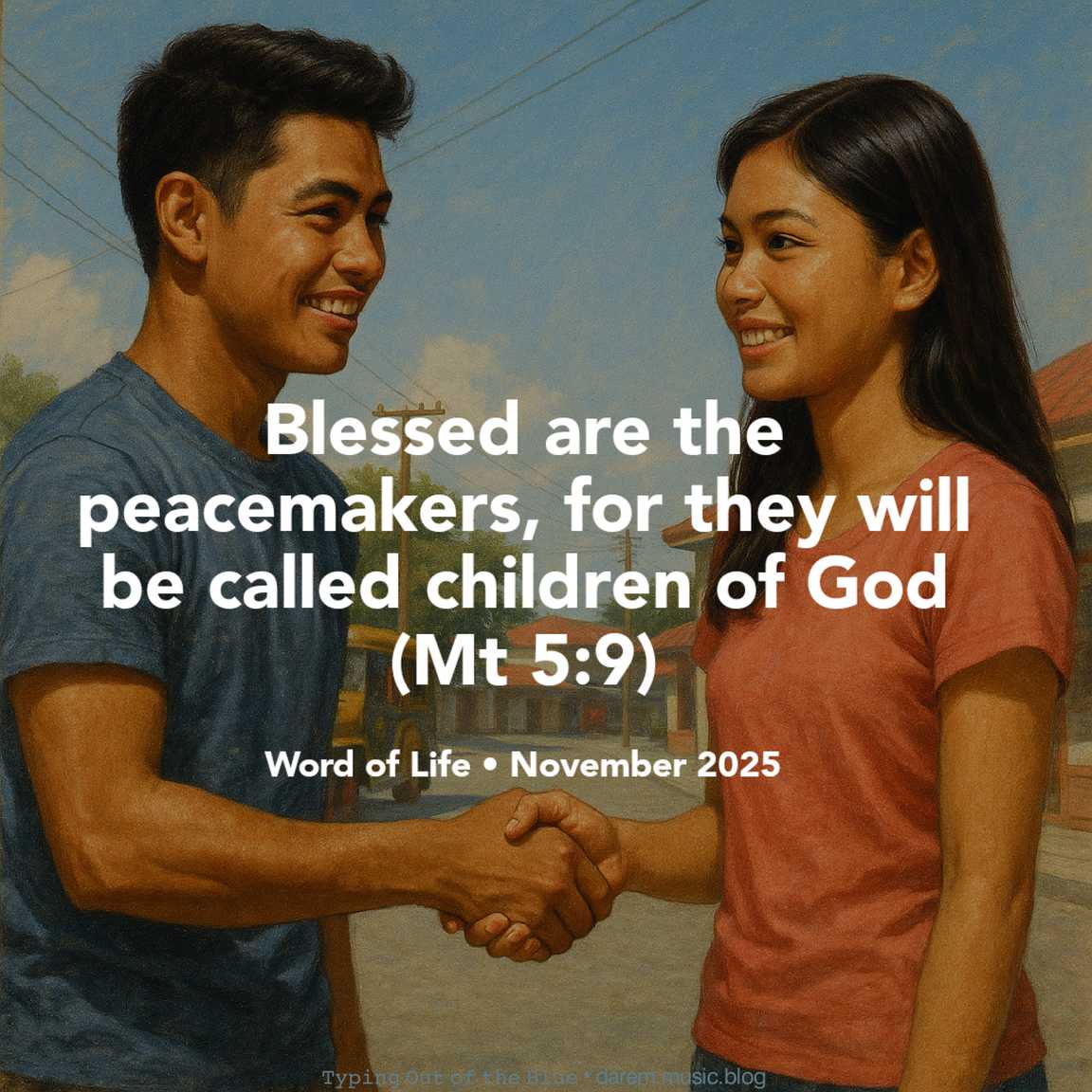
“Blessed are the peacemakers, for they will be called children of God” (Mt 5:9).
Recently, an observatory established by three Italian universities reported that more than a million hate messages were posted online in one year. Messages of hate against foreigners, Jews and, in particular, women are becoming increasingly violent.
Of course, we cannot generalise, but most of us, at some time, have experienced argumentative attitudes, insults and antagonism in our families or at work or during sport and so on which divide us and undermine social cohesion. On a more global level, there are currently 56 armed conflicts worldwide, the highest number since World War II, resulting in a significant number of civilian casualties.
It is in this context that Jesus’ thought provoking words resonate more truthfully and powerfully than ever.
“Blessed are the peacemakers, for they will be called children of God” (Mt 5:9).
‘Every nation and every person feels a deep longing for peace, harmony and unity. Yet despite our efforts and goodwill, after thousands of years of history, we still find ourselves unable to achieve stable and lasting peace. Jesus came to bring us peace – a peace that, he tells us, is not like that which ‘the world gives’, [i] because it is not merely the absence of war, strife, division and trauma. His peace encompasses all of these things but it is so much more: it is the fullness of life and joy; it is the salvation of the whole person; it is freedom; it is justice and fraternity among all peoples, based on love.’ [ii]
This month’s Word of Life is the seventh Beatitude with which the Sermon on the Mount begins (Matthew 5–7). Jesus, who embodies all the Beatitudes, addresses his disciples instructing them. It is worth noting that the eight Beatitudes are formulated in the plural. This suggests that the emphasis is not on individual attitudes or personal virtues, but rather on a collective ethic carried out in a group.
“Blessed are the peacemakers, for they will be called children of God” (Mt 5:9).
Who are the peacemakers? ‘This ‘beatitude’ is the most active one and explicitly asks for concrete efforts. The words are similar to those in the first verse of the Bible that refers to creation and they indicate initiative and industriousness. Love is creative by nature … and seeks reconciliation at any cost. Those who have learned the art of peace and practise it are called children of God. They know that there can be no reconciliation without giving one’s life, and that peace must always be sought everywhere… This is not an autonomous work that is the fruit of one’s own abilities, but a manifestation of the grace received from Christ, who is our peace and has made us children of God.’ [iii]
“Blessed are the peacemakers, for they will be called children of God” (Mt 5:9).
So, how can we live out these words? Firstly, by spreading true love everywhere. Secondly, we must intervene when peace is threatened around us. Sometimes, simply listening lovingly and attentively to those in conflict can provide a way forward.
Furthermore, it asks that we do not give up until broken relationships, often caused by trivial matters, are restored. Perhaps we could initiate special activities within our groups, associations or parishes to raise awareness of the need for peace. There are myriad proposals around the world, large and small, that work for this: marches, concerts, conferences and volunteer work set in motion a current of generosity that builds peace.
There are also peace education programmes, such as ‘Living Peace’. [iv] To date, over two million children, young people and adults in more than 2,600 schools and groups on five continents are involved in its initiatives. These include launching the ‘Peace Dice’ — inspired by Chiara Lubich’s ‘art of loving’ [v] – with phrases written on each side to help build peaceful relationships, and the worldwide ‘Time Out’ initiative which is a moment of silence, reflection,or prayer for peace at 12:00 noon every day.
Prepared by Augusto Parody Reyes and the Word of Life Team
[i] Cf. Jn 14:27
[ii] C. Lubich, Word of Life Jan 2004
[iii] Pope Francis, General Audience, 15 April 2020
[iv] livingpeaceinternational.org
[v] C. Lubich ‘The Art of Loving’, Rome 2000
—
The Beatitude “Blessed are the peacemakers, for they will be called children of God” (Mt 5:9) reminds us of our duty to build harmony in a world torn by division and hate. Over a million online hate messages and 56 ongoing global conflicts show how far humanity is from true peace.
Jesus offers peace not as the world gives—but as a fullness of love, freedom, and unity. Peacemaking calls for action, humility, and creativity. It means forgiving, listening, and restoring broken ties, starting with those closest to us.
Reflection:
Peace begins with one step of love. When we choose to understand instead of argue, to heal instead of hurt, we live as true children of God—bringing His peace where the world needs it most.
⌨ ᴛʸᵖⁱⁿᵍ ᴏᵘᵗ ᵒᶠ ᵗʰᵉ ʙˡᵘᵉ ᵈᵃʳᵉᵐ ᵐᵘˢⁱᶜ ᵇˡᵒᵍ